
Translated material
Sobakistan | Colta.ru
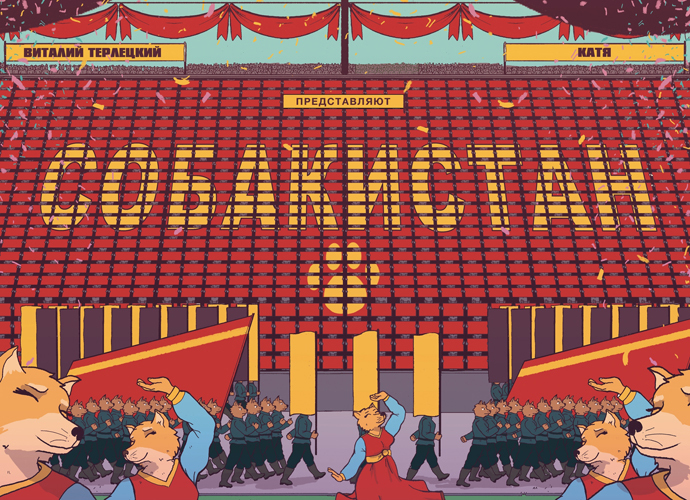
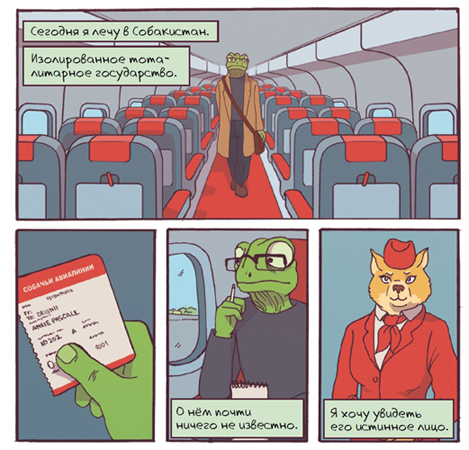
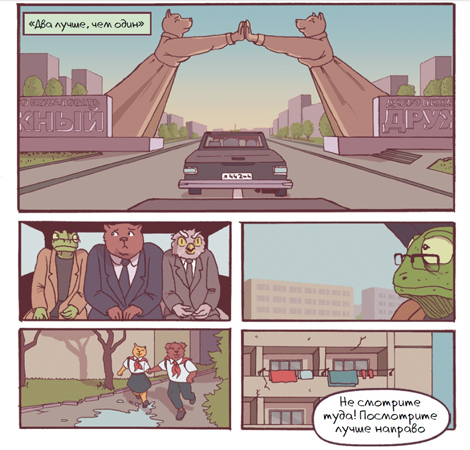
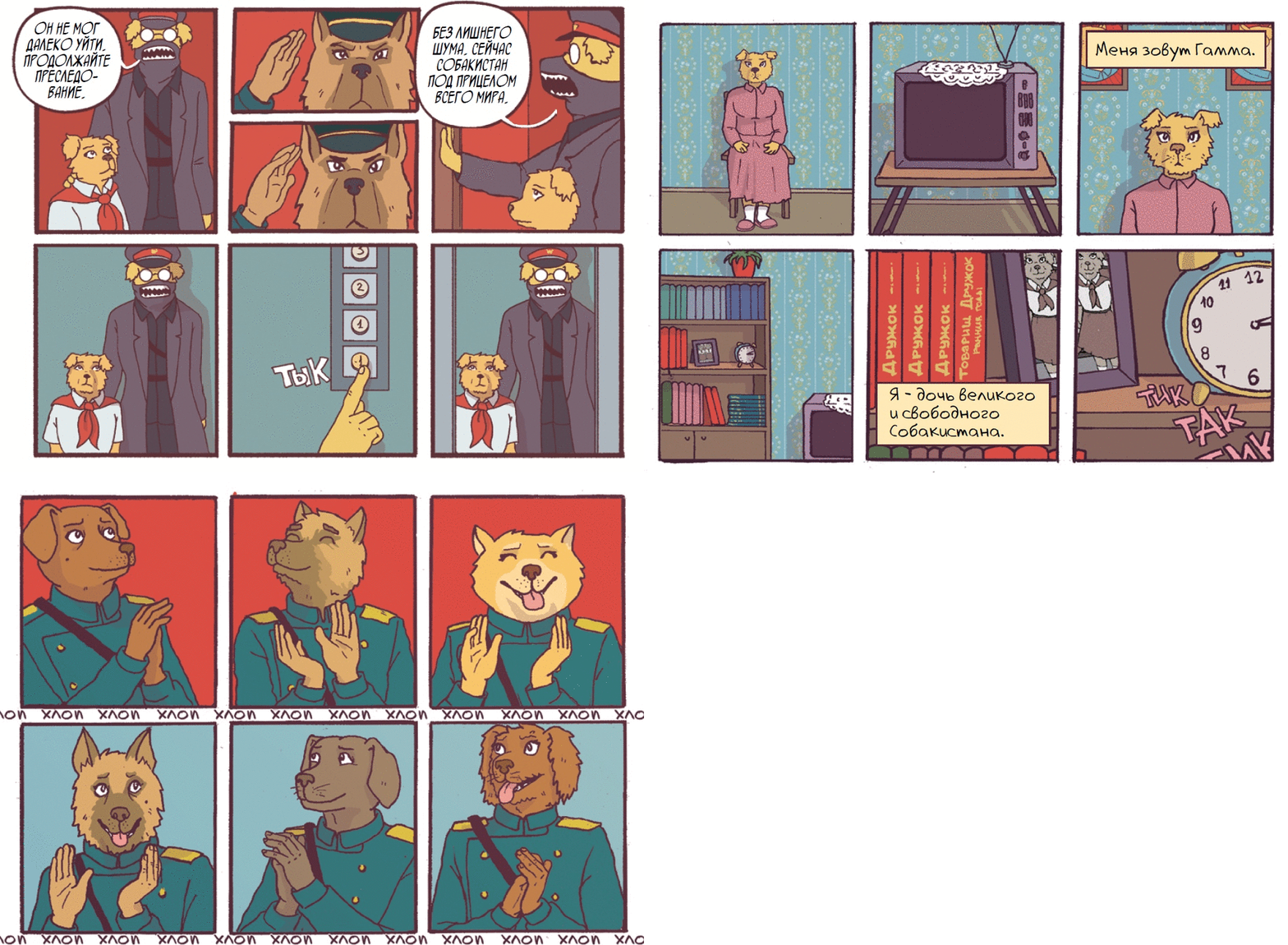
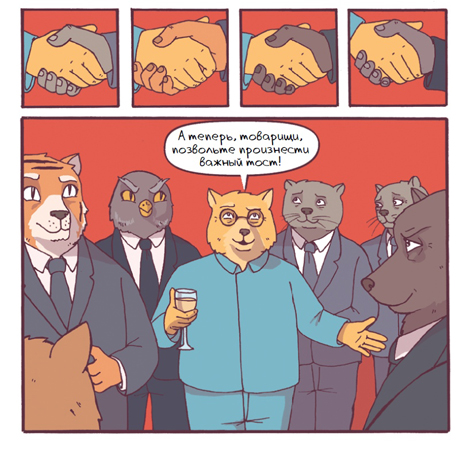
Screenwriter, publisher and artist Vitaly Terletsky in collaboration with the artist Katya finished work on the new comic book - “Sobakistan”. A perfectly drawn action -packed story on 160 pages accelerates from mocking to a political detective, but does not lose thoughtful contemplation. In the center of events is the death of the leader and teacher of the comrade friend Trusorovich Sharichyk, the chairman of the Supreme Pack of the Labbaging Friendly Republic of Sobakistan (32 tail, 2068), and the panorama of social types of Sobakistan society. Schoolchildren, diplomats, workers, a Hameleon journalist and an iron mask act on an impressive background of dog architecture and monumental sculpture of the city of Druzhny. The presentation of the book is going on right now - as part of the Moscow festival Comic Con Russia (October 3-6, Crocus Expo, Pavilion No. 1, from 10:00 to 18:00). Nadia Plungan spoke with the creators of the comic book.
- I remember your book “Products 24” (2017) , created along with Artem Bizyaev, is a complex, multilayer message about the collapse of the Soviet world and the recklessness of the nineties. You can probably call it even a manifesto of generation. "Sobakistan" is not inferior to her. How do you get it?
Vitaliy Terletsky: I don’t see the point of making a single projects ... I don’t know, I always wanted to make comics that I would like to read myself.
Katya: It seems to me that he is very correctly selecting the team and builds up work with the artist well, and this is really difficult!
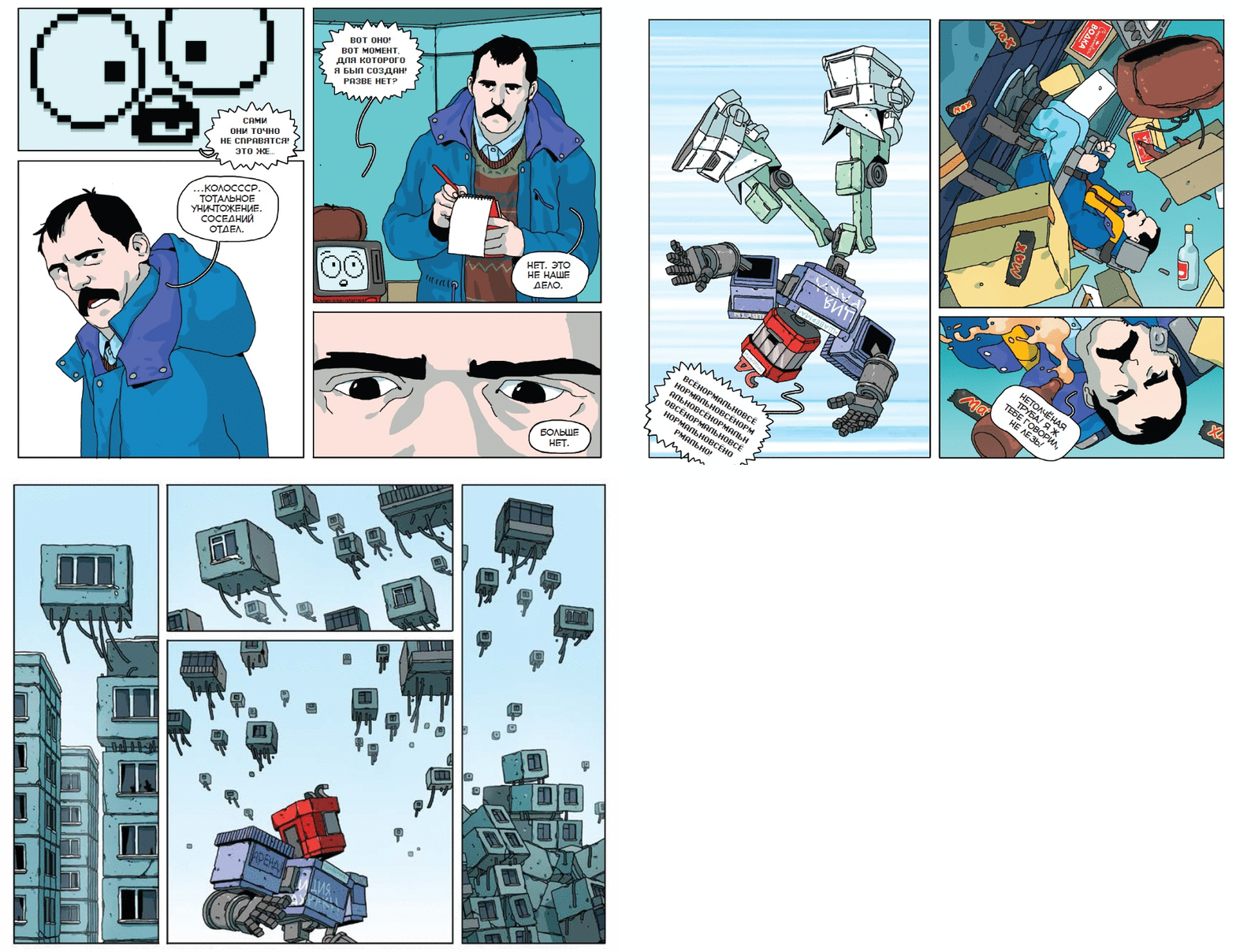
Personnel from the comic book "Products 24"
© "Terlets Comics"
- Well, but where do you get the plots from?
Terletsky: And with “products” and “dog”, everything was born from the details that Artem and Katya came up with me. By the way, our first comic book with Bizyaev is not “products”, but “Shafirovsky Prospekt”. There, a man on Shafirovsky Prospekt stands in a traffic jam for 48 pages and moves slightly. So, on the cover of this experimental comic book, Bizyaev drew a robot from the stalls to add epicity there. And then I decided that I wanted a great story about this robot. And with Katya the same thing. When did you come up with this? A year ago?
Katya: More than a year. We submitted documents for a Japanese visa. And so I received a photo, put a mask of a puppy on it and signed: "I'm going to Sobakistan."
Terletsky: The word "Sobakistan" then appeared, Katya invented it. I do not invent anything. I only steal.
Katya: And a year ago, I drew a postcard on which we made the cover as a result. That is, it was the first art to the book - even before the appearance of the book.
Terletsky: There are slightly different dogs depicted there, their ears are softer.
Actually, then Katya and I started a comic book together. She draws, I write, we live together, it would be very stupid to not do something. They started one comic book, worked up to the plot and concept, but then they still decided to make a “dog”-a story with a more loud name to pop our team. And then, when we already take ... what is there? Pulitzer? - It will already be possible to publish everything else.
 © "Terlets Comics"
- It turned out a multi -level story with a large number of pitfalls. It has analogies with North Korea, with closed Soviet and post -Soviet regimes.
Katya: For me, this is not about the Soviet Union, not about Korea, not about Turkmenistan. Rather, this is a comic about us about the modern fragments of the Union.
Terletsky: We started the comic before Kim met with Trump and somehow got warmer. And then everything was at the peak when they experienced nuclear weapons. We read the public “in Pyongyang is always sunny” - there are now under 90 thousand subscribers.
Katya: And the book "Sovetistan". She was written by a girl who, from childhood, is interested in for some reason the union and its history. She traveled at first Russia while she was a student. Now, not so long ago, she traveled to the former republics of the Union - Kazakhstan, Uzbekistan, Turkmenistan, Tajikistan - and wrote a research book, but it reads easily as artistic. The eyes of a European man look at all this and talks about his impressions.
 © "Terlets Comics"
Terletsky: We watched a documentary in four parts about Kim, called "Three Leaders, or Kingdom of Kimov." There is also a book that is called “Kim Jong Ir” in the Russian translation. ” She is about how, in the 80s, Kim Jong Ir, who was a wild fan of cinema, abducted the South Korean director Sin of the Oka and his wife, tortured them, and then forced him to make films. And Sin San Ok, among other things, took off Pulgasari . This is the North Korean Godzilla.
Katya: known all over the world just like a trash.
Terletsky: She yes, thrashovaya. It is known throughout the world, but it is very poorly made compared even with the Japanese Godzilla. There, the monster helps the medieval peasants to overthrow the bark power ...
Katya: We still have a book about the North Korean design.
Terletsky: A beautiful book! She is about everyday products. The guys are brought to the highest stage: labels, cards, sweets. But in general, we studied a bunch of documentaries and literature ...
- That's about North Korea?
Terletsky: Basically yes. After all, the Soviet heritage is here: we leave 300 kilometers from St. Petersburg - and now, please, everything remains. Nothing has changed, only worse.
Katya: North Korea in itself is also a Soviet product. Kim Il Saint is a native of the Soviet Union. He took all this scheme with the leaders from there. For me, the book is not about North Korea, not about the PRC, but about the Soviet heritage.
Terletsky: This is a phenomenon that in 2019 there are still these fragments of a huge empire. A striking example is Turkmenistan ... although what do we know about Turkmenistan? We will not say so confidently. Ultimately, both the Soviet and Korean themes are most likely just scenery. I wanted to tell the story. A good story should have an interesting setting with which it goes in a dense bundle, but it is important that it remains good if you take it out of the setting and replace the characters with others ... And this is what a good work from a masterpiece (laughs) !
- Katya, what do you think about the masterpiece?
Katya: I worked on this thing for so long that my eye was blurred. Now I have some kind of devastation, I can’t look from the outside. I have not had such large works yet. Before that, I painted only small stories - 10-15 pages.
Terletsky: This is the best that I have ever written. When Katya finished her, I bought her a cake.
- And how do you work?
Terletsky: Everything is done sequentially, just as from a movie, only simpler.
Katya: This time it turned out quickly because we were in a hurry. That is, Vitaly wrote the chapter, I painted it.
Terletsky: Yes, we used the conveyor method. At first we made a completely plot, I wrote, we discussed it and approved. After the plot, there are a script and a rental - a schematic breakdown on the frames, on the pages. After discussing the rental, I no longer introduce the answer, because it is already difficult to redraw. A good artist draws a maximum of two pages a day, and he cannot be redone a lot. Further color, layout, design.
When we work together, it is in any case co -authorship, therefore, the artist can at any stage of the script and swinging make changes. When we made “products 24”, Bizyaev forced me to completely rewrite the script four times. He is by education-the director of the animation, and then I was even a sucker. “They have no motivation. There is no tri -kak structure ”... a wild bore. But when we did Sobakistan, I constantly thought: “So ... what would Bizhaev say here? Could he get to the bottom of us? " As a result, they gave Bizyaev to read the script, and he said: “Everything is perfect. Change nothing. ” And he already gave three amendments to the finished comic book on the case. Good, minimal. Correct for an hour. And we realized that we were not worried about anything else.
- Do you draw how?
Katya: First I work with the concepts of characters, locations. So during my time I have formed large clusters of books on North Korea. Plus, I periodically watch the comics that I like on the schedule and tamping, I study how other artists solve similar problems. More often I draw in Djital, but this time I decided to try on paper for some reason.
- That is, there are sketches?
Katya: Lines are made on paper. Painted already in Photoshop. This was also some challenge for me, as it was harder to fix, but it was interesting, I liked it.
© "Terlets Comics"
- By the way, in the book the unusual monotony, the regulation of the interiors, through which the heroes pass through. Trams, corridors, rooms ...
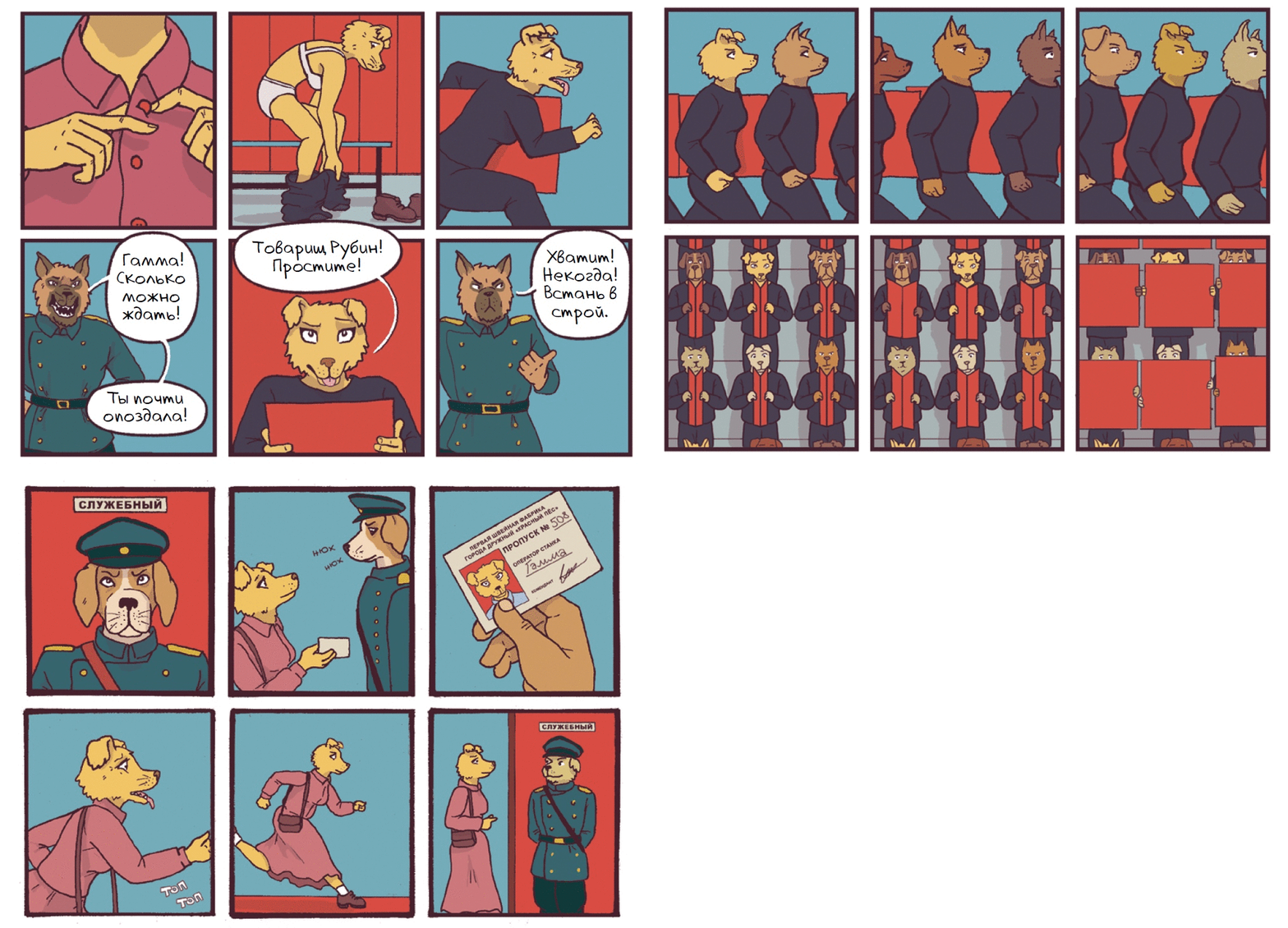
Katya: On visual techniques, I try to work, very tightly lining the composition of personnel with the history itself. I have a lot of these repeated shots. Similar, almost identical dogs. It is the cloning of the personality, which is characteristic of the socialist approach and all these countries with dictatorships. I tried to add this more. All interiors, panoramas are such, they are without sharp dynamics. More horizontal-vertical, some like that. All this is decided at the time of the tank, so the artist and the author must understand and feel good well.
-In both comics, in “Sobakistan”, in “Products 24”, two or three generations of characters are described, and the youngest seeks to turn around. In "Products" this is a young robot lacquer created by Arthur Borisovich at the Secret Institute. In "Sobakistan"-a top-schoolboy, lost among dogs ...
Terletsky: Here the fact is that it is shown how much this system is essentially with its seemingly inviolability and bulkiness in fact fragile: one small dog, one small detail can quickly and quickly make everything fall. In “Products”, however, there is more personal story, it seems to me, and “Sobakistan” is about how everyone turns out to be parts of the system to one degree or another.
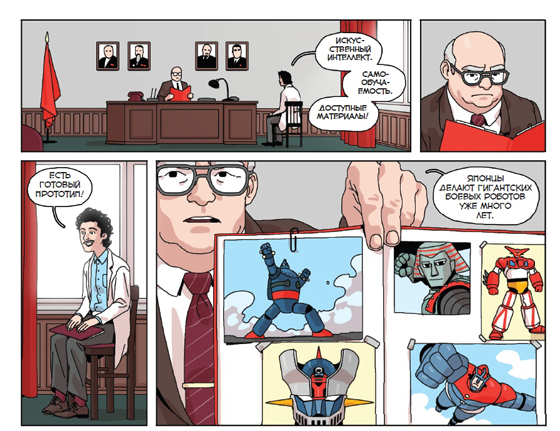 © "Terletsky Comics" Frame from the comic book "Products 24"
- And I thought the topic of “products” is a socialist robot that protects socialism from capitalism.
Terletsky: This is all the scenery again. In fact, there is a story about how the young man wants to prove something to his father. Everything else goes on the principle of dominoes, as in the show of Elena Hangi. And “Sobakistan” is a plot about how a fire flared up from one match in a warehouse with dried hay.
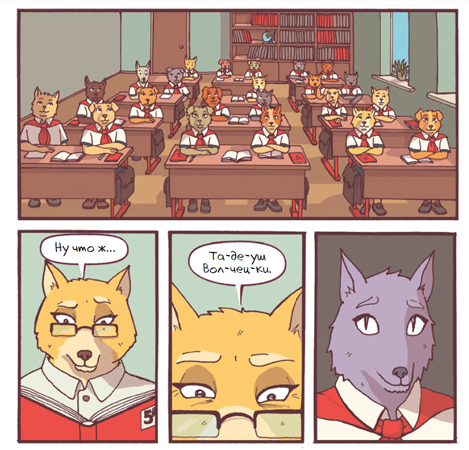
Katya: My favorite character in Sobakistan is probably an orbit. Small puppy, hostage system. She would like to change everything, but she is still small.
- Volchka's name is Tadeusz. The Polish-Soviet theme did not accidentally arise?
Terletsky: Well, the book mentions the “peaceful accession” of the territory ... Poland is convention, we have no allusions to real countries. When in the sixth chapter Comrade Druzhok meets a bear, he initially said: "We are very proud of our cooperation with Russia." But all our roots said that this place is very knocked out: among fictional countries, one real. Therefore, we replaced Russia with another country - a prodry.
 © "Terlets Comics"
- Well, the post -Soviet realities are still scattered everywhere. Golden toilet, for example ...
Terletsky: This is just hello to Turkmenistan.
- A. So there was the myth of the golden toilet of Yanukovych.
Terletsky: Yes?!
“Of course you don't know?”
Katya: No ...
Terletsky: I'm not interested in politics! I don’t go to rallies, I'm not one of those, I am making comics about dogs! I'm not in politics. When I studied at the institute, I went to a rally for United Russia for 500 rubles, because I had no money!
- Where did you study?
Terletsky: At the Technological Institute, I studied at a genetic engineer. I worked as a scientist leading agronomist at the Research Institute of Plant Protection. 5500, like from a bush, received a month. Everything is very poor there, but good and happy.
- It depends on which research institutes. In some places poor and evil, like dogs. Dogs ... hmm, yes ... and then, have you left there?
Terletsky: From the Institute of Plant Protection? Yes, work turned up. For seven years I worked in the comic book publishing house, for some time and the editor-in-chief. A bunch of “Deadpool” from afar, a bunch of “Spider-Man”, translated mainly, and then tired when the director sold it all. I shook, froze, then they called me to another project, he was covered, and now I am sitting at home, I do nothing. I’ve been going for six months. The money has not ended yet. “Sobakistan” was done, we’ll raise a little more, maybe.
Katya: And I studied at the architect. But after the third year, somewhere in the fourth, I realized that I did not want to go to architecture, and just went to work first by an illustrator at an advertising agency, then a designer, then went to the comic book publishing house. There I made a design, layout for translated ones mainly pieces. Then the freelange began to draw comics in parallel.
Terletsky: We are poor.
- It turns out that you coincided in the desire to change the comic culture in Russia?
Katya: Well, yes.
Terletsky: And I am the top of this, I am a demigod. Above us, only Lavrentieva, but not reach it.
Katya: Olya has very personal stories.
Terletsky: She is serious, and I believe that the comics should be funny. They came up with this nonsense that the comics are not for adults: "Serious comics are graphic novels." Do you know the difference between a graphic novel and a comic book? There is no difference. “I don’t read the comics, I read graphic novels,“ Batman ”is a book for adults, people are killing people there ...” What are you saying, my dear! This is Batman! Comics are younger art! You need to understand this. Therefore, even in serious stories, such as “products” and “dog”, there is a place for irony and humor.
Katya: The Russian comixists do not have enough experience, they still try something, but as a result it turns out the maximum interesting. Now, in my opinion, we have a good time for all this comic history. Many young, talented guys; I think that another five years - and everything will be very fine with us.
© "Terlets Comics"
- And everything will really go into the mass circulation, outside the subculture?
Terletsky: This will never go to the mass.
- Why?
Katya: People do not buy books.
Terletsky: There is generally a crisis of paper publications. In addition, interest in comics in Russia will never be at the same level as, for example, in America or Japan, where every third reads manga in the subway. In Japan, another culture and other circulations. They have the main weekly Syonen Dzamp - a thick book of 20 stories on bad paper - diverges in millions of circulations. Everyone reads it. It costs 100 rubles with our money, is sold in every grocery. And we print dogs with a circulation of 2000 and we are afraid that we will not sell. For comparison: translated tops, that is, comics about Spider-Man, are printed in a circulation of 5,000. A super-popular comic about Rick and Morty-and this is also with the support of his Yeduk, which now has five million on the channel-gives a total circulation of 20-30 thousand, and this is a lot. Yes, what are we talking about if Pelevin has 18 thousand circulation! Indeed, at the end of the zero, "Snuff" had 100 thousand circulation. STO, and now eighteen!
- A decline in paper books or what?
Katya: A lot of entertainment now.
Terletsky: A person needs to press a couple of buttons to entertain himself. And in Russia this is often done conditionally for free.
- Well, how does this explain then that there is demand in Japan? There are more entertainment there than ours. Maybe it's about generations?
Terletsky: Culture formed there. This is a tradition, this is a habit.
Katya: The fact is that in Japan now the standard of living is better, higher, they have more time and money for entertainment. And the books are cheaper there.
Terletsky: And the industry is well established there. They draw 20 pages a week - new, completely new, stories. This is a miracle. Their million. Choose any. And we have a very high competition in our entertainment industry, and it’s easier for a person to turn on a computer than to reach the bookstore, especially in winter. How often do you leave home in winter? We make a book for 160 pages in almost a year - in our free time and at our own expense. If she pays off and the entire circulation is sold, then, in a good way, she will not even cover the usual catin's bet for a drawing.
- And yet, since you really risk, it means that you yourself, first of all, are not enough graphic culture - here to the extent that you leave work and draw yourself.
Terletsky: In this regard - yes. In any case, I realized that more than anything else I want to earn only my comics and do nothing else. Someone succeeds-it means that it will probably work out with me.
- In Russia, there is a great lack of professionalism in literature and in art. If you do the work of real, highly professional and scenario, and artistically, then people will unite on this platform, both publishers and films will be created. Content is the main problem.
Terletsky: Yes, I lead to this. It would be possible to earn money somehow-and much easier. I could become a blogger, why not. If the dogs are not sold, another comic book will not sell, then everything: I will look for a new job, because I will not have any money. Well, I’ll fit somewhere. If so, it will be possible to try to develop and over the next five years go to a more serious steppe. It will be necessary to hope for dopitation, to hope to sell the book somewhere abroad, to publish it there. And, of course, make a film adaptation - one, another.
 © "Terlets Comics"
- “Sobakistan” you printed yourself.
Terletsky: Yes, and did it legally. Add one line of the OKVED in the IP, buy ISBN in the Book Chamber for 12 thousand rubles - now you are a publishing house. It turns out that it is so simple. I think this is a thin line where Samizdat ends - when you have an intermediary in the form of a publisher. Самиздат — пока всю работу, всю прибыль или весь убыток на себя берет именно автор. Вот тот момент, мне кажется. А дальше — легально, нелегально, штрих-код — это как штамп в паспорте: главное — чтобы жили по любви.
— Мне кажется, это рудименты советского времени. Мы же не считаем, что «Весы» или «Аполлон» — это какой-то самиздат. «Работать на настоящей работе», «печататься в настоящем издательстве». Все это устарело.
Терлецкий: Да, сейчас грани стерлись, мы в будущем. Но я считаю, что искусство должно быть коммерчески успешным. И здесь я четко отделяю искусственные коммерческие успехи, когда продает команда профессионалов. С другой стороны, была бы у нас такая команда? Пиарщики на уровне мультфильмов Disney для «Собакистана»? Кстати, в шестой главе, в начале, поют псы, напоминающие группу «Громыка». Так вот, мы сделали коллаборацию — заказали им песню про похороны товарища Дружка.
- Wow! Знаменитый психоделический твист !
Терлецкий: Дополнительное кросс-промо, взаимопроникновение двух медиа и прокачка в обе стороны. Нам было интересно ждать — они закончили как раз к старту продаж на московском Comic Con . Это самая большая и самая качественная выставка в России — за четыре дня проходимость 150 тысяч, а это очень много. Для обычного комикс-фестиваля нормальная проходимость — три тысячи человек, может быть, пять, если повезет. Там-то мы и собираемся окупить тираж.
Коллаборация издательства группы «Громыка» и издательства «Терлецки Комикс». Официальный саундтрек к комиксу «Собакистан»:
Subscribe to the COLTA.RU channel in Yandex.Zen to miss nothing