
Translated material
Letter to the Crimea of the Future
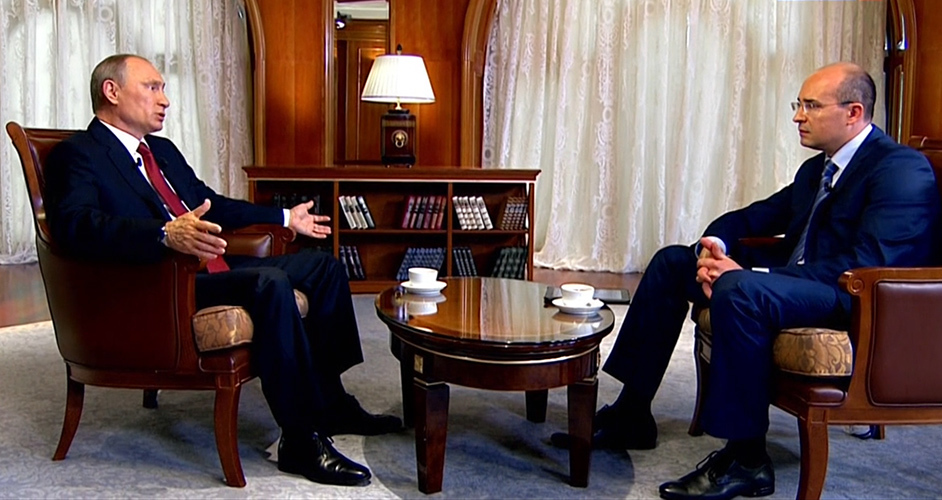
- What would you wish Crimeans today?
- Happiness.
The final dialogue of Andrei Kondrashov and Vladimir Putin in the afterword for the film-in general, he is not particularly needed, you can do without him dramatically, but the creators of the film-Kondrashov says that Putin himself was the playwright-for some reason it was necessary to declare in the final that this little interview was done now. Everything else Putin told Kondrashov “in hot pursuit” - they did not say the date, but it is understood that the conversation happened last year shortly after the accession of Crimea. Most likely, this is not true. It is simply impossible to imagine that Russian television and the Kremlin kept this conversation in a classified drawer of the table.
It is impossible to imagine that Putin told Kondrashov the truth about the Crimea at the same time, when he, Putin, spoke directly opposite things in public both about Russian participation in Crimean events and Russian plans for the peninsula. Putin’s public position about Crimea changed before our eyes, from a performance to the performance, Putin each time clarified his version of the “Crimean spring”, and the interview with Kondrashov is the next stage of the evolution of the Putin version, the current, the very last stage. Kondrashov Putin tells his new version of events in the Crimea precisely as of now, in the spring of 2015-two or three months ago he would talk about the Crimea otherwise. That is, the conversation is completely fresh, and then the question was why it was necessary to pretend that Putin's story last year.
During the week preceding the film, VGTRK or the Kremlin slightly threw Putin’s recognition to the tape of agencies, and each recognition became a sensation.
The point, most likely, is that without this mark - “in hot pursuit” - Putin’s enthusiastic story about the accession of Crimea would be too openly dissonated with the surrounding reality. For the spring of 2015, Putin’s story is too euphoric - so much that he can raise questions. About the Donbass, about the economy, about foreign policy isolation and a lot more, so it is better to be safe, ask Putin to change his tie and to remove the “afterword” in another interior so that the enthusiastic memoir will turn into an enthusiastic modern evidence. It seems that the trick did not work: during the week that preceded the film, VGTRK or the Kremlin, a little confessed to Putin’s belts on the tape of agencies, and each confession became a sensation-and about the decision to join the Crimea, which was made by Putin on the night of Yanukovych (and not after the referendum after three weeks), and about the Russian troops, which were transferred to the Crimea, “what to hide, under the guise, under the guise Strengthening the protection of our military facilities ”(and not a folk militia). These confessions, crossing out the official Russian version of the Crimean Spring that has yet existed for a long time, will be a scandalous informational occasion for at least for Ukraine, that is, even if Putin and Kondrashov and wanted to make a purely historical movie, it turned out to be a relevant report from the present.
But according to the plan, this is really a historical movie, and at some points clearly revisionist. The first Russian newsmaker to say that instead of the militias, the Simferopol airport and the Crimean parliament were taken by Russian special forces, as you know, Igor Strelkov, in the version of which he either managed or at least helped to lead personally. In the film, Kondrashov Strelkov is not mentioned at all - there is simply no such person (and I can say that he is not even in those episodes, whose witness I was , and shooters played a key role in them). The capture of the airport was described in perhaps too epic, literally - the “company of the militias, armed with shovel cuttings” under the command of the Crimean Samvel Martai (Kondrashov: “Samvel’s plan was simple, but true”) broke into a runway to dilute bonfires on it, which would not give the planes to land. The dialogue with Sergey Aksenov is charming in the retelling of Martai: “Samvel, you need to take the airport! - Well, not a question ” - and after a breakthrough into the strip:“ Valerich, I am on the runway and is ready to set fire to! “Samvel, wait for the team.” The SBU prevented, which would be about to shoot, and only at this dramatic moment it is not clear where trucks came from “polite people”.
The scene with the capture of the parliament, apparently, was generally shot before Vladimir Putin’s recognition - the deputies found the deputies in the building in the building only in the morning after the vote, as a result of which the Aksenov became the prime minister of Crimea, and at night, as Kondrashov said, only “the militias influenced the deputies”, which was extremely doubtful and in the context of Vladimir Putin’s recognition.
It is even more surprising that after a detailed description, as Putin called it, the transformations of Crimea into a fortress of the third of the film (that is, even more than the actual actually about the military) is dedicated to the adventures of bikers from the club "Night Wolves". First, Biker Vitaly Punko (originally from Dneprodzerzhinsk, but “in the Russian soul”) describes in detail the abduction of Ukrainian General Koval. "Vitaly Punko rushed to the old Yalta to confuse traces along the narrow streets." Koval said that Russian paratroopers were taken to Simferopol, but Biker Punko did everything in the film, and there is a melodramatic detail: Kondrashov asks exactly where the prisoner was sitting in the biker jeep, and it turns out that now the children's seat was settled on this place, because after the annexation of the Crimea, it became clear that he was ours, the biker decided to give birth to a Polina’s daughter.
Having dealt with Punko, Kondrashov shows another “night wolf” - Alexander Medvedev, who was attacked by militants in masks and wounded him with a knife. They thundered in the heart, exactly where the biker’s jacket says “Russia”; Kondrashov clarifies this, and the biker replies to him: “They beat him to Russia, yes.” In last year’s rallies, the biker participated with his foot injured in an accident, the doctors forbade him to walk, and he walked, and he had to amputate the lower leg. “But this is not the main thing, the main thing that Crimea is in Russia” - maybe the scriptwriters dissatisfied with the fact that they were imposed on the storyline about bikers, thus decided to ease it, turning into a black joke.
With much greater warmth and without any potential reasons for laughter, the history of the Crimean “Golden Eagle” was given: the detachment commander Yuri Abisov, who now became an officer of the Russian Ministry of Internal Affairs, recalls the Maidan and return the detachment to Simferopol - a video with the townspeople applaising the defeated fighters, can still remain, except for the most piercing, except for jokes, video drive. Now Abisov and his fighters are all right, and specially for Kondrashov, the detachment is arranging a demonstration-Kondrashov and Abisov stand at some concrete long-time, and the Berkutians are fighting at their feet, depicting the Maidan. Abisov says this in an open text - after the events in Kyiv, the elements that Golden Eagle learned from the Maidan fighters were added to the training of the detachment. They all remembered, recorded, systematized, and now every day on the parade ground is repeated last year's Kyiv fights. This Kondrashov wanted this, but the main metaphor of the film was obtained: time passes, Kyiv calmed down a long time ago, the revolution ended, and these fighters (and all their bosses up to Putin) transfer the long -lost war every day and find nothing strange in this.
A year after the accession to Russia, the prospects of Crimea are even more foggy than a year ago.
The surprise for me, who was in Crimea in those days, was the scenes shot in the blacksmithing shop. A year ago, near the Simferopol Central Internal Affairs Directorate, I talked with the militias blocking him - they had standard riot police in their hands, I asked where they took them, they answered what they had forbilities and I thought they were joking. Apparently, they did not joke - the real Simferopol blacksmith shows Kondrashov how he washed these shields a year ago for his friends. The standard police shield is aluminum, and they needed steel. As often happens, the most ridiculous fiction eventually turned out to be true, but this formula, acting and vice versa, describes all last year's events in Crimea.
Regarding the “Friendship Train” with the fighters of the “Right Sector” ( an organization banned in the Russian Federation ), who was traveling to Simferopol from Kiev, there is no documentary evidence at all that this train was and that there were militants. Kondrashov and his Crimean interlocutors tell about him as a fact-well, yes, the train arrived at the Simferopol station empty, but someone heard somewhere that the “right sector” was afraid of a meeting with the militias and went half a year. “Bandera landing unloaded a ton of weapons from the train”-what kind of landing, what tons, what three hours, who said it, it is incomprehensible, but the deputy prime minister of Crimea Mikhail Sheremet recalls this, standing on the platform, and from the point of view of the picture, everything is quite television and convincingly, especially if the plot goes on the memory of the real defeat of the Crimean buses in Korsun-Shevchenkovsky. Some words are also pronounced here, as if deliberately invented to become a meme on the Ukrainian and pro-Ukrainian Internet: "We were forced to eat broken glass, and we ate because we wanted to live."
And here it is even insulting. The degree of bitterness of Ukrainians is now, that then, in general, is known. The corpses of Korsun-Shevchenkovsky really were, and there is no reason not to believe the survivors, and that the fantastic is that a few days after the massacre on the Maidan, the proponents of the Maidan mocking the supporters of the Antimaydan. But in order to penetrate the tragic memories of these people, it is necessary to withstand the very strong resistance of the Kondrashov material, because when the real tragic episode falls into the context of the propaganda bast, it is very difficult to resist and treat the tragedy, and you must just be a very strong viewer to say: “So, condrashov, weather. People are sorry. I believe the Sevastopol residents who dreamed of returning to Russia, and not your bikers, and Putin is somehow confused in the testimony, it interferes. ”
If it is manipulated in the main thing, the reliability of the episodes is made almost inconspicuous. Afghan Veteran Oleg Gorshkov, at a checkpoint near the Turkish Val, blocked his “Priora” road to the Ukrainian military “Urals”. What kind of “Ural” is incomprehensible, Kondrashov clarifies with a tongue twister that there was a weapon in the cab; Most likely, the driver’s gun, perhaps even traumatic, would be something serious, they would have told more about this. The car was smashed, Gorshkov was not injured, but soon died of a heart attack. Why not believe in the feat of Gorshkov? I believe, but then Putin appears, Kondrashov asks him about the role of local militias, and Putin smiles: "A huge role, one of the main ones." What happened to Gorshvov? He drowned.
A year after the accession to Russia, the prospects of Crimea are even more foggy than a year ago. Despite the formula of Navalny about a sandwich, hardly anyone can vouch that after some short time the current status of Crimea will remain unchanged, and what is this status now-a controversial territory? Also, nothing good, almost the same as an unrecognized state. What will happen in a year, after ten, after ten, no one knows, and let’s suppose that Ukraine somehow succeeds to win, to regain the peninsula, the Ukrainian flag will rise above Simferop and over Sevastopol, and in Yalta, instead of the monument to Stalin, Roosevelt and Churchill will erect a monument to the hetman Sagaidachny. This is not science fiction, even now, right?
So. Life in Crimea is not very funny, and when (if) Ukrainians return, it is unlikely to become more fun, and the more difficult it will be on the peninsula, the stronger, as always in such cases, mythology about the lost opportunities and prospects in Russia. In the repulsed by Ukraine, Russian boys will grow up, squeezing fists at the sight of a Ukrainian flag, dreaming of a revenge or simply quietly spare about the times of Aksenov, Chally and Poklonskaya. And this film - it is precisely for these boys of the future, they will really need it, they will watch him and believe him, and no Ukrainians will do anything with this.
This film is only for Crimeans of the gloomy future, for no one else. Someone else will say that for the Hague, but there is still no reason to believe in the Hague.