
Translated material
The argument of the invader
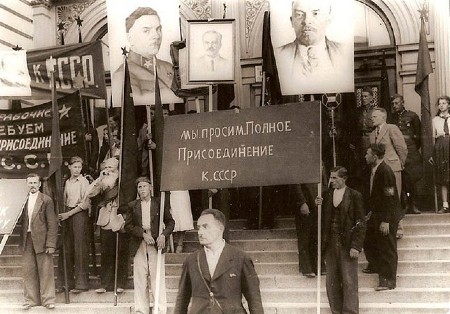
Pro -Soviet rally in Latvia. 1940
The 80th anniversary of the occupation of the Baltic countries, Putin's Russia meets without a shadow of repentance, in the revenge of imperial fumes. A bill on the rehabilitation of the Molotov -Ribbentrop with his secret protocols has been submitted to the Duma. The entry of Latvia, Lithuania and Estonia into the USSR is called voluntary and legal.
On June 14, 1940, the Soviet Union presented the ultimatum Lithuania, and on June 16 - Latvia and Estonia. Referring to the alleged provocations against the Soviet military contingents located in these countries, Moscow demanded permission to introduce the Soviet troops unlimited in terms of the number of contingents into the territory of the Baltic countries and the formation of new, pro -leading governments.
On June 15, special detachments of the NKVD on June 15 attacked two Latvian border posts, killed three border guards and two civilians and captured 10 border guards and 27 civilians. The ultimatums were accepted, because after the defeat of France the help of the victims of aggression, there was nowhere to wait, and on June 15, Soviet troops were introduced into Lithuania, and on June 17 - to Latvia and Estonia. Only in Lithuania, President Antanas Smeten called to reject the ultimatum and provide the Red Army with armed resistance, but was not supported by the majority of government members and was forced to escape to Germany.
The occupation and annexation of the Baltic countries in 1939-1940, along with the war against Finland, are the obvious crimes of Stalin. Nevertheless, in Russia, disputes are still not subsidizing on this occasion, and many historians and politicians reproduce the Soviet thesis about the "voluntariness" of the accession of Lithuania, Latvia and Estonia. Meanwhile, the occupation and annexation of the Baltic republics in form, and in fact, is no different from Austria Austria Nazi Germany in March 1938, from the occupation of Czechoslovakia and annexation (in the form of a protectorate of bohemia and moraia) in March 1939 and German occupation and annexation (in the form protectorate) Denmark in April 1940.
The arguments of those who are inclined to justify the Stalinist policy, but are not ready to repeat the lie about the "voluntary accession", usually come down to the fact that the occupation of the Baltic countries was vital to ensure the security of the USSR and in general "then everyone did this." In addition, it is one thing when the Hitler Reich occupies any country, and a completely different thing is when the “good” Soviet Union. The Russian Foreign Ministry has repeatedly stated the legality of the accession of the Baltic countries to the USSR and continues to insist that "and the introduction of additional units of the Red Army, and the joining of the Baltic states to the Soviet Union did not conflict with the norms of international law at that time."
It should be noted that not all countries "did so." England, France, and to a certain extent, and the United States can rightly be reproached for the "policy of peace" Hitler. However, these states themselves during the period of "peace of peace" did not commit any occupation and annexations. During this time, Hitler Germany occupied and annexed a number of territories, so the Russian Foreign Ministry, not wanting it, puts Nazi Germany and the Communist Soviet Union on one board, which, incidentally, fully corresponds to historical truth.
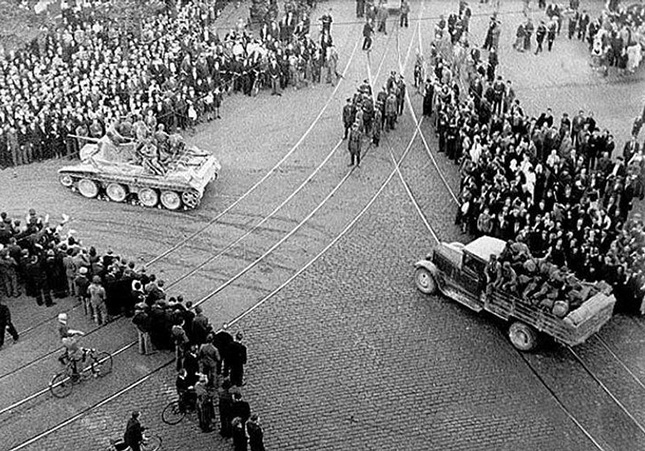
Soviet troops enter Riga
Another argument is given: since the USSR and the Baltic countries were not at war, it is unlawful to talk about the Soviet occupation of these countries. However, there is such a thing as a “peaceful occupation”, which does not occur as a result of war and hostilities, but is still accompanied by a threat of force if the requirements for the occupation of a particular territory or country are rejected. And in the verdict of the International Military Tribunal over the main Nazi military criminals in Nuremberg of October 1, 1946, Czechoslovakia, Austria and Denmark were also recognized as victims of German aggression, like Poland, Belgium, Yugoslavia and other states, on the territory of which military operations were underway.
The Soviet occupation and the annexation of Lithuania, Latvia and Estonia differs from the Soviet occupation and the annexation of Eastern Poland, Bessarabia and Northern Bukovina only in that in the latter case it was about the annexation of only part of the territory of states, while the Baltic states of Stalin swallowed entirely, which, of course, did not make any legitimate capture of the Soviet Union of Polish and Romanian territories. But then the capture of Lithuania, Latvia and Estonia of the USSR is generally no different from the point of view of international law from the seizure of Nazi Germany Austria, Czechoslovakia and Denmark. And if there are differences, then they are more likely in favor of the Nazis, since the latter, for example, in Denmark until August 1943, retained the power of the government that surrendered before them in April 1940.
As for the thesis about ensuring the security of the USSR, it is also very doubtful. In the Baltic countries of Nazi Germany, no more was sympathized with the Soviet Union. And if the USSR had guaranteed the preservation of the neutrality and independence of the three Baltic states, a script in which the armies of Lithuania, Latvia and Estonia would fight with the Red Army against the Wehrmacht would look quite likely.
The Soviet occupation of the Baltic countries became a direct consequence of the secret protocols for the Soviet -German treaties of 1939 - the Molotov -Ribbentrop Pact and the Friendship and Border Agreement, and both in the fall of 1939 and in the summer of 1940, Soviet troops were introduced to Lithuania, Latvia and Estonia under the threat of force. And it is no coincidence that right now, on the eve of the 80th anniversary of the Soviet occupation of the Baltic countries, a bill was introduced to the State Duma, offering to invalidate the Decree of the Council of People's Deputies of the USSR of December 24, 1989 on condemning the signing of the Molotov -Ribbentrop Pact in 1939 and the secret protocols for it.
The bill introduced more than 40 historians, publicists and public figures, however, for the most part marginal. One of them, Doctor of Historical Sciences Vyacheslav Zimimonin, for example, claims : "Then this pact was unfairly condemned. He was simply necessary due to circumstances that developed in the world. The Soviet Union needed a respite and time to prepare for the inevitable aggression on the part of Germany." Also, in his opinion, "the Baltic countries voluntarily became part of the Soviet Union on the basis of the will of their citizens. There was no occupation of the Baltic states."
For some reason, in Lithuania, Latvia and Estonia, and in the European Union as a whole, the vast majority of the population does not share the point of view of the Russian historian. But it practically does not differ from the position of the Russian Foreign Ministry .