
Translated material
Unkind advice
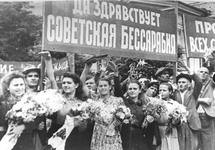
On July 3, 1940, Soviet troops completed the occupation of Bessarabia and North Bukovina.
On June 26, 1940, Vyacheslav Molotov handed the Romanian ambassador in Moscow George Davidesk a statement by the Soviet government with a demand to transfer the USSR Bessarabia and the northern part of Bukovina within the borders according to the applied map. On June 27, 1940, Romania announced universal mobilization, but after Germany refused her military support, she was forced to give in force.
In Berlin, they were outraged that Stalin, in addition to Bessarabia, in a secret protocol to the Molotov Pact - Ribbentrop, also captured the Northern Bukovina, about which in 1939 there was no question and which was never part of the Russian Empire. In addition, the German minority (8 percent of the population) lived in North Bukovina. However, Hitler, who had just cut off with France and had plans to quickly prepare the sea landing for landing in the British Isles, was not ready to fight with the Soviet Union in the summer of 1940. Therefore, in Berlin, so far they advised Bucharest to retreat, promising in the future to help the return of the lost territories.
On June 28, the Red Army began the occupation of Bessarabia and Northern Bukovina. It took six days to its full completion. The operation dragged on until July 3 due to the low discipline of the march and frequent breakdowns of technology. A resident of Bessarabia, the artist of Euphrosyne Kersnovskaya, deported on June 14, 1941 and spent 15 years in Soviet camps, recalled the arrival of the Red Army:
"On the way through the village there were dirty, protective color of the armored vehicle, wedges ... Here and there they stood by the side of the road, and the smeared fighters were repaired. Black puddles of lubric oil were visible on road dust. One car was out of order against our house. Something black flowed from it, and the guys, pushing each other with elbows, giggled and triggered:" ... Sheeps: where he became, there is a puddle ... "They, whispering, pushed the elderly peasant, until he finally stepped forward and asked:" What are you guys? Only the border crossed at once - for repairs? "
The mechanic muttered through his teeth: "We have been on the campaign for three months already ..."
Behind the Soroksky bridge, on the rise, 50 meters above the bridge, under the slope lay a translated car. Next to her is the corpse of a soldier, covered with a cloak. Face under the helmet. On the side of the road he sat with a dull look of soldiers with a rifle.
How did it happen? I asked.
What the mountains! Will the brakes withstand?
I was surprised: what are these "mountains"? Little bias! "
Romanian troops and refugees went beyond the rod. Soviet troops did not meet resistance. Some of the Ukrainian and Russian population even welcomed the Red Army. The Romanian majority of the population and other ethnic minorities met the "liberators" wary, but did not provide active resistance. Most of the implacable opponents of the Soviets preferred to retreat with the Romanian army.
But very soon, the measures of the occupation authorities very thoroughly restored the majority of the population of the former Romanian provinces against the Soviet regime. The main part of Bessarabia was included in the Moldavian SSR formed on August 2, 1940, which also entered the territory of the Moldavian Autonomous Soviet Socialist Republic from Ukraine, which existed on the left bank of the Dniester. The rest of the territory of Bessarabia became part of Ukraine as a newly formed Akkerman region, in March 1941 renamed Izmail, and parts of the territory of the Odessa region. North Bukovina was also included in Ukraine as a newly formed Chernivtsi region.
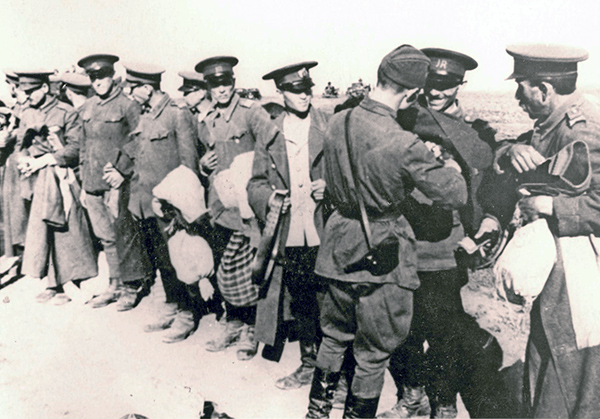
Inspection of Romanian soldiers on the new border
On June 23, 1990, the Commission of the Supreme Council of the Moldavian SSR came to the conclusion that "Bessarabia and North Bukovina were always components of the state of Moldova, created in the XIV century on the territory of the ancestors of the Romanians - Geto -Dakov" and that "ultimatic notes of the Soviet government, directed by Romania, contradict the norms of international law and are an example of politics Imperial dictatorship. The commission also said that "on June 28, 1940, the USSR occupied Bessarabia and Northern Bukovina by the power of weapons and contrary to the will of the population of this region" and that "with the establishment in Bessarabia and the Northern Bukovina of the Stalinist Soviet regime in these regions, crime was committed in these regions: massacres, references, and organized hunger."
Forcibly collectivization, the closure of churches, a deficit of goods and repressions against the intelligentsia and representatives of the property classes quickly set up the population against the new government. Even in the summer of 1940, 8 thousand people were deported from Bessarabia to Siberia and Kazakhstan. And in the spring and summer of 1941, about 31.5 thousand "anti -Soviet elements" were deported from Bessarabia and Northern Bukovina.
Many residents sought to escape to Romania, but met the bullets of the Soviet border guards in their path.
On April 1, 1941, the first secretary of the Communist Party of Ukraine Nikita Khrushchev informed Stalin:
"Part of the peasants of the next four villages of the Glybok district of the Chernivtsi region went to the district center - the village of Glybokhoko (now - Bloby. - B.S. ) demanding to send them to Romania. The crowd totaled about one thousand people, mainly men. In the middle of the day on April 1, the crowd entered the village of Glyboy, went to the building of the NKVD, some carried the crosses, there was one white white. The banner (the participants of this procession themselves was supposed to symbolize peaceful intentions) We approached the building of the district executive committee with the same request: to send to Romania.
In the village of Glybook, located 15-16 kilometers from the border, there are already the first secretary of the regional party committee, chairman of the regional executive committee, head of the UGB and other regional workers, from the city of Chernivtsi they sent people from the local population who knew the Romanian language from the city of Chernivtsi.
By the evening of April 1, who came to the village of Glyboy, gradually dispersed.
The head of the UGB instructed to arrest the instigators, which was done tonight.
Two days ago, several groups of peasants with the same demand came to the district executive committee of the Storozhinetsk Border region. It turned out that they were incited by fists and curtains (members of the Romanian right -winging organization "Iron Guard". - B.S. ). The identified instigators were arrested in the Storozhinets district.
Today Comrade goes to the Chernivtsi region. Burmistrenko.
At about 19 hours on April 1, a crowd of 500-600 people in the Glybok district tried to break into Romania. Border guards opened fire. As a result, according to preliminary data, about 50 people were killed and wounded, the rest fled. Nobody broke abroad. "
Joseph Vissarionovich was completely satisfied that no one left for Romania, but on the same day, April 2, Nikita Sergeyevich criticized the comradely: “It is not clear from your message what the national belonging of peasants who wanted to leave for Romania, are there Ukrainians among them, what percentage? In general, your work is clear in your border areas. Of course, shooting is not the main method of our work. In the sense that you, Nikita, would shoot and shoot everything. And where, you see, political and educational work. Yes, and instigators would have to be identified and arrested in advance.
Khrushchev explained the word "Harders" in a response shifrogram on the night of April 2 to 3, 1941: “I report that the peasants who wanted to leave for Romania are Romanians, there are no Ukrainians among the Ukrainians. (In the Glyokov district, even in 2001, the Romanians made up 52.6% of the population, and Ukrainians were 46.8%, but it is unlikely that among those who tried to break into Romania completely in Romania There were no Ukrainians .
The word "curtains" in exact translation means "guard". So recently the Party "Iron Guard" calls itself.
Your remark about the weakness of our work in the border areas is correct. Burmistrenko went to the Chernivtsi region yesterday. " (RGASPI, Foundation 558, inventory 11 (I.V. Stalin Foundation), Case 59, Ll. 5-7).
With the outbreak of World War II, the majority of residents of Bessarabia and Northern Bukovina, drafted into the Red Army, preferred to immediately surrender to the Romanian troops (they were not placed in prisoners of war camps like Romanian citizens). During the Great Patriotic War, there was no partisan movement in Bessarabia. And of the 2892 people who participated in the Soviet partisan movement on the territory of the Left Bank Dniester, included in the Moldavian SSR, there were only seven ethnic Moldavians. All this says in favor of the fact that the residents of Bessarabia and Northern Bukovina were not too happy about this in the summer of 1940.