
Translated material
Do not atone for surrender
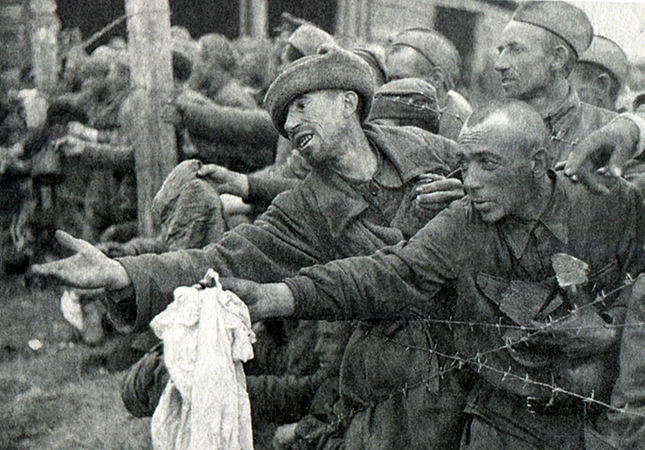
On August 16, 1941, Order No. 270 of the Red Army Supreme Command of the Red Army was issued "On the responsibility of military personnel for surrender and leaving the enemy of weapons." In addition to Stalin, he was signed by Vyacheslav Molotov as the First Deputy Stalin in the State Defense Committee, Marshals Semyon Budyonny, Clement Voroshilov, Semen Tymoshenko and Boris Shaposhnikov, as well as Army General Georgy Zhukov. The order accused of betrayal and voluntary surrender to the commander of the 28th Army, Lieutenant General Vladimir Kachalov, commander of the 12th Army Major General Pavel and commander of the 13th Rifle Corps, Major General Nikolai Kirillov. All these accusations were not true.
In 1945, the former chief of staff of the 37th Army, Major General Konstantin Dobroserdov, stated during the interrogation that the military personnel who were captured with him were eyewitnesses of how the Germans were killed in the battle of Kachalov. On January 25, 1952, the testimony of the inhabitants of the villages of the vodnevka and the old man, who, as eyewitnesses of the battle, confirmed that from the tank’s, was removed from the tank’s body in general and that they buried him in a common grave on the outskirts of the old woman were officially recorded. Just in this area, the last time they saw Kachalov. In the same year, one of the inhabitants of the elderly was interrogated, who told that the German officer ordered him to put a birch cross with the inscription "Lieutenant Kachalov General" on the grave. And six months later, according to the results of the reburial of the remains from the mass grave in the old man region, an act was drawn up that the remains of the Soviet General form were discovered on the skeleton of one of the dead. In addition to Kachalov, there were no other Soviet generals who died or missed in the area. Already in 1952, he could be recognized as dead in battle and completely rehabilitated. But I had to wait for the death of Stalin. Only on December 23, 1953, General Kachalov was rehabilitated and was no longer considered a traitor.
One of the fighters of the 12th Army in a letter to the widow of Mandelin told how her husband tried to break out of the Uman Kotl in the Uzkoye area: “Pavel Grigoryevich led the remnants of the commandant’s company and other scattered units of the group’s headquarters. On the lower street, leading to the Yatran river, he was stunned by the butt of the machine gun and took off the machine gun Captive. " Most likely this is a heroic legend. From German documents it follows that on the night of August 7, the Generals of Prendelin and Kirillov, breaking through the encirclement, were blocked in a small forest with a group of soldiers and commanders and, when the cartridges ended, surrendered. After the war, they were repatriated in the USSR and shot in 1950. Mondeline was also charged with anti -Soviet statements, including about collective farms, in the diary that he was captured. The diary did not reach us, but it is unlikely that the general would have retained the diary that compromises him during repatriation.
Even Monday was charged with the fact that he issued the composition of the 6th and 12th armies during the interrogation, which by the time of captivity no longer existed and the composition of which the Germans knew at that time from trophy documents better than their captured commander. In the shooting sentence, Kirillov was charged with only voluntary surrender. Stalin could not be mistaken. Mondelin and Kirillov were rehabilitated only in 1956.
On the basis of purely erroneous data in order No. 270, severe conclusions were made: "Can I endure in the ranks of the Red Army, deserting to the enemy and surrendering to it, or such cowardly superiors who, during the first hitch at the front, tear off the insignia and desert the rear? No, it is impossible! If they give free rein to these panties and deserters, they are in a short time, they are in a short time. They will decompose our army and destroy our panties and deserters, whether the commanders of the battalions are considered to be the commanders of the battle, they do not observe the battlefield, and still imagine the regiments and battalions.
Therefore, it was ordered: “The commanders and political workers, during the fight of the insignia and who desert the enemy or surrendering to the enemy, are considered malicious deserters, whose families are subject to arrest as families who violated the oath and betrayed their homeland. To oblige all higher commanders and commissars to shoot such deserters from the staff ... Each serviceman, regardless of his official position, demand from a higher boss, if part of him is surrounded, to fight to the last opportunity to break through to his own, and if such a boss or part of the Red Army, instead of organizing a rebuff, will prefer to surrender to him - destroy them by all means, both by terrestrial and air, and the families surrendered to the Red Army to deprive state benefits and assistance.
To oblige the commanders and commissars of divisions to immediately shift from the posts of commanders of battalions and regiments hiding in the cracks during the fighting and afraid to lead the battle to the battlefield, to reduce them as impostors, to transfer them to ordinary people, and if necessary, shoot them in place, putting them out in their place of bold and courageous people from the younger missiles or from the ranks of the distinguished ones. Red Army ".
The number of Red Army soldiers and commanders who surrender, order No. 270 had no influence. It is enough to say that the two largest "boilers" - Kiev in the second half of August - September and Vyazemsko -Bryansky in October 1941, in each of which more than 660 thousand prisoners were captured in each of which by the Wehrmacht after the publication of order No. 270. As a rule, prisoners are captured by the one who comes. The number of prisoners began to quickly decrease only in the fall of 1942, when the German offensive stalled and followed the Soviet counterattack near Stalingrad and other sections of the front. In 1943-1945, when the Red Army was advancing mainly, the number of Soviet prisoners decreased even more, although even in 1945 14,825 Red Army soldiers were captured. Thus, the dynamics of the number of Soviet prisoners was determined by the general strategic situation, and not by the publication of repressive orders.
Due to order No. 270, a lot of innocent were injured. On the example of Generals Kachalov, Mondayelin and Kirillov, we were already convinced that even the highest military leaders became victims of false accusations. What can we say about ordinary fighters and commanders who actually died or captured by no means voluntarily. Meanwhile, these accusations were taken seriously, the families of the unfortunate were deprived of benefits or went into exile, which often led to starvation. The fighters who returned from captivity and commanders were subjected to repression for as if voluntary surrender.
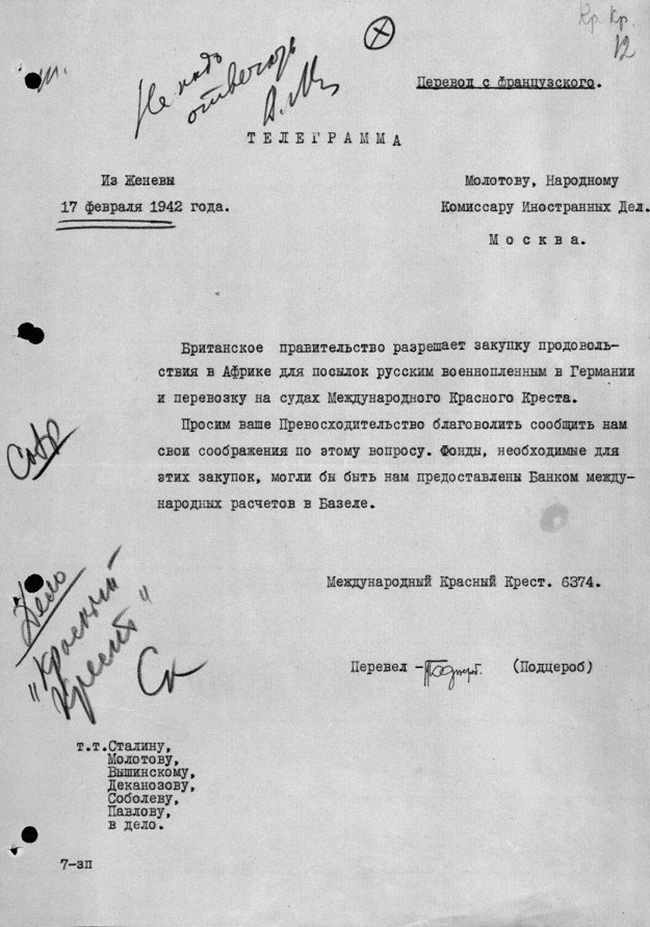
Stalin was completely indifferent to the fate of his prisoners. In early February 1942, from the International Red Cross in Geneva in the NKKU, a proposal was made to distribute sugar among Soviet prisoners in Germany and Romania, but in return to allow a certain number of food premises by the German prisoner in Russia. On a copy of this telegram, Stalin’s resolution was preserved: "It is decided not to answer."
And when, through the American ambassador in Moscow, William Standley Vatican proposed organizing an exchange of information about prisoners of war, Molotov answered on March 28, 1943: “Confirming the receipt of your letter of March 25 this year with an message about the proposal of the Vatican to establish information regarding Soviet prisoners of war and prisoners of war of the axis, I have the honor to report that this issue is not interested in the Soviet government.” Molotov also expressed "appreciation for attention to the Soviet prisoners of war" - it turns out that they were dealing with an American diplomat, but not to the Soviet drug addict foreign affairs.
These and similar answers to sentences regarding the fate of prisoners of war, as well as order No. 270, may have generated the phrase attributed to Stalin: “We have no prisoners of war, we have traitors”, often cited in foreign sources since 1943. It is still unknown whether Stalin said something like that, but this quote transmits his attitude to his prisoners correctly. For Stalin, the prisoners did not represent value, since they could no longer be used in the war, and he was not going to spend any resources on their maintenance, including through the international red cross.
After the war, the majority of Soviet prisoners who could not prove that they were captured by wounded or unconscious, as if second -class citizens. For a stay in captivity as such, if this was not accompanied by accusations of treason, they were not repressed. However, the secret for them until the mid-50s was difficult to access universities or any prestigious work. In addition, many prisoners, after liberation, were mobilized into labor battalions, the conditions in which were little different from the Gulag.