
Translated material
Metropolitan
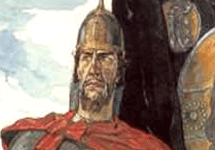
In December, the Russian Orthodox Church celebrates the day of memory of Alexander Nevsky. This historical figure is one of the most significant in Russian history, but also one of the most contradictory: what we know about his activity is sharply different from the existing myths about him.
Back in the middle of the 16th century, under Ivan the Terrible, Alexander was canonized as a holy noble (that is, professing a true, Orthodox faith) prince. This was done mainly to approve the idea of the continuity of the power of Moscow autocrats from Kievan Rus - through Alexander and Vladimir princes.
Then there were several such sacralizations of the image. The next occurred under Peter I, when the relics of the prince were transferred to St. Petersburg, and he himself, under the influence of imperial ambitions, turned into the predecessor of the emperor in the Baltic, patron and military intercessor for Russian land. The stylized image of the "helmet of Alexander Nevsky" was even included in the large state emblem of the Russian Empire of 1857.
And already under Stalin, on the eve and during the Great Patriotic War, thanks to the famous film Eisenstein and the Soviet military order of Alexander Nevsky, who was established in 1942, a new take-off of the popularity of the ancient Russian prince, accompanied by the immoderate exaggeration of his military-political merits.
The latest trends within the Russian Orthodox Church show that the current church consciousness artificially constructs a new, fourth in a row the sacred reincarnation of the image of the prince - now as a Christian diplomat, the "first Eurasian" and the wise national leader. An article published in an official newspaper signed by Metropolitan of Tashkent and Central Asian Vladimir remarkably outlines this ideological structure, adding new to the previous myths.
It turns out that the “political leader of the Russian land” not only headed the defense from the east and the west, ”“ all the Swedish invaders defeated the army, defeated the crusaders and saved Rus' from “aggression from the west”. He was still a skilled diplomat who built his activities on the principles of modern international law and "ahead of his time by 700 years." The prince, as stated, “followed the truth of Christ in practice,” adhered to the rules of the peaceful resolution of conflicts, the non -discretion of power or threat of force, did not take away other lands and “did not impose political dependence”, but considered “the protection of his fatherland with weapons in the hands of an obedient Orthodox Christian.” It was these rules that "provided Rus' with the most important thing-the world," as well as "the development of mutually beneficial trade, economic and spiritual and cultural ties with all the countries of Eurasia."
How to evaluate such a design? Of course, the name of one medieval alchemical treatise is immediately recalled - "Can a chimera, buzzing in an empty space, absorb secondary intentions?" We will answer honestly: maybe our obsessed with phantom imperial pains of the church-state chimera. In the best domestic traditions of guiding shadows on the wove and "make us beautiful." The recipe is simple - a combination of falsifications (when the unprecedented is declared that has taken place), fraud, defaults about the dark aspects of the hero and blind patriotism.
All this looks especially strange in the light of appeal to the "truth of Christ." But back in 1927, the remarkable religious thinker Georgy Fedotov wrote: “The peculiarity of the hagiography of the Holy Prince is that its hero is not a“ spiritual ”person in the specific sense of the word - that is, not a man of contemplative, prayer feat, but a politician, as a politician, Alexander Nevsky judges history, and the court should be completely independent of the personal sacredness of the prince. Alexander does not canonize the policies of the Neva hero. "
So what is canonized and sanctified by the authority of the church? Firstly, the gross distortions of the facts were neither the so -called Neva battle of 1240, nor the ice battle of 1242 by great military victories and they did not put a barrier to the promotion of the crusaders in the Baltic states (the long -published books of V.V. Kargalov, J. Fennel and I.N. Danilevsky can be recommended).
Secondly, the monstrous immoralism of the authors of this chimera. How to evaluate all the chatter around the seemingly peaceful resolution of conflicts and following the truth of God, in which there is power, in the light of the well -known facts of the political activity of the prince - the denunciation of 1252, the Batu (actually established the IGA regime), the betrayal of their brothers, finally, the brutal suppression of the two anti -Horde uprisings of the Novgorodians in 1257 and 1259, during which "who was nosed, who was nosa. And other eyes are taken out. " How does the authors of such publications turn to write that the prince acted on the principle of "not in the power of God, but in truth"? Is this the truth in their understanding?
Thirdly, just mistakes-not Alexander established in 1261 the diocese of the Russian Orthodox Church in the Horde, and he was not in any sense as the founder of the "Russian-Chinese diplomatic ties" (referring to Dannic trips to Karakorum, or what?).
And finally, the very politics of Prince Alexander Yaroslavich (he became named after the flattering Moscow chroniclers from the end of the 15th century) - unconditional humility of the Horde and a break with Europe - did she bring a lot of good to the country and the people? While the successors of his opponent Daniil Romanovich, continuing the unsuccessful struggle of the Galician prince with the Mongols, one hundred and twenty years earlier dumped on them than the successors of the "Neva Hero".
At one time, a wonderful Soviet historian Academician M.N. Tikhomirov called his devastating review of the script of the film about Alexander Nevsky "Modeling above the story." Alas, the mockery continues, and if earlier a lie was covered with a Petrovsky tricolor or a red star with a sickle and a hammer, now the cross of Christ. The latter is worse.
In 1837, Peter Chaadaev wrote (obviously, in reckless hope) that the time of blind love has passed and now we owe the motherland the truth. " Will this come "now"? And what will happen to both the truth and with the homeland otherwise?