
Translated material
And where is the people?
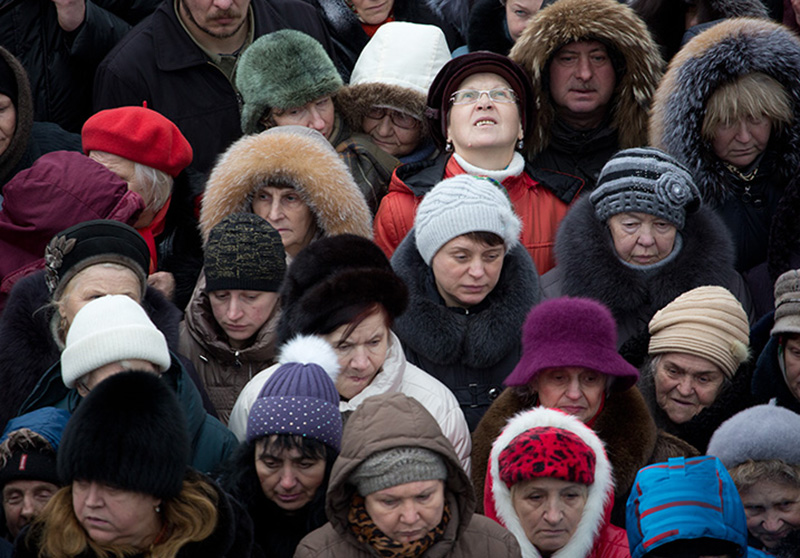
At first, not about the war, not about Putin, not about politics at all.
Recently, a microbiologist Irina Yakutenko came on the air of the Berlin Voice radio station. Putin here is only with such a side that this broadcast we led with Masha Mayers, who previously worked at Echo of Moscow, which Putin forbade. There are now many Masha from Echo in Berlin, and there will be even more. It is called - relocation, but in fact - flight, forced emigration, salvation of both bodies and shower. The remaining in Russia inevitably go under the risks, including professional deformation. And not only journalists with whom everything is clear, but in general, all, at least some professions: both potters and carpenters. Because any profession is forced today in Russia to walk around the common figure of silence. "In Russia, if you can’t talk about the war - and you cannot but talk about the war, because this is the most important thing - how can you talk about something else?" - So the composer Boris Filanovsky formulated the problem, who, of course, also in Berlin.
Irina Yakutenko is not just a microbiologist and scientific journalist. She is the author of the best book written in Russian about Sars-Cov-2 with the name "The virus that broke the planet." I read this book: it is really well done. Maybe because Yakutenko wrote it not in Russia, but in Berlin, receiving the latest information from Covid from the Chanitia clinic and from the Robert Koch Institute. And so Yakutenko on the air spoke about the new wave of Covid, and we asked about the old wave: how did it happen that at least a million people died in the epidemic in Russia? And Yakutenko, easily spinning the thread of an educational conversation, only waved her hand: “Well, because they were not vaccinated. But in fact, because the society is atomized. Neither solidarity nor mutual responsibility. Mask is not just barrier contraception so that you will not be infected. This is not infected. And when everything is on your own, and in themselves, and in themselves, and they are dark and dark, and they are dark. They do not want to know anything.
I sigh. The circulation of Yakutenko’s book in the 146 millionth (that is, now in 145 million) Russia-5000 copies. Such is the sober evaluative look of the publisher at the minds of Russians and them, forgive the high part, thirsty for knowledge. Irina also prepared the new edition of the book, but now in Russia no one needs it. Because the Russian people ...
Stop. I'm talking about atomization. I'm talking about the people.
Atomized mass cannot be a people. The people are subjectivity, self -aware of community. These are united people who are aware of their goals and needs quite well, in order to solve who are managerial functions, in what volume and for what time to trust. And the fact that the Russians in Russia consider themselves to be a Russian people, the proof of the existence of the people in Russia is not yet. In Russia, in general, often behind the words from the European vocabulary there is a completely different meaning. This is what the situation is with the "people" and "nation", that is, Volk and National. The people in the West are primarily horizontal ties. Social, neighboring, professional, political, cultural, and so on, when people without external coercion begin to act as a single organism. Hence - "My District", "My City", "My Country", "We, The People". And the state is just a hired structure, in a radical version - only a "night watchman", as in the UK or the USA. In Russia, people are not a connection, but a community of language and history. And very often - the unity of the race. From here this is a contemptuous (and in fact - idiotic) Russian: "Yes, you will not have a white person left there in Europe!"
For the "people" in the Russian understanding, skin color and eye cut are important. For the metropolitan Russians, Rishi Sunak or kindergarten Khan is not the British. For Russians, these politicians are more visible examples of erosion and corrosion of the English people. And Fatikh Akin - he, of course, is not a German director (albeit of Turkish origin) for the metropolitan Russians, but living among the Germans of the Turks, part of that terrible "Islamic wave" that rolls on "good good white Europe." In the speeches of Russian radiodes of nationality, from Dugin to Putin, this uniform horror is constantly breaking through: Europe is dying! We, Russians, the last chance to protect Europe from falling to the abyss! From this angle of view, Putin’s war in Ukraine is a war that all the peoples of Europe exist exclusively in the Russian sense.
In fact, this is not Europe rolled into the abyss. This Russia stands on the edge of the abyss separating it from the civilization of the twentieth century. The way the metropolitan Russians behave in relation to the war in Ukraine is not at all how Americans behaved in relation to the war in Vietnam. Russians behave the same way as Kovida during the pandemic. The murmurs (and even running from the war) are terrified only that they can kill them in the war, but for the most part, spelling that they kill Ukrainians there. The absence of horizontal connections within their own country deprives both empathy and solidarity in relation to everything that is outside the country. Other lives are not taken into account. The Russian world does not unite with other worlds according to the principle of human community (I repeat: professional, social, cultural), but is divided by the medieval into “its own” (race, language, history) and “strangers” (other race, other language, another story).
From this, I would not hasten to conclude that the war of Russia will be inevitably lost, since the Ukrainian people are opposed by a fragmented Russian mass. Conclusions, it seems to me, you need to make completely different ones here.
First: it is time to stop deifying the Russian people, swear to these people and (all the more so!) Search for some moral grounds in the "deep people". The Russian people are simply occupied by the state, fragmented, powerless, badly educated and poorly aware of themselves, which can sometimes be sympathetic, but in no case should you indulge. This is a snail that crushed and distorted the state sink covering it - unlike the western snail, which changes the shells as its own development.
The second: Russian emigrants (especially new and forced), it is reasonable to set itself the task of not only the development and assimilation of new experience, but also the transformation of oneself into part of the surrounding people. That is, overalling, stammerication, wandering, crushing and earning - this is an important slogan on emigrant banners. The problem is that many perceive “pupils” formally, exactly in the stupid sense in which the Russians living in Russia consider themselves a “people”. When they ask me if I was notorious in Germany, they usually mean whether I read German newspapers and I drink beer with liter mases. But all this is not too important. It is important - how you have grown into local life horizontally. And here, of course, the knowledge of the language plays an important role, and sometimes the knowledge that beer is drinking in Bavaria with liter mases, but in Cologne - 200 -gram Kölshas.
From my point of view, the Russians in Europe, from my point of view, is reasonable to grow and germinate, like ivy and wild grapes on the trunk of a tree, become the absolute part of the local landscape, and not cherish a special "Russianness" in itself. And then, when the Russian sink will crack once again, it will fall apart a broken shell - perhaps to think about returning, Radeia not about the fastest reconstruction of a new sink, but about the self -awareness of the snail, now crawling down the slope.