
Translated material
Reprisals on the list
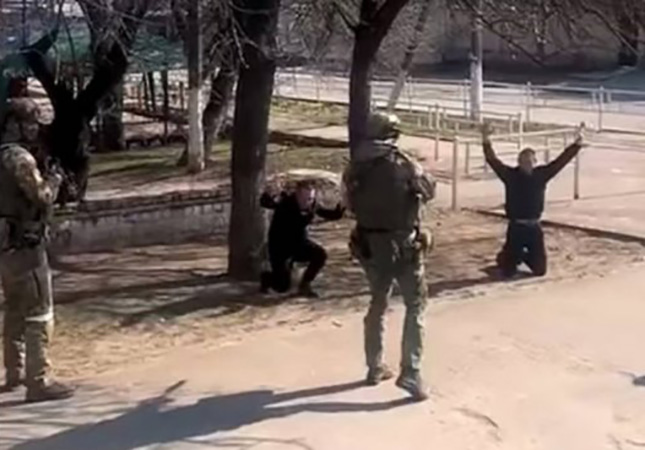
Capture of Ukrainians in Kherson
In the captured territories of Ukraine, Russians act with terrorist methods: spot reprisals, mass deportations, filtration camps, torture.
In 2014, during the capture of Crimea, dozens of activists were stolen ; At least six were killed. We devoted a special project for violent disappearance on the peninsula. The invasion of Donbass began with the abduction of a deputy of the City Council of Gorlovka Vladimir Rybak . On April 17, 2014, four men in camouflage seated him in the car and took him in an unknown direction, after he tried to go to the building of the city executive committee to remove the DPR flag. On April 22, the body of a fisherman with traces of torture was found in the River of the state end.
This year, before a large -scale invasion of Ukraine, the Western media wrote , referring to the US intelligence received by the US received, that Russia has compiled lists of persons subject to murder or arrest: ATO veterans, activists, journalists, Belarusian and Russian dissidents.
As of May 11, 271 people were kidnapped in the temporarily occupied territories of Ukraine, the Governor of the Zaporizhzhya Region Alexander Old woman said . Of these, 153 people were liberated by that time.
By May 15, the coalition of Ukrainian human rights organizations introduced 186 people in her list of missing active citizens. Of these, 95 people are released, 10 are found dead.
Melitopol
Russian invaders stole the head of the Melitopol multi-profile center of vocational education to Olesya Dorokhov, the Ukrainian Ombudsman Lyudmila Denisova reports . With the outbreak of war, Dorokhova organized the Center for Assistance "From Heart to Heart" in the educational institution - the only Ukrainian humanitarian headquarters in Melitopol. "In the center, people could get food, essential things, medicines, volunteers formed a bag for lonely and bedridden patients," writes Denisov.
In early March, the mayor of Melitopol Ivan Fedorov was stolen, he was exchanged for nine Russian conscripts.
The journalist and director of the RIA "Melitopol" Svetlana Zalizetskaya on March 23 reported the abduction of her father. Three days later he was released. The journalist said she did not give consent to cooperation.
On March 21, the invaders took Tatyana Kumok in an unknown direction of Israeli citizen. She regularly covered the situation in the city on her FB page. Her parents Mikhail and Vera, also Israeli citizens, were stolen a few hours earlier. Mikhail Kumok - publisher of the newspaper "Melitopol Vedomosti". At the same time, the military took away journalists Julia Olkhovskaya, Lyubov Chaika and Evgeny Boryan. Later all the abducted were freed. Journalists were convinced of "the need to cooperate with the invaders."
Energodar
In another occupied city of Zaporizhzhya region, Energodar, according to the mayor Dmitry Orlov, the Russians abducted the head of the fire and rescue squad Vitaly Trojan: they searched in his office, sealed him, and then took Trojan in an unknown direction.
After that, firefighters in Energodar went to the rally in support of the boss - lined up with cars near the House of Culture "Suprutnik" and turned on the sirens.
As Energoatoma wrote in the telegram channel, the Russians dispersed the rally with shooting, having beaten the participants. At the same time, they damaged fire engines, beat the glass. The acting was also stolen The commander of the rescue detachment S. Pilinsky, who replaced Trojan.
On May 17, Orlov turned to the Ukrainian public services engaged in the exchange of prisoners with a request to make every effort to rescue from Russian captivity his deputies Ivan the Samyudyuk, stolen exactly 60 days earlier.
Kharkovshchina
On May 22, the head of the Kharkov Regional Military Administration announced the abduction of the head of the village of Dvurechansky Galina Turbaba. At that time, she was "under arrest" for four days.
In March, the head of the Kirkunov territorial community Nikolai Sikalenko was stolen . It was reported that he was taken to another occupied village - the Liptsy of the Kharkov district. In May, after the liberation of the circuses by the Ukrainian army, it became known that Sikalenko was released: he made an appeal to the villagers, saying that the time had come to restore it.
A few days before Sikalenko, the chairman of the Great Burgly community Viktor Tereshchenko was stolen . He was called to work and stolen directly from the office. The next day, Tereshchenko was released .
In April, it became known that at the end of March, the famous writer and volunteer Vladimir Vakulenko and his son were stolen in the village of Kapitolovka of the Izyumsky district of the Kharkov region.
The shooting lists of the inhabitants of Kharkov helped to compose collaborators. If the city was taken, key social activists were planned to be "eliminated" on the first day. “In addition to this short (less than 200 people) list there were still lists of thousands, maybe tens of thousands of Kharkiv residents, who were publicly lit up somewhere with a pronounced patriotic position. This is more likely not for executions, but for filtration camps,” Kharkov public activist Nikita Soloviev explained in an interview with faces.
Kherson region
As the political chairman of the President of Ukraine in Crimea Tamila Tashev said on May 6, in the Kherson region, the Russian military can hold and torture about 500 Ukrainians. According to her, many people are kept in Kherson, as well as in settlements on the border with the Crimea - in particular, in Novoalekseevka and Genichesk. People are kidnapped according to the lists: the invaders bypass activists, participants in the Crimean Crimea City 2015, ATO veterans.
The Chairman of the Board of the Crimean Tatar Resource Center Eskender Bariev said that the stolen people were taken to the Crimea and kept in the secret boxing of the Simferopol jail. The head of the CRC has information about 118 stolen activists, journalists and representatives of the Ukrainian authorities. Among them are 18 Crimean Tatars.
"Of the 118 forcibly stolen people, part returned home after torture, the information of the stolen information is unknown, and the part is located in the Crimea," Bariev said. The human rights activist spoke about the “torture” in the Genichesk: “They arranged a basement-pile in the 17th school-there the invaders carry out interrogations and torture of people. As a rule, they take cars from men, require money, and then they are thrown into the cemetery or leave on the road.”
On April 27, Ukrainian military intelligence reported that more than 300 pro -Ukrainian activists and ATO veterans are kept and tortured in the IVS in Kherson.
According to the Main Directorate of Intelligence of the Ministry of Defense of Ukraine, the filtration camp was organized in the village of Velikaya Lepetikha Kherson region. At the end of April, about 400 Russian military in the form of the Russian Guard arrived there: they actively searched for male recruiting age, delayed and exported to the Crimea.
According to Tasheva, filtration camps also operate in the Crimea, closer to the border with the Kherson region. Ukrainians are brought there from recently captured territories, including from Mariupol. They carry out “filtration measures” - in particular, undress to examine for tattoos that could indicate their belonging to the Armed Forces or other Ukrainian armed groups.
In social networks of the administrations of occupied cities, reports of new abductions of civilians are constantly appearing. So, in the message of the Kakhovsky territorial community, it is said about the abduction of May 21 of a resident of Kherson Valentin Gladky.
On May 11, the Russian military abducted the former deputy of the Kherson Regional Council, director of the Acantan farm Viktor Lamazyuk. On May 25, it became known that Limznyuk returned home.
According to Suprikaln (Ukrainian public broadcaster), on May 16, the invaders stole from the house of Alexei Vorontsov, an engineer of the Kherson branch. Since March 2, the team "Supriklne Kherson" has been working remotely; It is noted that the invaders have repeatedly attempted to search for personal files of the television company in order to recruit, interrogations and receive information.
The Kherson Regional Prosecutor's Office asks the department to send information about the participants of pro -Ukrainian rallies in Kherson, stolen during their acceleration.
As the head of the Kherson Military-Civil Administration, Gennady Laguta, said on April 27, out of 49 chapters of territorial communities in the region at that time, the Russians were abducted by 35. "17 of them were released, many are now in captivity. And we don’t even know where they are. If we take activists, bloggers, ATO participants and very active citizens, then the abduction are calculated by hundreds of abduction," - said the official.
In captivity are the mayor of the naked pier, Alexander Babich , former mayor of Kherson Vladimir Nikolayenko, ex-governor Andrei Putilov , who is considered one of the organizers of the civil blockade of Crimea, and many others.
With Nikolayenko, the invaders released several plots. In the first, he gives his weapon after the capture of Kherson. The second became viral with social networks. The propagandist from Izvestia is trying to get Roman Shukhevich from the hostage of the hero of Ukraine. Nikolayenko refuses and says that Shukhevich fought for Ukraine, and not for Nazi Germany. Why propagandists laid out this video is incomprehensible.
According to Ombudsman Denisov on May 1, the Nazar Kagalnyak veteran died in the Kherson region after torture. According to Denisova, a former military man who suffered two heart attacks and a complex heart operation, the Russian military abducted from home, "cruelly beat and tortured that he was a former participant in hostilities." “The invaders were brought home crippled by the torture of Nazar. His condition was critically worsened, after which the man was taken to the Hospital of the city of Olesha, where he soon died. Two minor children of Nazar have remained orphans, because for the past five years he raised them without his wife,” the Ombudsman said.
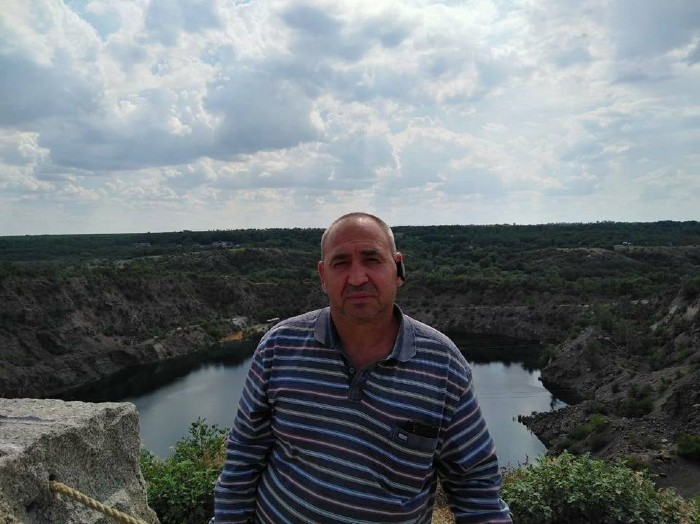
Nazar Kagalnyak
On March 28, the military of the Russian Federation abducted a resident of the village of Novivozenskoye, Kherson region, Vladimir Darmostuk. According to the daughter of the abducted Irina Grebenyuk, her father was wounded when he was abducted. After April 22, nothing is known about him.
In Kakhovka on March 12, local journalist Oleg Baturin disappeared. On March 20, Baturin showed up and said that he was abducted. “I lost a lot of weight. The tired. Tired. March 12 at 17:00 at the Kakhovsky bus station they grabbed me. They beat me. They threatened. They threatened. They said that they would kill. For almost eight days. 187 hours of captivity. Almost without food. For several days almost without water, without replaceable clothes. Without understanding where I was. But they clearly knew what they wanted to break, to show what they would show with what would happen. Every journalist: they will be crushed by you.
On the same day, March 12, the Russian military stole the head of the Kakhovsky bridgehead, the ATO veteran and journalist Sergei Tsigip in New Kakhovka. There was no information about him until April 23, when Russian propagandists released a video with Tsigipa. They presented him as a "senior officer of the command of special operations forces of the Ukrainian army", which, after a full -scale invasion of Russia to Ukraine, allegedly moved to Russia. Tsigipa in the video claims that he has been in Russia for several weeks, and speaks of the "dubious strategy of the Ukrainian army." “I have no doubt that they“ worked with him. ”I can only imagine that he had to go through,” Baturin wrote about him.
Abduction in the Crimea
The practice of violent disappearance in the occupied territories began in 2014 with Crimea. The first victim was the Crimean Tatar activist will decide Ametov, who was stolen on March 3, 2014, when he spent a single picket against the annexation at the Council of Ministers of Crimea. On March 15, he was found dead with traces of beatings. In Ukraine, on suspicion of the abduction of Ametov, two participants in the "Self -Defense" of Crimea and the former Russian military who fought in the Donbass were put on the wanted list. The Office of the Supreme Commissioner of the UN Human Rights documented 43 cases of violent disappearance in the Crimea. 30 people were subsequently liberated, 11 are still listed as missing, the death of one (Ametova) was confirmed, another (Valentin Vygovsky, sentenced to 11 years of strict regime in the case of espionage) is still in custody.
Terror in Crimea continues. Crimean Tatars receive Stalin's terms for fabricated "terrorist" cases. And on April 29, civil journalist Irina Danilovich, who collaborated with many independent media, was stolen in Koktebel. Judging by the video received by relatives Danilovich, four men in civilian clothes pushed a journalist into a car on one of the gas stations on the road from Koktebel and took away. On the same day, OMON employees in Balaklava spent the houses at Danilovich’s house. The Russian security forces said to Father Danilovich that his daughter received ten days of administrative arrest for "the transfer of unexpected information to a foreign state." On May 11, lawyer Auder Azamatov found Danilovich in the Simferopol pre -trial detention center. As it turned out, she became a suspect in the case of the illegal turnover of explosives (part 1 of article 222.1 of the Criminal Code of Russia) - a journalist threatens from 6 to 8 years in prison. At the same time, formally, the measure of restraint was chosen only on May 7.