
Translated material
Large -size humanism

The case of Ivan Golunov stirred up the stagnant waters, and everyone suddenly started talking about drugs, and all suddenly became experts in the field of drug policy. “We need serious reform of the 228th article of the Criminal Code,” the head of the Accounts Chamber Alexei Kudrin wrote on June 11 on his Twitter. The State Duma can soon be submitted by the bill to mitigate liability for drug storage, not related to their sales, Interfax said on the same day with reference to the uninocabula deputy Nikolai Brykin. And even Tatyana Moskalkova, who is authorized for human rights with not the most, to put it mildly, human rights reputation, expressed in the spirit that laws and law enforcement practice should be revised in a very serious way - so that everything was built on “clear evidence”.
And here it is necessary to remind the gentlemen of the jury that the need to mitigate the punishment under the 228th article of the Criminal Code of the Russian Federation, which regulates the so-called "drug crime" for a long time. Who says? First of all, human rights activists, lawyers, as well as scientists - criminologists and sociologists studying drug policy, as well as social workers and civil activists. Who objects to them? First of all, power fighters with drugs - now in Russia it is police officers, until 2016 there was still the Federal Drug Control Service, but both the FSB officers and employees of the FSB may be related to drug decorations. All of them, as well as prosecutors, as well as legislators - supporters of strict measures and repressions and categorically against any mitigation of criminal legislation regarding illegal psychoactive substances.
And public opinion in Russia as a whole on the side of the "hawks": the best way to combat drug trafficking is to shoot drug trafficks, and drug addicts should be planted if not in prisons, then healing is forcibly. Opponents, supporters of humane drug policy, generally avoid the words "drug addict", considering it dividing.
Roughly speaking, at one pole - the death penalty "for drugs", on the other - a kind of absolute ecstatic legalase. But our reality is located in the middle. Here we live beloved. Here, corrupt police can throw forbidden substances to a journalist to stop his investigation of the criminal business. Here, those who really suffer from drug addiction, formed against the background of abuse of opiates and opioids, can torture, refusing to be medical care after detention, and squeeze the necessary indications. Here - we are talking about Russia - on average annually, about 100 thousand sentences for drugs, about half of the convicts go to places of imprisonment, others receive conditional terms.
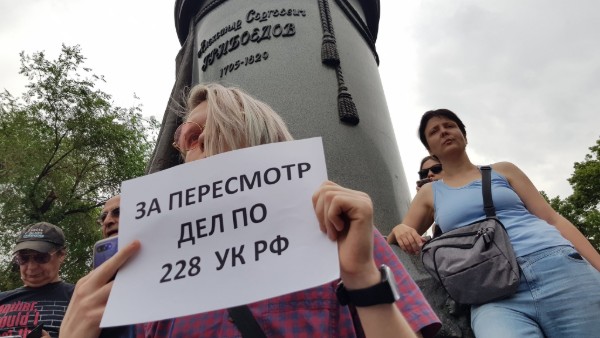
Pure ponds, 06/12/2019. Photo by Yu. Timofeeva/Grani.ru
For almost three post -Soviet decades, a very painful drug policy situation has developed in Russia. The authorities declare zero tolerance to anyone, both recreational and medical, consumption of psychoactive substances. But citizens of the Russian Federation used, use and will use them one way or another. Nobody really conducted the exact number of drug users - no one really conducted verbally scientific research in Russia. But around the problematic consumption of psychoactives, a whole business has grown - the so -called rehabilitation centers, more reminiscent of private prisons where people really do not treat people, but cripple (here you can, of course, recall the “city without drugs” and Evgeny Roizman, but this successful Populist Political Policy seems to be a small dealer against the backdrop of real sharks of the rehabilitation business).
Militant drug -fiber - and statistics confirm this - does not lead to a decrease in the number of drug crime, nor to improve human health, on the contrary, contributes to corruption and abuse in the conditions of blocking the open discussion on drug policy, silence of scientifically substantiated data in the field of experts from the field of decision -making. And if you press, crush, crush, then it may explode. It bombed where they did not wait - a clumsy toss in the case of Golunov literally led people to the streets, forced the authorities to listen to the leaders of large media, who, apparently, agreed on the conditions of the liberation of the journalist. But in parallel, the problem of Article 228 was exposed.

Photo by Yu. Timofeeva/Grani.ru
Will the problem of mitigation of legislation proposed in the State Duma solve the problem? Will the deputies agree to the proposals submitted by the civil society? For example, to cancel the vicious concept of "derivatives", which also allows us to factory, - it was such a project that was sent to the State Duma at the end of spring by the Human Rights Rights.
How large-scale should the reform of drug policy in Russia be in order to truly improve human life and thereby increase the level of social good? I am unknown to the exact answer to this question. Any mitigation of punishment under Article 228 will facilitate the situation of ordinary drug users, which mainly fall into the millstone of the judicial system. But in one thing I am sure: while authoritarianism, corruption and censorship will triumph in Russia, no cosmetic changes in anesthesia will change the situation as a whole. Even if the respected Mr. Kudrin will continue to write his kind, reasonable, eternal tweet.
Alexander Delphinov, poet, journalist, expert on international drug policy