
Translated material
"Progress M-12M" could fall due to problems with the engine
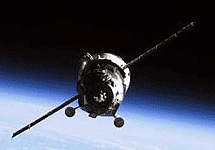
The reason for the fall of the cargo spacecraft "Progress M-12M" could be problems with the engine. "According to preliminary data, there was a violation of the motor installation, which led to its emergency shutdown," the press service of Roscosmos said. Earlier on Wednesday it became known that the “M-12M progress” could not be taken to a given orbit, after which he fell in the Choy district of the Altai Republic.
According to RIA Novosti, fragments of the ship fell in the taiga, where people could be. The explosion was heard at a distance of 100 kilometers. There is no data on victims yet, said the head of the Choysky district of Altai, Alexander Borisov. "The explosion was so power that for 100 kilometers from the windows almost the glasses were climbed. I have been living here for 40 years, we are used to the fact that the steps (launch vehicles. - Ed.), But there was never such a strong explosion," Borisov said.
Meanwhile, in Roscosmos they said that the accident would not affect the vital activity of the crews of 28/29 expeditions of the International Space Station. "The availability of food supplies, water and means of ensuring the life of life allow the functioning of the crew for a long period," the agency said in a statement. To investigate the reasons for the current situation, a commission was created from representatives of Roscosmos and organizations of the missile and space industry.
According to the source in the rocket and space industry, the convergence of the space truck from the orbit occurred due to the fact that he did not manage to gain the necessary orbital speed. “According to the flight cyclogram confirmed by the Roscosmos, it turns out that the cargo ship for 325 seconds did not separate from the third stage of the Soyuz Rocket Board. Therefore, after that, partially burned in the dense layers of the atmosphere, the ligament collapsed in Altai,” the agency’s source explained.
"Progress M-12M" was supposed to bring a standard set of goods to the ISS. The ship also had to deliver foods and water for the ISS for the crew, products, books, gifts, fuel in the tanks of the refueling system, medical equipment, linen, personal hygiene equipment, equipment for scientific experiments conducted at the ISS, cargo for the American food segment, including food products and sanitary-hygienic supports. The total mass of all delivered goods is 2.67 tons.
The launches of cargo ships "Progress" have been carried out since 1978. In total, more than 130 launches were carried out, all of them, to the present, were successful. Currently, the ISSs are shown to the ISS, Roscosmos Cosmonauts Andrei Borisenko, Alexander Samokutyev and Sergey Volkov, the astronauts of NASA Ronald Guarant and Michael Fossum, as well as the astronaut of the Japanese space agency of JAXA Satoshi Furukava.
On July 4, 2010, Progress M-06M, after an unsuccessful attempt, was attached to the international space station in automatic mode. On the first attempt, the Progress could not be attached to the station and flew past due to the refusal of the automatic rapprochement system and joining the course.
In August, work was temporarily suspended to prepare for launches of the Proton-M launch vehicles and Breeze-M Handicraft blocks. This happened after the Express-AM4 spacecraft was bred due to a malfunction for non-calculated orbit. The loss of "Express -AM4" is not the first failure in the space industry lately. In December 2010, as a result of the unsuccessful launch of the Proton-M launch vehicle, the three navigation spacecraft Glonass were not taken to orbit and fell into the Pacific Ocean. The loss of satellites led to personnel permits, in particular, the head of Roscosmos Anatoly Perminov lost his post.