
Translated material
Venue
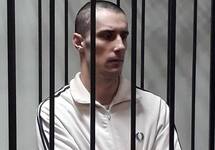
Ukrainian soldier Alexander Shumkov, convicted in Russia to 4 years in general regime in the Right Sector case, after delivery to Tverskaya IK-4 in Torzhok, was immediately sent to the schizo. This was announced on Monday night on her FB page Lyudmila Shumkova, aunt Politzeck, citing an unnamed Russian human rights organization.
At the stage from the pre-trial detention center-1 in Bryansk, the 29-year-old Shumkov was taken on March 21. The arrival of Politzek in IK-4 was not reported. It can be assumed that the road from Bryansk to the pre -trial detention center -1 to Tver, and then - took only a few days to the colony. In any case, the length of stay in quarantine (where, in accordance with the standard practice, the FSIN send all newly arrived prisoners under the pretext of the prevention of epidemics) is two weeks.
On March 29, another Ukrainian prisoner of the Kremlin was delivered to Torzhokskaya IK -4 - the Crimean activist Vladimir Balukh , sentenced to 4 years in 11 months of a general regime in fabricated cases of storage of cartridges and TNT checkers and an attack on a policeman. Just on April 8, reported by the Crimean human rights group, the sister of the Politzeck Nadezhda brought him a program with food and things, but the FSINOVS refused to pick her up, citing the fact that Monday was an “unusual day”. On Tuesday, the Baluha sister intends to again arrive in IK-4 to make a program.
In a conversation with the hope of the FSINOV, they said that her brother still remains on quarantine. Until the political prisoner is transferred to the detachment, they noticed, a date with him will be impossible.
As stated in the publication, earlier the CCG received information that the Baluha had already been sent to the schizo. However, the IK-4 administration did not confirm this information.
As for Shumkov, his aunt accused Ukrainian officials of inattention to the fate of Politzek. "From the Foreign Ministry and office of the Ombudsman they still send letters that he is in a pre -trial detention center in Bryansk," she wrote.
On March 27, the director of the Consular Department of the Ministry of Foreign Affairs of Ukraine Sergey Pogoreltsev in a letter Lyudmila Shumkova announced a refusal to state payment of advocacy services for the Politsek. The official explained the refusal by the fact that Shumkov seemed to not apply to those categories of prisoners abroad to Ukrainian citizens, to whom the resolution of the Cabinet of Council of Council guarantees state payment of legal assistance. In fact, in this resolution, among other categories, citizens "who are illegally retained in the territory of the aggressor state ... and/or are undergoing criminal prosecution of politically motivated charges."
The verdict of the Ukrainian was sentenced to December 4, 2018, the acting Chairman of the Sevsky District Court of the Bryansk region Viktor Rukhmakov ( 
According to the plot of the prosecution, Shumkov was in the “right sector” from November 28, 2013 (date of creation of movement) to August 23, 2017 and “for a long time” was the guard of its then leader Dmitry Yarosh. The last fact was emphasized in the case, testifies to the "significant role" of Shumkov in the PS. The activity of the movement was called "directed against the interests of the Russian Federation and encroaching on its territorial integrity."
Among other episodes of the case, the participation of Shumkov in September 2015 in the civil blockade of Crimea was mentioned. He was also charged with participation in a number of shares aimed at intimidating the inhabitants of the Kherson region, protesting against the blockade of Crimea and calling for the restoration of economic and political relations with Russia. "
It was claimed that Shumkov on his own initiative arrived in Russia, hiding from criminal prosecution in his homeland, and directly at the border post announced membership in the PS.
Politzek himself did not plead guilty. He pointed out both the distortion of facts and the fact that his persecution by the Russian authorities is unlawful in principle. “The main issue arises, which will be considered in the ECHR,” said Shumkov in the debate at the appeal: “does the court of one state have the right to make a decision regarding the organization in the territory of another state.”
In his testimony in the first instance, the defendant stated that Yarosh left the guard in early June 2014, and in November of the same year he left the “Right Sector” and entered the Ukrainian army (previously the release date was called on November 1). Meanwhile, the Supreme Court of Russia banned the activities of the PS in the country only on November 17, 2014.
Serving in the Ukrainian army, Shumkov reported in court, he was the interrogator of the military prosecutor's office of the Kherson garrison. Former colleague Mikhail Allanazarov, said Politsyk, handed him the contacts of a person whom he presented as an informant who has information about the drug supplier in the ATO zone. Allanazarov, who deserted from the Ukrainian army and received a temporary asylum in Russia, was the main witness to the prosecution in the Sumykov process.
According to Politzek, he phoned his face, which he was recommended as an informant. The meeting was scheduled in the city of Brovary, Kyiv region. As Shumkov said, he and the informant traveled to Brovary in the car, discussing the details of the intended control purchase. Next, the informant invited the soldier to smoke a cigarette with marijuana. Tighten, Shumkov lost consciousness. Waking up, he saw that there were still some people in the car, after which he lost consciousness again, and then came to his senses already in Russia. There, on August 23, his detention was officially issued; He stopped in touch with his family on the 17th.
Earlier, lawyer Farit Murtazin was different described by the course of events. He stated that Shumkov did not go to Brovary, but to the Russian border to meet with the informant. On the road, the soldier stopped the car and dozed off - then several unknown people burst into the salon and stunned Shumkov with blows and current from a stamper. The Ukrainian woke up already in Russia.
Initially, Shumkov gave a confession, reading a pre -prepared text on the video. In court, he explained: “It was complete prostration, absolute stress and shock, when I realized that I was in the hands of the FSB. I was given some documents under the pretext that if I sign it faster, I would be exchangeed faster for prisoners of war that are in Ukraine, and if I didn’t sign it, I didn’t return to myself alive.” He was inclined to give him such testimonies by the appointed lawyer Inna Ivantsova.
From the documents of the military unit of Shumkov, which were announced in the first instance, it follows that the soldier was really seconded to the prosecutor's office of the Kherson garrison. Nevertheless, the department denied that in the period from August 17 to August 23, 2017, Shumkov was on a business trip. After the disappearance of the soldier, the prosecutor's office opened a desertion case against him. It was also reported that back in June 2017, accusatory acts on the illegal storage of a gun, cartridges to it and psychotropic substances were transferred to the Kherson City Court in the Kherson City Court.
In May - June 2018, Shumkov kepta hunger strike in solidarity with Oleg Sentsov for several weeks.