
Translated material
The flag above the Bundestag
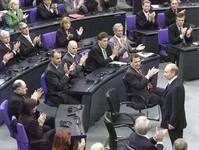
A record (three -day!) Visit to Germany Vladimir Putin began almost triumphantly. The triumph was prepared in advance and very carefully. Interview with the leading German publications and the ARD television channel, jointly with Gerhard Schreder, laying the wreath to the memorial to Soviet soldiers in Tyrgarten (before the chancellor did not take part in this event) and, as an apotheosis, a speech to the Bundestag deputies. First in Russian, then in an almost impeccable German, with a slight accent of the Higher School of the KGB.
The speaker’s speech was repeatedly interrupted by applause. A friendly laugh sounded a couple of times, and the president, smiling embarrassedly, entered a living dialogue with the hall. After graduating from the performance, Putin was awarded the applause, and the deputies clapped standing standing.
In itself, speech, read quickly and assertively on a piece of paper, did not contain many new thoughts. The message that the Cold War is over is late for at least ten years, even taking into account the recent cooling in relations with America. Detailed excursions in the history of Russian-German ties with the mention of the Russian queens and poet Pasternak, who translated the Fauster more than Goethe, were a pure tribute to the ritual. The calls to create "modern, long -term and reliable ... security architecture", without which the atmosphere of trust and the construction of united Europe are unthinkable, have heard more than once from Putin's mouths. Like the thoughts that Russia has long been in the front edge of the struggle "with international terrorists", without receiving any support from the West in its righteous Chechen war. The president’s phrase that he could not prove the danger of terrorism and the need for cooperation for a long time was curious, however, and now irrefutable evidence came from New York and Washington.
And he said very strictly, excitedly and convincingly that politicians were primarily guilty of American terrorist attacks. “We still have not been able to recognize the changes that have occurred in the world ... We still live in the old system of values, we are talking about partnerships, but in fact we still have not learned to trust each other,” said the President of Russia.
Perhaps these were keywords. Preparing for the performance, Putin knew that he would stand on the stands in front of people who, for the most part, did not trust him and are afraid of Russia. The American tragedy, among other things, gave the Kremlin a completely unique chance to play at anxieties and fears of any Western audience, including German Bundestag. Having learned the role of the Prophet who was not heard in the foreign Fatherlands, the president beat the patient himself and looked extremely sincere. The counter-terrorism style was observed in everything, from the first minute when Putin for some reason went down to the Berlin land on a military helicopter. And a little earlier, when he offered himself to the West as an ally on the new anti -fascist coalition, he studied the Russian security forces and leaders of the Duma factions from anti -American rhetoric and hinted that the “depth and character ... cooperation” with the West would depend on how NATO leaders would be imbued with our Chechen concerns.
Well, the style, successfully tested by Putin in the presidential campaign in his country, was also made for Europe. The reason is simple: today there are almost the same feelings as Russian voters after explosions in Moscow, Buinaksk, Volgodonsk are experienced by Europeans, Americans, and almost the whole world. And what has been done with Russian citizens, the Kremlin is trying to implement on a global scale. We are talking about the re -education of the West, which is already a little penetrated by counter -terrorism consciousness. The task is grandiose, what to say ...
As the deputies applauded, the Secretary General of the North Atlantic Alliance George Robertson said in Brussels that today Russia and NATO are more close than ever. The Chancellor Schroeder at yesterday’s press conference in foggy expressions even promised to revise the attitude to the Chechen war. These foggy expressions, especially on the eve of the next hearings in the PACE on the Chechen problem, truly impressed the exploding bomb.
How long these applause will last and this is the dullness of the minds, it is not easy to say. It depends on a number of circumstances, including the nature of the upcoming war and the number of response acts of the terror unnamed to this day. Of course, if desired, Western politicians are easy to solve the Kremlin game and accept it only to the extent that it is dictated by foreign policy considerations, realizing the simple difference between the rally of retribution and the PR massacre, which Russia leads in Chechnya. But today these topics and these contradictions are pushed to the background, and in Berlin Vladimir Putin feels almost a triumph.