
Translated material
The area of martyrs
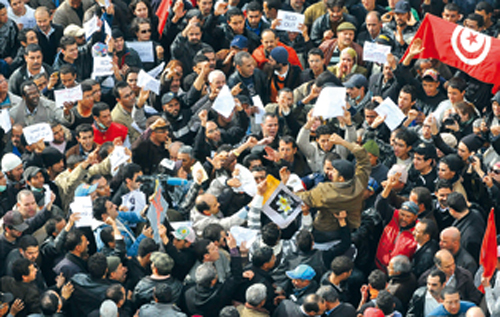
Demonstrators in the center of the Tunisian capital require the immediate resignation of all associates of the overthrown President Ben Ali
Report from the area of martyrs. Not a single city in Tunisia suffered so much from police repressions during the January mass protests as Casserin - a city on the border with Algeria. From police bullets, 16 people died there in three days of manifestations. But it was the young, for the most part, the people of Casserin gave the start of the revolution, which overthrew a long -term dictatorship. How it was - on the spot I recognized The New Times
What can be seen from Casserin today when looking at the capital - Tunisia? The acute desire to squeeze the associates of the overthrown President Ben Ali from the government apparatus - yes. But what else? Who will administer the crimes of the previous regime? But this is the main test for the new Tunisia, according to Casserin. “It cannot be such that they shoot people for throwing stones! This cannot go unnoticed! - convinced the author Adel Bakkari, an employee of the local magistrate. “The case must be explored by honest judges, someone must be responsible.”
Forgotten city
Casserin, located on the very border with Algeria, has long been forgotten. And it's not only in the January drama. At one time, the favorable economic situation in the country has largely developed thanks to the reforms of President Ben Ali, who liberalized trade and tourism. But in the casserin of the fruits of reform, it is practically not visible. Even the naval streets of the city are lifted with pits and potholes, most houses are terrifying. The only industrial facility in the city is a paper factory. Among the youth, it is not easy to find those who have a job. As in other regions of Tunisia, in Casserin, fierce protests broke out at first due to reigning unemployment.
Human Rights Watch discovered municipal and medical documents confirming the death of 16 people during mass protests. Dozens of others who fell under a police shell were injured. Foreign journalists have already called the events in Tunisia "Jasmine Revolution". But in Casserin Jasmine does not smell - only tear gas and gunpowder.
"This is Casserin!"
Among the dead is the 17-year-old Mohammed Amin Mbarka, the son of a mechanic. On the evening of January 8, he told his father that he was going to meet with his girlfriend. In fact, as his friend Hamza Mansuri said, the young man went straight to a demonstration of protest, which took place in those hours in the main square of the poorest region of Casserin - Zekhura. Hundreds of young men gathered here, loudly demanding to stop unemployment and "put Ben Ali to the wall." Everything happened unexpectedly. As Mansuri says, they stood nearby with Mohammed Amin, at some point looked at each other, and the next instant his friend was pierced by a bullet. Mansuri tried to find an ambulance, while others went to look for the father of Mohammed to tell about what had happened. “We were all in shock,” Mansuri, a stately young man engaged in trade shares his feelings. He says that his friend was shot by a police sniper: “Where did they (snipers) come here? There have never been here before! "
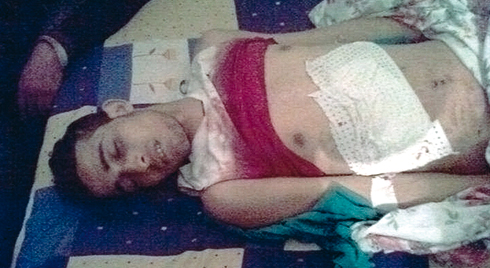
The police shot this young man on January 10 in Sidi Buzid
Residents of the Zekhur district named the place where Mohammed Amin died, the "area of the martyrs." The local young people vied with the author put their mobile phones to the author, on which they photographed chaos and the cruelty of the police. On one of the video is a scene in the intensive care unit of the hospital: a young man lies with a fragmented head, and everyone around shouts: “This is Casserin!”
Katafalk under the bullets
The day after the death of Mohammed Amin, a funeral procession was held through the “Martyrs' Square”. And again people watered tear gas, and again, from all over the corners, snipers shot. Then the heat with the body of the mbark turned back to get to the cemetery in the other way. At this time, Mansuri-he was here-noticed literally a hundred meters away from himself a fragile girl, 16-year-old Afaf Dorea, who was wounded in the leg. She had to be urgently taken to the hospital. The only free taxi was the one in which another murdered was taken. According to Mansuri, during the funeral, at least one person was killed, and at least five people died that day.
Afaf Daudy turned out to be a student. She said that she did not participate in the demonstration, but simply visited her friend and stopped in the square to say hello to his acquaintance. The bullet crushed her a hip bone. On the way to the hospital, she said, the police stopped them at the checkpoint. They missed only after they showed the dead man in the back seat.
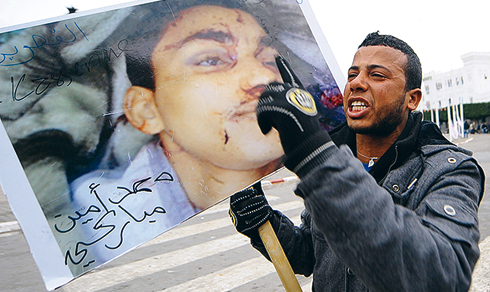
A resident of Kasserin with a portrait of the murdered Mohammed Amin Mbarka: "We will not forgive this!"
On January 10, two days after the death of a friend, Mansuri again came to the “Martyrs Square” - there was another demonstration here. He was wounded in the left shoulder: the bullet went close to the neck. “I would protest for the rest of my life,” he says.
That same evening, the police and snipers suddenly disappeared from the city. The angry residents of Kasserin set fire to several administrative buildings ...
Justice - now!
One of the most incomprehensible mysteries of the Tunisian uprising: the more snipers shot people, the more purposeful people became. And the authorities believed that the bullets would stop the humble people before. But they underestimated Casserin - this used to identify itself as a victim. And today he considers himself a focus of freedom. And its inhabitants want justice, not the "jasmines."
Sala Bin Nasr Mbarka, the father of the murdered boy, told the author that so far none of the officials was doing the murder of his son. And he wants a complete investigation, despite the fact that he does not have money for a lawyer.
Afaf Daudi, chained to the sofa during the treatment, looks at the situation with the skepticism: "Before what is happening in the casserin, nobody cares."
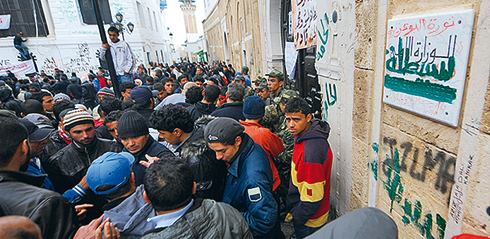
Young people from Sidi Buzid at the Premiere’s residence in Tunisia: “Killers-to answer!”
Mansuri with contempt speaks of the distant capital of Tunisia: “There they (new authorities) speak only about politics, and not about murders. As if they seized power during a fun party. “And he adds:“ Thieves must be expelled, and the authorities must immediately investigate the murders. ”
Mansuri is right. If Tunisia really wants to move forward as a state where the law reigns and human rights reigns, then transitional authorities are simply obliged to find and punish those responsible for the death of people as quickly as possible: both those who gave orders for murders and those who followed them. Otherwise, the disappointment and despair of Casserin will go to cynicism and a bitter sense of revenge. And as a result - in new violence.