
Translated material
Not to be confused with the Revolutionary Council
In the opposition
 Not to be confused with the Revolutionary Council
19 February 2013 Ilya Yashin
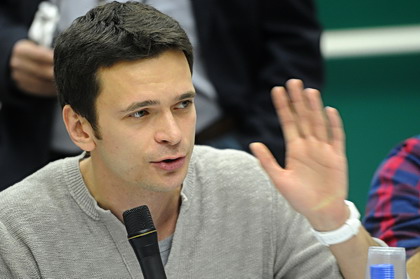
The next large protest action will take place in Moscow on May 5 and will be timed to the anniversary of clashes in Bolotnaya Square. Such a decision was made on Saturday by the coordination Coat of the Russian opposition. All forces and resources in the spring will be abandoned to prepare this particular demonstration.
I must say that disputes about how often the opposition should rally arise in the Constitutional Court from the very first meeting. From the left flank they are invariably called to arrange a kaleidoscope of protest activity: a month after the “march against the scoundrels” to organize a “procession against the executioners”, then “social march”, then “anti -corruption standing” and immediately a human rights rally. The liberal-conservative wing, on the contrary, demands to abandon the “rally” and adopt the theory of small affairs. The slogans, they say, only annoy people, we need constructive.
Polar points of view, however, give an understanding that truth is in the middle. The opposition, of course, cannot abandon street protest - simply because a more effective way of pressure on power in its arsenal has not yet appeared. But it is not worth the smell, arranging an infinite rallies and pickets, since the participants in protests for the most part are clearly not ready for permanent protest.
The KS still follows the Lenin principle “better than less, and better” and will focus on the preparation of the May demonstration. May 6 - a date that cannot be ignored. In addition, a lot of questions have accumulated to the authorities: from the promoted flywheel of arrests and up to the dust of the Olympic budget, to the dust of the Olympic budget.
Another hot discussion turned around the Magnitsky List. The very idea of personal sanctions, of course, does not cause disagreements: the ability to block foreign assets of Russian crooks and complicate their movement around the world, all oppositionists, regardless of political coloring. However, how correctly it is to contact foreign governments with a request to include this or that official in the “black list”?
The opposition can appeal only to public opinion, but not to the state structures of other states - part of the members of the Constitutional Court believes. Leave cleanliness, you need to make “black lists” and carry them to foreign embassies, this is Realpolitik - others answer. It seems to be stylistic disagreements, however, the subject of a serious dispute.
However, on this issue it was possible to make a completely compromise decision: the COP publicly nominated for the most odious representatives of the power vertical in the "List of Magnitsky". These were the head of the Central Election Commission Vladimir Churov, President of Chechnya Ramzan Kadyrov, the chairman of the Moscow City Court Olga Egorova and the head of the Investigative Committee Alexander Bastrykin. It was decided to abandon the format of official appeal to the US government, but the KS expressed its position on this issue quite clearly and there is no doubt that it will be heard both in Russia and at the international level.
In general, recently, many opposition supporters have been criticizing the Constitutional Court for the lack of dynamics and too long discussions of procedural and - it would seem, unprincipled issues.
Of course, I would like more dynamics and more coordinated work. However, it seems that the expectations of some voters associated with the activities of the CS do not fully correspond to the real content of this structure.
It seems that people often confuse the Constitutional Court with a kind of Revolutionary council - the executive body that must distribute directives, send commissars to the regions and formulate tasks to the opposition to the supporters of the opposition.
The CS cannot become such an organ for at least two reasons.
Firstly, civil activists are very different from the soldiers of the revolution and fundamentally do not accept the command-administrative style of communication. This means that even if the COP tomorrow really begins to send revolutionary directives, few will fulfill them. The real task of the KS is rather to stimulate the self -organization of “angry townspeople” than trying to make everyone walk in construction.
Secondly, representative chambers formed in the elections with several dozen participants in style and maintenance of work are more reminiscent of parliament than the executive branch. In ideologically homogeneous revolutionary, decision -making takes several minutes. In the variegated KS - up to several days. It is necessary to spend considerable time to coordinate positions and consultations on important issues.
However, what seems to be the weakness of the CS is actually his strength. Before our eyes, the protest and the formation of a fundamentally new political culture occur. Politicians of different flanks, authorized by tens of thousands of voters, lead a public dialogue and agree on topics that were not ready to discuss with each other before. The nationalist Thor and Antifacist Gaskarov do not catch each other in the gateway, but sit at a common table and talk. Discussions at times, of course, acquire an overly emotional character. But for that they are discussions, in the end.
There are, of course, losses, but they are mainly associated with objective reasons. The Presidential Administration by all means strives to divide the opposition into systemic and “irreconcilable”-the old tactics, tested back in 2007-2008. Therefore, under the pressure of the leadership of their parties, the KS left Oleg Shein (“Fair Russia”) and Ekaterina Aitova (Communist Party).
However, the pressure has the opposite effect: it ralves those who are ready to continue the struggle.
Photos of the hedgehog and ITAR-TASS / Sergey Karpov