
Translated material
Yanukovych's balance?
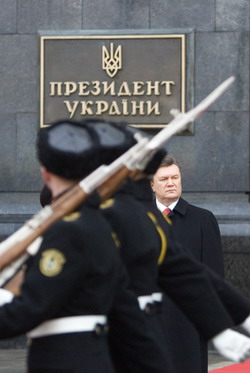 Yesterday's first meeting of the President of Ukraine Viktor Yanukovych with US President Barack Obama will surely attract increased attention of the Kremlin. Even despite the fact that in Moscow they knew about the persistence of Kyiv, who for a long time called the White House door, and maybe coordinated the position with Mr. Yanukovych in negotiations with Mr. Obama. Most likely, the point of view of the White House will be interested in Vladimir Putin and Viktor Sechin to a greater extent than the views of Viktor Yanukovych, who were indicated after three famous meetings in Moscow. However, other scenarios are possible.
The suffocating from the economic crisis Ukraine turned to the IMF with a request to allocate a loan and is vitally interested in the support of the White House. President Yanukovych will most likely discuss this issue with President Obama, as well as to provide Kyiv with additional financial assistance to Washington.
In this case, the Ukrainian leader will have to dwell on his doubts in detail whether or not to “surrender” to Gazprom Putin and Sechin and, if so, to what extent. Let me remind you that we are talking about a possible decision to transfer control of Ukrainian gas transmission networks to the Kremlin in exchange for a significant reduction in the price of the gas supplied by Russia.
But the position of the Ukrainian president at a meeting with Obama is not as weak as it seems at first glance. Mr. Yanukovych may well apply successful Yeltsin tactics: in the 90s, Boris Yeltsin scared the US President Bill Clinton, an intermediary in negotiations with the IMF, and the possibility of the Communists returning to power in Russia.
In other words, Viktor Yanukovych can hint Barack Obama about the need, for example, more active cooperation with Russia both in the gas region and in the issue of extending the term of the Black Sea Fleet of the Russian Federation in Sevastopol, which expires in 2017, etc.
Whether such a tactics will be successful, becoming a reality, it is difficult to say, because for this it is necessary to understand how much the administrations of the White House are important events taking place in the “zone of Russian interests”, which directly affects Europe. Especially when you consider that President Obama concentrates the lion's share of his efforts on the Iranian Front and his conviction of the need for new sanctions against Tehran requires not support for Moscow and Europeans, but voting in the UN Security Council.
You can also consider the meeting of Viktor Yanukovych with Barack Obama as an attempt to create some counterweight to relations with the Kremlin, but only with one amendment. The Ukrainian leader will rather behave not as President of Kazakhstan Nursultan Nazarbayev and his colleague in Azerbaijan Ilham Aliyev, but as the president of Turkmenistan Gurbanguly Berdymuhamedov. The latter, as you know, successfully used almost every visit to the representatives of the State Department to Ashgabat in order to raise the gas price supplied by Gazprom. Mr. Yanukovych can go the same way to achieve a reduction in gas value.
Three trips of Mr. Yanukovych to Moscow to clarify the position of the Kremlin and improve relations with Russia only partially shed light on his game. True, behind the Kremlin’s ears of the President of Ukraine for gas, a possible extension of the rental term of the Russian Black Sea Fleet, refusing to join NATO, and so on, things should follow. Especially considering that the Kremlin wants to get the whole of Ukraine immediately, and not in parts, including Kyiv’s exit from the WTO, which is necessary for the entry into the Moscow Customs Union invented by Moscow.
Unfortunately, Yanukovych’s one desire to balance the relationship with Moscow (unless, of course, it is really available) is not enough. It should also be taken into account by the fact that the Obama administration has so far chose a rather vulnerable, frankly weak position in relations with the Kremlin and in negotiations with “old” Europeans. In addition, negotiations on energy depversification ended, for example, with the “gas” Turkmenistan, where Washington still does not have an ambassador.
Europeans are not ready to angry Moscow at all, especially when they recall how they were frozen without gas as a result of the Kremlin’s aggressive actions. Low -income in negotiations with Russia and the lack of effective efforts to diversify gas supplies shows the real opportunities of European diplomacy.
So, Viktor Yanukovych, may try to get the support of Barack Obama in matters of allocation of the IMF loan and US financial assistance, at least which should become at least:
• rejection of the actual seizure by the Kremlin (Gazprom) of command heights in Ukraine, turning its president into the “British queen” and returning the country to the Imperial Lono;
• announcement of an open and transparent tender for the reconstruction of Ukrainian gas transmission networks with the participation of both American, European companies, and Gazprom or his “daughters”;
• postponed decision to extend the lease of the Black Sea Fleet of the Russian Federation;
• Attracting American firms to cooperation, for example, in the nuclear field, etc.
Mr. Yanukovych should understand that financial assistance does not happen for free, as well as a decrease in gas prices, if Moscow goes to it. Washington should answer the strict conditions set by the President of Ukraine in the Kremlin as tough.
Otherwise, firstly, it will be difficult to understand whether the president of Ukraine is a real political figure that defends the interests of Ukraine, and not Russia. Secondly, can he really balance between Moscow and Washington. Thirdly, this will show how much the Obama administration is ready to defend democracy, the interests of Europe and its interests, if any.
Photo by RIA Novosti