
Translated material
Corruption - 20. With hope ...
In society
 Corruption - 20. With hope ...
June 4, 2009 George Satarov
 The previous article ended with the thought that as corruption forms an extensive structure, a similar structure should form anti -corruption measures. This means that direct action measures against certain manifestations of corruption should be supplemented by measures in completely different areas - reforms in various areas of law, economy, taxes, finance, and management have a branched bunch of influences on various types of corruption. We are now talking about an extremely important factor that significantly affects the planning and implementation of anti -corruption policy, specific anti -corruption programs and projects. Therefore, it is useful to illustrate the above the thesis with specific examples.
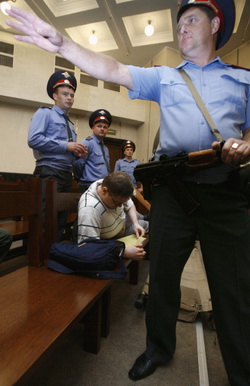
Let's start with the notorious and now discussed facts of various crimes committed by the police. Most of them are obvious manifestations of corruption in the sense that we gave it by the definition from the article “Corruption-3” . Indeed, any form of illegal violence against citizens is carried out using the powers (authorities) with which the police are endowed with the sovereign of the principal named people . As a rule, such violence is used by the police, in addition to other reasons, either for illegal facilitating the performance of their duties (example: torture during the investigation), or as a method of profit (example: illegal initiation of cases with their closure after receiving a bribe). This means that the police use the imperious resource received from us not for its intended purpose, but for his personal purposes. As a result of this, instead of ensuring the safety of citizens, the police become additional, and often - a dominant, source of danger. This means that the police betray the purpose of their principal. As you can see, we exactly fall into the definition of corruption. Moreover, these theft and betrayal entail additional negative consequences: shooting at citizens, drunk raids, even more turning the police into the main threat of citizens' security.
One of the reasons for this type of corruption is the complete absence of police dependence on its supreme principal: citizens. I am convinced, and often my position is reinforced by the position of some police officers that the decision should be sought on the path of the indigenous reform of the Ministry of Internal Affairs. In particular, it is proposed to completely tear the police from the vertical of the Ministry of Internal Affairs, turning it into a type of municipal service, like a sheriff service in the United States. At the same time, the head of such a service should be elected by residents of the municipality or appointed by its representative body, also freely elected.
It is clear that such a service should be financed from the municipal budget. Is it possible today? Of course not! And the main obstacle is the current tax system. Now it is contrary to the federal structure of the country and the independence of municipal power from government bodies. The pyramid of the current tax system should be turned from head to toe. The own tax base of municipalities should be formed, and the share of tax revenues to the municipal budgets should increase sharply. This is an example of a ligament between the anti -corruption measures that we talked about at the beginning of the article.
But let's move on. Let us think about what the tax base of municipal budgets can be formed. One of the possible options: to switch to the municipal level taxes, the collection of which is growing with the development of business. If we are talking about business, then there is an option when they are limited to small business or small and medium. Such a measure sharply increases the interest of the municipal authorities in the development of business. And this, in turn, will help reduce corruption generated by the pressure of the municipal authorities for business. Here is an example of another ligament.
Now I offer you another important example. I mentioned earlier that in our indema a large project is being completed, dedicated to the analysis of the transformation of the judiciary in Russia. One of the ideas laid down in this project is as follows. The functioning of the judiciary depends not only on its structure, specific norms describing the criminal or civil process, etc. (all this is called institutional design), but also from the functioning (including institutional design) of institutions and authorities associated with the court. Among them the prosecutor's office and the police. Those. It is again about various and not always obvious interactions between the authorities.
Consider such a phenomenon in the life of our courts as an indictment. An insignificant share of acquittals was also characteristic of Soviet justice. It is difficult to imagine, but now it is even less. Here is a story told to me more recently by one lawyer. Shortly before our conversation, he conducted a certain criminal case. Won - received an acquittal for his client. The judge was expelled for this “crime” from the judicial corps, and the case was aimed at repeated consideration. But the same thing happened the second time, with the same outcome for the second judge. The third judge, completely frightened, is praying, and persuaded the lawyer to the deal: the minimum possible conditional sentence. Exactive at large, but amazed in rights.
Let's proceed from how many philosophers and sociologists do this, what the court provides citizens with justice services. In our case, the courts are not a source of justice, an independent referee, as we need, citizens, the supreme principal. Instead, the court forms part of the unified punitive machine of the state. It is this fact that is reflected in the maximum indictment (I mean, first of all, criminal proceedings). Thus, we can state: the courts (of course, partially) betray the purpose of their principal. Have you already understood where I am getting? Great! We move on.
And for what and why do the courts betray the purpose of the principal, which leads to a hypertrophied indictment? The answer is a combination of psychological and institutional factors. On the above example, we see that one of the reasons is fear. But in the same way, other motives can serve as the basis for the submission of a punitive machine - good, career growth, etc. All these motives are not connected with justice or the law. So, we see that judges often betray the interests and goals of the principal and use the power handed by him to achieve their own goals. We again got into the conditions for determining corruption.
But back to the institutional reasons for this type of corruption. There are a lot of them. At the macro level, the basic cause is a deficiency of independence of ships and judges. But if you understand more in detail, you can find a lot of unexpected. Imagine what will happen if the activities of the police and the prosecutor's office are evaluated by some abstract numerical indicators, on the significance of which career growth, title, salaries, bonuses depend? As always and everywhere, people will begin to work for these indicators. There is simply an inexorable law of nature. And if the number of such indicators includes the share of convictions in the courts in excited and transmitted cases? The answer is also obvious: the police and the prosecutor’s office will become in all possible ways to cooperate with the courts, to influence them in order to increase their indicators, and with them - the indictment, and with it, reduce the justice of justice. Probably, no need to explain that this is just our case.
Of course, I spoke only about one of the many factors. But we still do not design a program to strengthen the independence of ships. It is only about the complexity and diversity of the connections between inefficients in different areas of state regulation and management, which together lead to corruption and its side negative effects.
The main conclusion that we must draw is this: the anti -corruption policy cannot be reduced to a primitive set of measures, each of which is aimed at its appearance. Alas, this does not happen, and if it happens, it does not give a result. Countering corruption is a complex, extensive multi -link system, which, moreover, should be constantly analyzed and corrected during the implementation of anti -corruption policy. After all, corruption, as a living organism, reacts to our effects, tries to evade, adapt and not give up. That's what a difficult picture. Where is there: “Corruption!? Yes, you just need to take it and ... ".
What follows from this if we return to our basic question “What to do?”. And the fact that the anti -corruption policy should include the following necessary components:
Deep diagnosis of the corruption situation in the country.
The determination of the main subject of anti -corruption policy, possibly - the authority responsible for its implementation.
Development of an anti -corruption policy strategy.
Development and implementation of specific plans and programs.
The introduction of a monitoring system of the corruption situation, the results of which should affect the constant adjustment of plans, programs and, is possible - strategies, as well as an audit of the implementation of plans and programs.
In the following publications, I will dwell on each of the above points, limiting myself, of course, the framework of the genre of journalism.
To be continued
Author - President of the Indem Foundation
Photo by RIA Novosti