
Translated material
The results of the year. People and non -resident
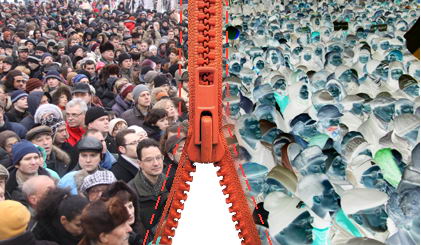
In 2010, much did not happen. It was not clear which of the two diarkhs would go to the following presidential elections (however, this was not expected). Not a single new political party was registered - their number froze seven on the magic figure. But United Russia safely won all regional elections, and in the political “party”, which is federal, they are discussing their two possible scenarios - whether the “United Russia” will win with the constitutional majority or absolutely.
But this does not mean that the year was uninteresting. Of the new domestic political phenomena, the most important thing is a change in the attitude to the Ned -Range. This term is due to the fact that the Russian government from imperial times informally divides the population subordinate to it into “people” and “non -resident”. The people believe the state and the sovereign, they are sincere, patriotic, modestly, sometimes sometimes naive, but internally wise. “Negro”, on the contrary, consists of suspicious people, too many thinking about themselves, prone to criticism and, therefore, unreliable. The sovereign’s task is to rule his people, neutralizing the “non -resident” who tries to confuse these loyalists or even rebell. In 1906, the tsarist government, guided by these ideas, formed the Duma from the "peasants", but the case ended deplorable; I even had to change the electoral law steeply (two -thirds of the number of electors were received by the landowners and a large bourgeoisie). At the end of the existence of the USSR, the most orthodox party members dreamed of the moment when factory workers say their weighty word in defense of the state and building. They did not wait.
The bewilderment of Julia Latynina about why Vladimir Putin is so selectively approaching the solution of acute problems, finds his explanation if we accept this logic as relevant to this day. The people are their own, the "Putin majority." Of course, he is not idealized as it was at the end of the century before last and even a couple of decades ago. Especially taking into account the fact that the same people who voted for Putin, and before that they supported Yeltsin, Zhirinovsky, Swan, then put up with the collapse of the USSR, then began to nostalgic for the lost value. The people have to more actively and carefully care for being loyal - the underestimation of social psychology can lead to dramatic consequences, as happened in the first weeks after the monetization of benefits. But the people are recognized as the right to emotion if it does not go beyond the limits of certain frames (each time redrawn, depending on the situation) and dictated by sincere patriotic feelings.
I will give a “football” example, but not modern, but historical. In the memoirs of the famous Spartak football player Andrei Starostin, it was said about the sad return of our national team after the Chilean World Cup of 1962 (then Andrei Petrovich was the head of the team). In Vnukovo, the players first insulted a local loader with a bad word. The players blushed, but said nothing - has the right. After some time, Starostin - already in an individual quality - ran into a man, “from a needle dressed”, “with a pack of foreign cigarettes”, which began to explain to him the backwardness of our football compared to foreign. Starostin reacted in a completely different way to this interlocutor, not recognizing him the right to criticize. The images of the “people” and “inado”, thereby, went beyond the ideas of power, turning into more common stereotypes. Moreover, if, under the “non -city”, power, as in tsarist times, usually understood the intelligentsia, then the people themselves are most often bureaucracy. In the case of Starostin, for example, it was clearly not about the intellectual, but about the nomenclature of the middle hand, which had the opportunity to go abroad (which was unrealistic for numerous "dislike" intellectuals).
Moreover, in relation to "folk" youth, there is even the term "overwhelm." Let the guys from the city outskirts are defiantly “zig” at the age of 15-16-but soon they will have an army where Comrade Sergeant will beat out of them, explaining that Comrade Zhukov is better than Herra Hitler. And there they will return, go to work, get families, become normal citizens. Hence the rather calm reaction to their actions, unless, of course, they do not reach the deadly, as a well -known gang of market and its analogues. The authorities belongs to the “non -aged” youth, which is “infected” with pacifism and democracy, which makes it “alien”.
Putin reacts acutely to the discontent of the people (in his understanding). For example, in 2009 in Pikalevo, and in December 2010-in communication with the leaders of fan clubs. The opinion of “Nearby” (of course, understood as an intelligentsia) does not matter to him - it was clearly manifested in conflicts around NTV and Yukos. Medvedev, for the first time in a decade, began to pay attention to the signals emanating from “Nerdoda”, and we are talking not only about words, but also about some matters. Back in 2009, many prison officials were dismissed, including its boss - this happened after the Magnitsky case. This year, the president intervened in the solution of the issue of Okhta Center, which led to the transfer of this project. The situation with the Khimkinsky forest - Medvedev suspended the work, but a few months later decided to resume them. At first glance, social activists who opposed his deforestation lost, but this story can have more large -scale consequences. Now, officials will have to respond to the wishes of civil society before the implementation of the project - in order to avoid the scandal in a situation where the project is almost impossible to turn back. We draw attention to the fact that the new Moscow authorities are much more accurate to relate to relationships with Archnadzor than their predecessors.
We also note the position of Medvedev in relation to the media, expressed during an interview with the leaders of the television channels. It is generally accepted that the people of the current television are quite acceptable - when they sees filtered news on the screen, and then Petrosyan with Kirkorov. “Negro” needs another television - with real discussions, different points of view, with the lack of a taboo to discuss complex topics. Obviously, in this case, the president expressed an understanding of the opinion of the “active minority”. From the same series, the permission of rallies on the 31st of the 31rd, and the deviation of the most odious provision of the bill on rallies, which actually prohibited many oppositionists to be their initiators.
Of course, Medvedev cannot only be the president of this minority - in the end, the majority voted for him. In many cases, Medvedev rightly meets the majority - as, for example, in the situation with pregnancy benefits and childcare. However, attention to the "Nearless" is already significant. Moreover, it seems that it is connected not only with the presidential mentality. Another thing is more important - while the economic situation seemed predictable and cloudless, at least until 2020, it was possible to neglect the "non -war", relying on the electoral majority. In the new situation, a “smart” economy will be required, impossible without people who do not know how to “walk” - and ignore the opinion of although a weak, but existing civil society, is becoming increasingly difficult.
What next? It seems that the Medvedev course has a big problem - it is moderate, evolutionist, and, consequently, is sharply criticized from different sides. Some believe that Medvedev auditing the heritage of the “glorious” 2007 with the siege of the Estonian embassy, anti -Western rhetoric and anti -libella campaign during the plebiscite elections. Others were unhappy with the president for not having fired the prime minister, did not release Khodorkovsky (about how they released Bakhmin, who did not testify against his former boss, they had already forgotten), did not dismiss the Duma and, in the end, did not add up the authority. Another problem is the disbelief that power is capable of serious, not imitation changes. The question is whether Medvedev will be able to create a pragmatic coalition for modernization in this situation, which can provide the president with real support. And which will include active representatives of the Russian people, indivisible to parts.
Author-First Vice President of the Center for Political Technology
Collage hedgehog