
Translated material
The mummy killed tuberculosis
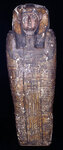
British researchers, apparently, managed to put an end to the question of the causes of death of the 2600-year-old Egyptian mummy from the British Museum , first described in 1825. This mystery tormented scientists for almost two centuries (publication in the journal ProChedings of the Royal Society B ("Royal Society - Biology") - DOI: 10.1098/RSPB. 2009.1484).
We are talking about the first mummy in the history of the Mummy (the remains of a fat fifty-year-old woman from Thebes, found 6 years before), who was subjected to scientific opening on the table of the Italian doctor and the pathologist Augustus Granville (Augustus Bozzi Granville, 1783-1872), which made the corresponding description for the London Royal Society. The hieroglyphs on the wooden cover of the sarcophagus talked about the fact that we have Irtyersenu , the "mistress" ("housewife"). She lived during the 26th dynasty, around 600 BC. It did not belong to the highest strata of society, however, its poor family could not be called (rich jewelry and drawings testify to this).
The question of the death of this mummy made it one of the most famous and discussed among all the ancient Egyptian mummies, and the autopsy of Dr. Granville laid the foundations of the scientific study of the mummies of Egypt. Granville then came to the conclusion that the woman had repeatedly gave birth and died of ovarian cancer. However, twenty years ago, the remains of the mummy were again disturbed and subjected to a new study. It turned out that the tumor was actually benign (benign cystadenoma (cyst) of the ovaries) and therefore could not cause death. Then, the mummy found signs of other diseases - malaria and some acute inflammatory process, which could be caused by both pneumonia and tuberculosis.
It was very difficult to resolve this issue to finally resolve this issue - because of the method by which the woman is mummified . During the usual mummification, the internal organs were either removed and kept separately in special vessels (canopies), or using an enema, a potent chemical solution was introduced into the anus, which decomposed the insides directly on the spot (the brain was removed through the nostrils with iron crocheted). However, Granville’s mummy was in this sense “non -standard” - it was covered with a soft, brown, with which it is extremely difficult to work with. The oily substance has still blocked any possibility of molecular analysis and DNA extraction.
However, now the HELEN DONOGHUE infectious diseases from the University College London London London ( UCL ) and its University of Birmingham have used the combined method of DNA amplification and recently The developed methodology for the search for repeating fragments of DNA of mycobacterium tuberculosis ( Mycobacterium Tuberculosis , found in the tissues of the lungs, bones and gall bladder). At the same time, biomarkers, specific to cell walls of bacteria in lungs and bones, were also found. In their aggregate, these findings clearly indicate the path of the spread of tuberculosis infection - from the lungs to other parts of the body. In ancient Egypt, such a disease could not but lead to a fatal outcome, according to Donhau.
It should be noted that specialists in Paleopathology - a science involved in the investigation of the causes of the death of ancient people - previously suggested that tuberculosis could be widespread in the country of pharaohs.
The scientific group, however, could not resolve another riddle and accurately recreate the process of the mummification of the "mistress". It is noted that during the famous public lecture, read by Dr. Granvil in 1825, this doctor suggested that the deceased for preservation was immersed in a tank filled with hot bee wax mixed with bitumen. And to confirm this thought, he lit a candle made from the collected substance at a lecture. However, the latest study did not find evidence of the presence of wax or bitumen. Scientists suspect that instead of wax, Granville collected another substance called a fat (cadaveric wax) - it is formed as a result of the destruction of fat during the decomposition of the body. So the question of the material of the mummy remains open.
Sources:
DNA TESTS ON MUMMY Show Tb Killed Ancient Egyptian - New Scientist
Fresh Autopsy of Egyptian Mummy Shows Cause of Death Was Tb Not Cancer - Guardian
DR Granville's Mummy Was Killed by Tb, Not a Tumour, Researchers Reveal - Times
Tb The Culprit in the Great Mummy Whodunnit - AFP
Mummy Autopsy Result 'Was Wrong' - BBC News