
Translated material
Terry chronicle
Every day, new terrifying Russian crimes in Ukraine are opened. Exhumation in the Izyum tract has been completed. Evidence is collected in torture prisons. UN experts confirmed the facts of rape of young children.
On September 23, in the raisins of the Kharkov region, the exhumation of the bodies from mass burial ended. According to Oleg Sinegubov, the head of the Kharkov regional military administration, 436 tel was taken out of there. Most of them have signs of violent death, 30 bodies with traces of torture. Most of the dead are civilians, 21 - military.
"There are bodies with a rope on the neck, with broken limbs and with gunshot wounds. Several men are amputated with genitals. All this is evidence of terrible torture that the invaders subjected to the inhabitants of Riser," Sinegubov notes.
According to Sinegubov, this burial is not the only thing in raisins: there are three more in the same area; There are mass burials in other liberated cities of Kharkiv region.
In the liberated cities and villages of Kharkovshchina, the investigation works in the premises where the invaders arranged torture. In the Izuyum police department, for example, Ukrainian investigators found magazines with a list of detainees who were served by the Russians, as well as the instruments of torture - electric cables. Investigators study every camera where people were holding - they seize DNA samples and fingerprints, collect evidence for the court.
“In dark basement cameras, people were from several weeks to months, not always understanding what the invaders want from them,” Bulvinov noted. “As always, wherever there were rashists,“ landfills. Empty bottles, boxes, mattresses, rags unequivocally indicate that Russians lived here. ”
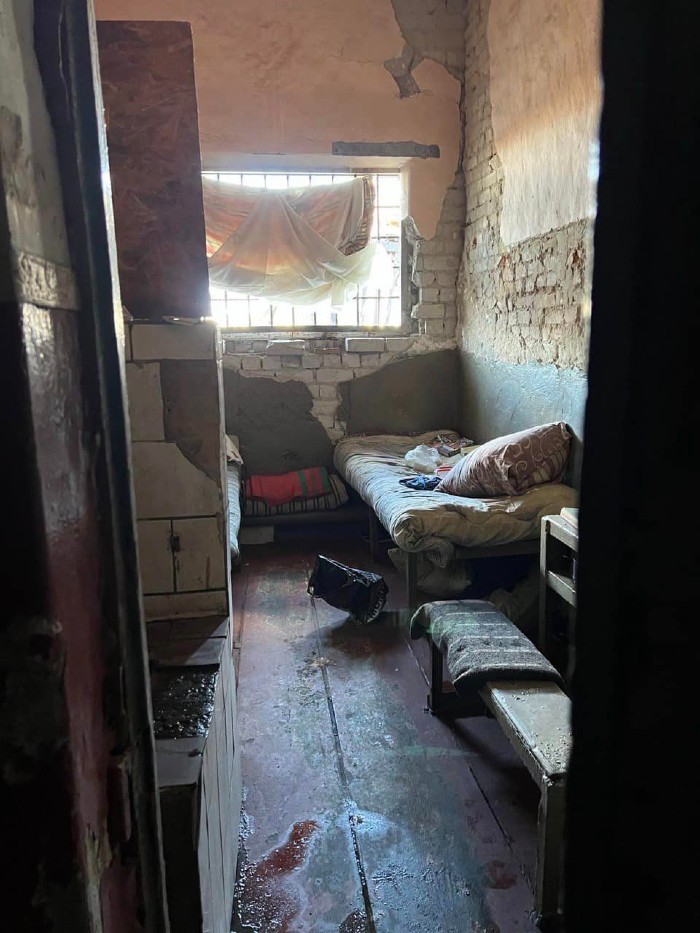
Two more torture were in the Cossack Lopani - in the basements of the railway station and the store.
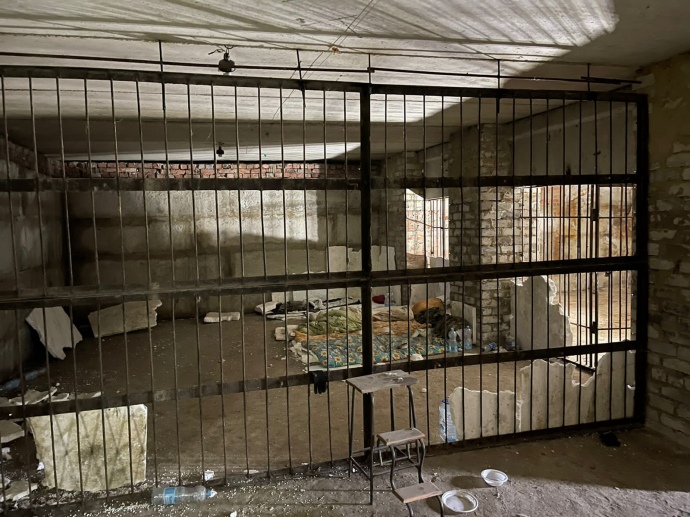
About the torture prison in the Balakli, 69 -year -old Anatoly Garagaty spoke to our specialist - he spent 100 days in captivity for the invaders.
On September 26, the SBU published a photo of the torture basement in the village of Liptsi, in the office of the LPR People’s Police. There, Ukrainian patriots were subjected to cruel torture, after which they were exported to the territory of Russia.
***
Ukrainian prisoners of war are subjected to inhuman circulation. Long -term rehabilitation is to the defenders of Azovstali, who returned to their homeland as a result ofthe last major exchange . “Everyone is really in a completely different state. There are those who are physically in a more or less normal state, with the exception of chronic malnutrition associated with poor content conditions. There are persons who were applied to very cruel torture. Unfortunately, the percentage of such persons among those we returned is large enough,” said Kirill Budanov, head of the Main Directorate of the Ukrainian Ministry of Defense. According to him, the Ukrainians were in captivity differently - this depended not on the "category" of the prisoners, but on the places where they were held.
The head of the Ministry of Internal Affairs of Ukraine Denis Monastyrsky said that some of the released prisoners are in the hospital in the Chernihiv region and “in fact, they need to need medical rehabilitation, and“ absolutely everything ”in psychological rehabilitation. According to the head of the Azov Patronet Service, Elena Tolkacheva, many liberated Azovites have an extreme degree of anorexia. "The state of our military is simply shocking. There are cases when relatives cannot recognize their relatives. Our guys are exhausted, shell -shocked, very many hidden fractures and exacerbations of varying degrees of chronic diseases," says Tolkacheva.
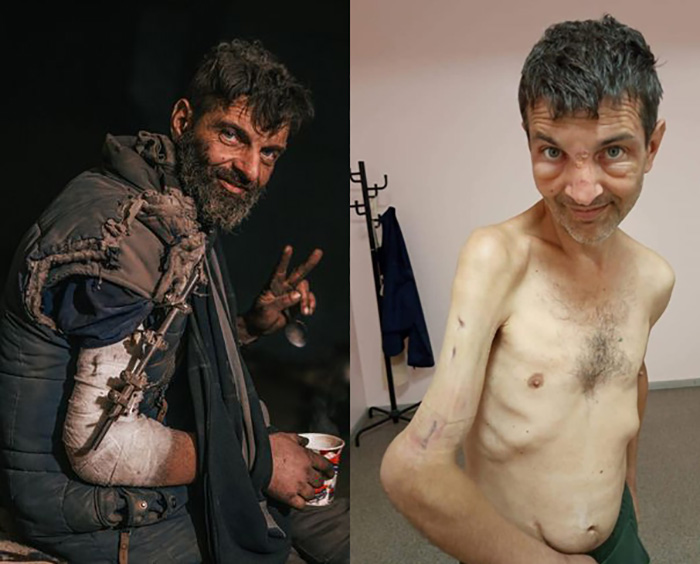
Defender "Azovstal" Mikhail Dianov before and after captivity
As a result of the attack in the colony in Elena, which the invaders tried to pass off the Ukrainian blow,more than 50 Azovites died . On September 18, the “DPR Terborne Headquarters” said that the Ukrainian troops allegedly inflicted a new blow to the colony: one died and five prisoners of war were injured.
Briton John Harding, a 59-year-old paramedic freed from the DPR captivity, in an interview with The Daily Mail, said that he and his comrades were regularly beaten and tortured with electric shock, for which the electric hills for livestock and old telephone devices were used. Together with Harding, the British were captured by Aiden Aslin, Dylan Hili, Andrew Hill, Sean Pinner and Paul Uri. According to Harding, Uri died before his eyes - he was captured by medicines.
On July 15, the Ombudsman of the DPR Daria Morozova reported that Uri died five days earlier. She called the cause of death “diagnoses and stress”: Uri had insulin-dependent diabetes, damage to the respiratory system, kidneys and a number of diseases of the cardiovascular system.
In September, the head of the Foreign Ministry of Ukraine Dmitry Kuleba said that Uri's body was returned to Ukraine with traces of "unthinkable torture". As the Ukrainian Ombudsman Dmitry Lubinets specified , the corpse does not have some parts of the body and there are numerous cuts and traces of torture that "a person simply could not bear."
The 45-year-old Uri, the volunteer of the Humanitarian NPO Presidium Network, was detained on April 25 at the checkpoint in the Zaporizhzhya region.
***
The UN special commission documented the facts of monstrous crimes committed by the invaders in late February and in March in the Kiev region, Chernihiv region, Kharkovshchina and Sumshchina. More than 150 victims and witnesses in 27 settlements were interviewed.
The Chairman of the UN Commission Eric Moze informed the UN Human Rights Council that the Russian military committed crimes related to sexual and gender violence. The age of the victims of such crimes is from 4 to 82 years. In some cases, relatives were forced to be present in rape.
Oonian experts documented beatings, current torture, and anyless executions.
The report says in detail about the use by Russians of an explosive weapon with a wide area of defeat in civilian infrastructure - the destruction of schools, hospitals, residential buildings.
On September 18, the Russians fired at a psychiatric hospital in the village of Strelcha Kharkov region at the moment when evacuation began. 30 patients managed to withdraw from the building, there were more than 600 of them. 4 medications were killed, 2 patients were injured.
The investigation of Russian war crimes in Ukraine is engaged in a number of international structures in coordination with Ukrainian law enforcement agencies.
The Ukrainian journalist Stanislav Aseev, who went through the torture prison at the DPR, was created by the Fertifier Initiative , which offers the remuneration for information about Russian war criminals. According to Aseev, the fund will cooperate with Ukrainian military intelligence.