
Translated material
Sumo fight
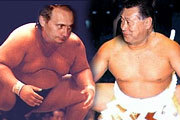
The territorial dispute of Moscow and Tokyo can be compared with the Japanese struggle of the sumo : two heavyweights, clutching each other, stomp on the spot. In this devoid of external dynamics, but complete inner drama of the competition, you need to push the opponent beyond the borders of a rigidly defined circle. On December 31, 2000, the next round of this more than half a century of duel ended to no avail.
After in November 1997, Boris Yeltsin and the Japanese Prime Minister Rytaro Hasimoto at a “meeting without ties” in Krasnoyarsk promised to make maximum efforts to sign a peace treaty by 2000 ”, many in Russia and in Japan regarded this as a very specific signal: two leading powers of the Asia-Pacific region will enter the third millennia, Finally settling the territorial problem.
However, this did not happen. During the unofficial meeting of the two leaders in Cavan in April 1998, the discussion of a peace treaty took no more than 15 minutes. The Japanese prime minister tried to compensate for the complete absence of any movements from the Russian side with a new idea called the Hong Kong version: Russia recognizes the Japanese sovereignty over the southern chicken, but it may have been preserving administrative control over them for some long time. Moscow rejected this idea.
Having trodden after Krasnoyarsk on the spot for more than three years, neither side was able to push the opponent out of the circle of his own principles. Meanwhile, a combat draw in the last round of the "dialogue of the deaf" can turn into a general defeat. In both capitals, they say louder that after the “line of 2000”, Japanese-Russian relations will enter the new phase: the era of Friendship “Boris and Ryu” will be replaced by the era of the “cold world”.
Outwardly, everything looks quite encouraging: the replaced Yeltsin Vladimir Putin managed to meet with Japanese Prime Minister Josiro Mori in less than a year, which became an absolute record in bilateral relations. The first meeting of Putin and Mori took place in St. Petersburg in April, the second at the Grand Eight summit in Okinawa in July, the third in September to Tokyo, during the official visit of the Russian president, and finally, in November, at the APEC summit in Brunei.
However, as you know, the quantity does not always turn into quality. Already the September visit of Putin to Tokyo originated the Japanese with serious doubts about the magic of the number 2000. With all the abundance of signed agreements (15 documents), the Tokyo summit did not bring the parties to the elimination of the main stimulus in bilateral relations. The disappointment of Tokyo immediately resulted in a spy scandal with the Russian naval attache. There has been no such incident since the 50s when bilateral relations have been in a state of "cold world".
As before the end of 2000 there was less and less time, in the statements of the Japanese side, annoyance began to break through more and more. “It’s a shame that we are entering the XXI century without a peace treaty,” the official representative of the Japanese Foreign Ministry Kavamur, who flew to Moscow with the Minister of Foreign Affairs, Iohae Kono, complained in an interview with Russian journalists. Two weeks before the New Year, Kono himself in Tokyo said that he did not understand the Russian position, and said that he would come to Moscow on January 16-17, 2001 (and not in December of the outgoing year, as expected earlier). Thus, the head of the Japanese foreign policy made it clear - in Tokyo finally parted with "Krasnoyarsk illusions."
Four South Kourillas, Kunashir, Shikotan and Habomai, belonged to Japan 90 years under the Russian jurisdiction, belonged to Japan 90 years before the Soviet army was captured in August -September 1945. The logic of the Japanese side remains unchanged - it is necessary to restore historical justice and return the islands of Japan. The Russian position has undergone some changes: from the Brezhnev formula, the "territorial problem is not" to the Gorbachev-Ultsin recognition that the problem exists and needs to be solved. Putin's diplomacy will hold the same position.
However, today this is not enough. Moscow and Tokyo approached such a stage when you can cut the gordelee only by stepping on the throat of their own song and showing remarkable political will. Who should do this - Japan or Russia? Each of the parties expects that the opponent will make concessions. Sumo's duel continues.