
Translated material
A suitcase without a pen
About why Moscow’s attempt to fasten the allies on the organization of a collective security agreement (CSTO) to its Syrian campaign ended in failure
On July 4, the Kazakhstan capital of Astana opens the next round of negotiations on the Syrian settlement under the auspices of the warrants-Russia, Turkey and Iran. The round promises to be more interesting than the previous ones, since it is on it that it is necessary to discuss the mechanism for the deployment of foreign peacekeeping military contingents, including, of course, Russian, in several provinces of Syria. The attention of the media and observers to negotiations was provided in advance. On June 22, the official representative of Turkish President Ibrahim Kalyn at a press conference in Ankara made a real sensation, announcing that Russia, Turkey and Iran are already consulting with each other on the distribution of certain “influence zones” in Syria. Moreover, Jordan and the United States are also involved in this process. “We expect that we and the Russians will be mainly in Idlib ( Idlib Province, which is under the control of the Syrian opposition. - NT),” Kalyn explained, “Russians and Iranians in the vicinity of Damascus, in the south, in Deraa - Jordanians and Americans.” After that, the Turkish official voiced an interesting detail: Moscow, it turns out, has already offered to send de -escalation to the zones that have yet to be created in the Syrian Arab Republic (SAR), military from Kyrgyzstan and Kazakhstan.
"We did not discuss it"
To the statements of the Turkish representative, the chairman of the Duma committee on defense, former the commander-in-chief of the airborne troops, Vladimir Shamanov, immediately responded to the statements of the Turkish representative. He not only confirmed the fact of negotiations with Bishkek and Astana on sending troops to Syria, but also said that the question of sending Russian units for a peacekeeping operation was being worked out.
And here it has already come to react for Kazakhstan and Kyrgyzstan. Moreover, the reaction was quite defined. “Kazakhstan does not negotiate with anyone about the direction of his troops to Syria,” said Kairat Abdrakhmanov, head of the Kazakhstani Foreign Ministry. He made it clear that if Kazakhstan, if he sends his peacekeepers to some hot point on the globe, then only if there is an appropriate resolution and the UN mandate. This is a “fundamentally important condition,” Abdrakhmanov emphasized.
And the President of Kyrgyzstan Almazbek Atambayev, who had just visited Russia on an official visit, was even more defined. “This question was not raised at all. At narrow meetings, Vladimir Vladimirovich and I had dinner for 2.5 hours, the question was not raised at all, ”Atambayev emphasized. And he immediately described the decision-making procedure on sending the Kyrgyz peacekeepers abroad, as “a very difficult thing”: “... if this issue rises someday, then for him, firstly, the decision of all CSTO countries, the UN resolution, and then the country's parliament finally decides.”
“If Kazakhstan, if he sends his peacekeepers to some hot point on the globe, then only if there is an appropriate resolution and the UN mandate”
However, the topic arose, of course, not from scratch. Some negotiations, most likely, unofficial, went to this subject. This was actually recognized by the secretary of the Security Council of Kyrgyzstan Temir Dzhumakadyrov. According to him, earlier the question of sending troops "rose at the CSTO site." “It was about the peacekeeping contingent of the organization that could be sent to the de -escalation zones in Syria,” the Kyrgyz official said, making a reservation, however, “there were no official proposals.”
Dangerous de -escalation zones
Recall that negotiations in Astana on Syrian settlement have been going on since February 2017. Five rounds have already passed. During the fourth round, in early May, representatives of Russia, Iran and Turkey who took on the role of the guarantors of their declared truce in Syria (which, by and large, did not comply with any of the parties to the conflict), signed a memorandum of the creation of four de -expedition zones, where military operations will not be conducted and where civilians can be able to be in. The de -escalation zones include the Idlib province, partially - neighboring provinces of Latakia, Hama and Aleppo, a number of territories in the north of the provinces of Homs and East Guta and some areas in the south of Syria - the province of Deraa and Kuneitra. In fact, these zones are controlled by a moderate armed opposition, which Russia, Türkiye and Iran do not consider “terrorist”.
And now in Astana it is necessary to discuss the mechanisms of control over these zones. This task is very difficult. The experience of organizing such zones suggests: immediately after it is announced that combat operations will not be carried out in some areas, including aviation, the opposing parties immediately begin to use the lull to reform and replenish reserves. It is not difficult to assume that in the de-escalation zones controlled by moderate groups, radical groups, such as "Jebhat al-Nusra"*, will immediately try to leak. And then conflicts for control of these zones will immediately begin. Therefore, those who will protect them are doomed to participate in hostilities and, therefore, suffer losses.
Candidates for participants in the peacekeeping coalition are not at all going to supply the country's countries-Russia, Turkey and Iran-cannon meat
It is no accident that the states that proposed the creation of de -escalation zones would like to reduce their costs to ensure security there. That is why, according to informed sources, along with the traditional placement of peacekeepers directly on the boundaries of the zones, a rather exotic option is also being discussed - to place peacekeepers in two special centers in Russia and Turkey, from where they will fly out where the violations occurred. In practice, this option means that it is possible to control these zones who will be able to place the maximum number of armed people there. So the desire of the guarantor countries to attract other states to a peacekeeping operation is understandable.
However, candidates for participants in the peacekeeping coalition are not at all going to supply cannon fodder to guarantor countries. The already mentioned head of the Ministry of Foreign Affairs of Kazakhstan spoke quite frankly on this score: the issue of ensuring the effectiveness of the four de-escalation zones in Syria is in the competence of the Garant countries of the Astana process, that is, Russia, Turkey and Iran.
Ostentatious unity
The position of Astana and Bishkek looks quite rational, if not for one significant circumstance. Russia announced their involvement in the peacekeeping operation in negotiations with Iran and Turkey, therefore, was sure of their readiness to start deploying in Syria.
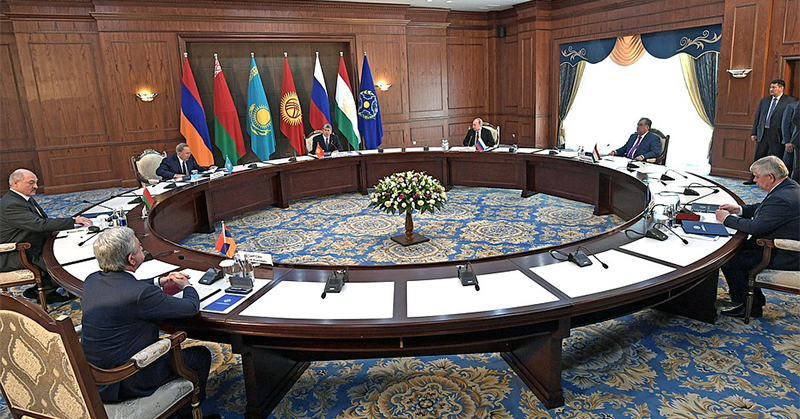
Kazakhstan and Kyrgyzstan are members of the Organization of the Treaty on Collective Security, that is, the military allies of Russia. During regular meetings, the political and military leaders of Russia, Belarus, Armenia, Kazakhstan, Tajikistan and Kyrgyzstan - countries included in the CSTO - ritually swear their readiness to confront general threats, joint efforts to ensure security everywhere in the world. But with every crisis, this ostentatious unity fails. The states, which seemed to have committed their obligations to participate in a collective defense, are pursuing their own interests exclusively. It is enough to recall how in 2009 the Kyrgyz President Bakiev first promised to fulfill the CSTO decision on the closure of the American Manas air base and even received $ 2 billion from Moscow gratuitous assistance, which was supposed to compensate for financial losses. And then he allowed the Americans to stay by renaming the base to the “Transit transportation center”. A year later, during the riots, the next Kyrgyz President Rosa Otunbaeva turned to the CSTO with a request for help, but in the end she did not receive her.
You can recall another episode: in 2009, Alexander Lukashenko blocked the signing of the collective forces of operational response (Moscow then insisted that such forces are vital to ensure security), and did it exactly at the moment when he had problems with the sale of Belarusian dairy products in the Russian market.
In 2009, the Kyrgyz President Bakiev first promised to fulfill the CSTO decision on the closure of the American Manas air base and even received $ 2 billion of gratuitous assistance from Moscow, which was supposed to compensate for financial losses. And then he allowed the Americans to stay by renaming the base to the "Transit transportation center"
No matter how the CSTO participants try to pretend that this military union is important for them, they are clearly not ready to make serious sacrifices to the collective security altar. Why is a separate question.
Union - not the same
Before the CSTO from the moment of creation ( in the current form, as an international organization, has existed since 2002. - NT) have been in principle insoluble problems. First of all, to create an effective military union, a clear general threat is needed. For example, basic motivation, justification for the creation of the North Atlantic Alliance was the threat of Soviet invasion. But for the post -Soviet republics of Central Asia, where serious territorial disputes between them are more important than the threat of external aggression. For them, it is much more relevant to agree on the inviolability of the boundaries between them than on collective self -defense. Therefore, they were originally determined to form a non -real defensive union like NATO, but a certain political system of collective security like an OSCE.
For Armenia, for example, the main threat proceeded and comes from Azerbaijan. But Yerevan does not expect, of course, that in the event of a military conflict, Belarusian special forces will perform on his side (the Constitution of the Republic of Belarus, by the way, in principle prohibits the sending troops abroad to participate in the fighting) or Kazakh paratroopers. All hope that at a critical moment will intervene Moscow and help to maintain the sides of the slide to the war.
For the post -Soviet republics of Central Asia, where serious territorial disputes between them are more important than the threat of external aggression. Therefore, they were originally determined to form a non -real defensive union like NATO, but a certain political system of collective security, like the OSCE
Thus, the CSTO is not a full -fledged military union, but only the amount of bilateral military agreements between Russia and the former Soviet republics. Moreover, in such a union there was no urgent need, and he appeared as a tribute to the Putin President’s inferiority complex, who is convinced that the great power must be headed by a military unit, to have vassals. However, in such a system of relations, the leaders of the “Union” states consider ritual statements about the unity of the sufficient fee for those economic preferences and military support that they receive from Russia. And if so, then they do not consider it necessary to support Russian adventures. For example, the Kremlin did not expect those whom he considers to be vassals, approval of their actions in Ukraine. Partners are evading from direct participation in a military confrontation with the West. And now, as we see, they do not want to participate in the Russian “peacekeeping” in Syria.
The farther, the more the CSTO is turning for Moscow into a suitcase without a pen.
The leaders of the Union states of the states consider ritual statements about the unity of a sufficient fee for those economic preferences and military support that they receive from Russia. And if so, then they do not consider it necessary to support Russian adventures
* "Jebhat al-Nusra"-an organization banned in Russia as a terrorist.