
Translated material
Confession of a wildlier
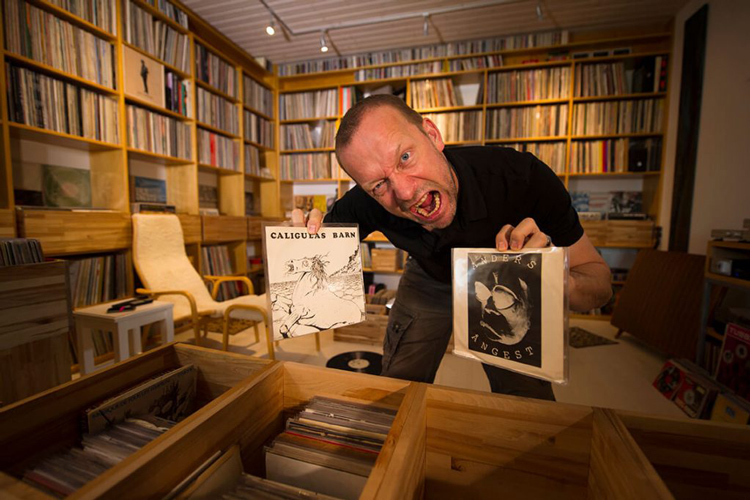
The Avant-Dzhazovaya Trio Thes comes to Moscow Thing under the control of Mats Gustafsson is not only one of the leading saxophonists of modern jazz, but also a self -proclaimed “wildlife”, that is, a fanatical collector of vinyl antiquities. Gustafsson's latest release is not an album of any of his constant projects (among which- The Thing , Fire ! / Fire ! Orchestra , Swedish AZZ , Discaholic Anonymous Trio et al.), And the book of “Wildly: Confessions of collectors of records”, which included interviews, taken by Mats from “Colleagues by Monastery”: including, for example, Torston Moore or Henry Rollinza. On the eve of Moscow concerts The Thing (November 28-29 in the KC house) COLTA . RU talked with Gustafsson precisely as with a collector vinyl.
- From what moment did you become a “wildlife”?
- Quite early. Mom had several cool EP Elvis Presley and Little Richard. And I have already collected everything that lies badly: knives, matches of matches, and so on. But at some point, it became clear that the records were much cooler-and from eight years I proclaimed myself the collector of the notes of the Little of Richard. It all began with this - however, very many years have passed, while I realized that this is a kind of mental illness, from which I could not be cured!
- That is, your first plate was the recording of the Little of Richard?
- The funny thing is that I myself ask everyone this question - but at the same time I very vaguely remember the first record that I bought. But yes, it was definitely a record of either the Little of Richard or Stevie Winwood.
- And the first rare record that you bought?
- Hmm, but this is an interesting question - and, it seems, no one has asked him yet. It seems that the first plate, for which I paid more than usual simply because it was old, was the album of the quartet of John Coltrane “ Plays Chim Chim Cheree , etc. ”released by Impulse . I was 14 years old, and I found it in a store of used records in Umo, my hometown. I remember I have a fanatic from an old -fashioned cover of thick cardboard ...
- And all these early acquisitions are still in your collection? Or had to get rid of something then?
-Something is still here, something is gone. Such is life! Lass Marshaug, the publisher of the book about “Disagical Schools”, formulated this very accurately: you must cut the grass on your lawn. And any collector is doing this: he sells records that he does not really like, and buys those that he likes more. For the lawn look - and sounds! - better. But, of course, it happens that you are stupidly getting rid of truly cool records. Then then you have to purchase them again. The worst that I have ever done was shipped by a bunch of Vinilov in the late 1980s, with the onset of the CD . Therefore, there are still many holes in my collection, and as far as possible I fill them out. Koltrain is just a great example-then for some reason I sold several of his records at once, which came out at Impulse . Since then I have been trying to collect them back.
-Can you call yourself a “complistic”-a person who systematically collects all the releases of some artist or label?
- In some cases, yes - for example, with Albert Euler or Derek Bailey. And, for example, with Steve Leice or San Ra - no, because they have notes, let’s say, not super -class ones. There are super -class - but not very. For me, music still is of paramount importance. It is clear that there are not “five-star” records that I still buy, because they are either good musical or interesting from a historical, cultural or geographical point of view ... You see, I perceive my collection as a kind of archive or library, where I can always find something that will help me work on my own music. This is an important factor in the collection for me - so that it works as a resource, as a source of inspiration.
- In general, it is useful to listen to a lot of other people's music to a modern musician? Or not? Sometimes you have to face the opinion that it, on the contrary, distracts from its own creativity, has too much external influence, undermines the independence of the musician ...
- In my opinion, everything is exactly the opposite. Ours, I’m not afraid of this word, the duty is to get acquainted with another music: the more, the better. This is the same elementary curiosity: when the musician ceases to be curious - everything, stew the light. No, of course, it is not necessary to be a fanatical collector like me, but not at all interested in other music, as well as, for example, literature or visual arts - this is not cool. Curiosity rewards you: how many interesting ideas, how many interesting new facts, interesting new information can be drawn from other people's works! It is very important for me - to develop, to be interested in what is happening around. If I cease to be interested in this, then you can just stay at home, not compose anything and not go anywhere.
- Where do you buy records? Alive, in music stores? Or on the Internet - on Ebay , Discogs , etc.?
-I am touring quite a lot, so I give a lot with a tour: in each city you can find two or three good stores, sometimes you meet there with different people, and they drag you somewhere else-so this is a common thing. In addition, this is a great opportunity to relax against the backdrop of a rather grueling touring life: to go to the old records in the day, and give a concert in the evening. Even in recent years, I have been engaged in the site of “Wildlists”, and we are constantly changing music there. This is an important point, because I just can’t afford records that cost two or three thousand euros! I can only exchange them. And for this, I decided 10-15 years ago that whenever I see a good record in the store, which I already have, and it is not too expensive, I will buy another copy. Therefore, I always have a certain number of takes for sale or exchange - 200 pieces in total: both singles and albums. We have developed such an unofficial circle of “wildlines”, 40 people. We live!
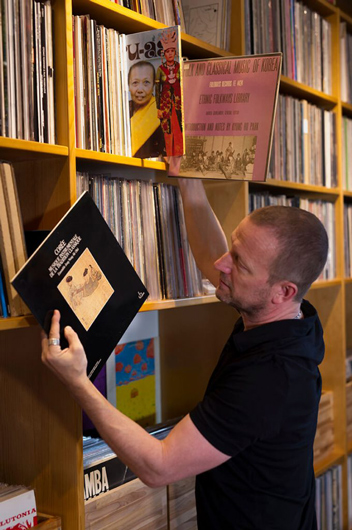 © ziga koritnik / The Vinyl Factory
- Who enters this circle? Those whose interviews and stories are collected in your book are Torston Moore, Henry Rollins, Oren barn? By the way, Oren Ambarchi once bought a record from me on Discogs !
- Is it true? Ha ha, I'm not surprised-he is a truly crazy collector, he buys something all the time. And yes, of course, he enters our “wild” circle - along with Torston Mur, Jim O'RURUK, Stephen O'Melly ... In general, if you think, most of the musicians with whom I work, in combination, the collectors vinyl. And, it seems to me, this is not by chance!
-The most expensive plate you have ever bought?
- Oh, there was one record for which I paid 2000 euros. I had to sell a lot for this. For me, this is rather an exception, but, you see, sometimes this happens.
-What is the plate?
- Bomb, not a plate. Do you know Francois Tyuska? Yes, a French pianist. He had a project: an exhibition of architect Le Corbusier in the early 1960s-either in the museum, or even at the World Fair, I don’t remember already. And for this exhibition they recorded a forty-foot-with the Don of Cherry, Jean-France Jenni-Klarm ... There are no more than a dozen copies of this record in the world-the music there is completely outstanding. Now it was reprinted, by the way, one English label, but I had never come across the original before. And then one dude contacted me and offered to buy this record from him - and in exchange he was not at all interested. Well, what to do! I had to fork out. But the most important thing - inside the plate, a sketch was discovered, which in my understanding looks absolutely like a drawing Le Corbusier! It's just incredible. Of course, it will be necessary to show him to experts, but if this is true, the work of Le Corbusier, then you understand: 2000 euros are just nothing. Not a price at all. And in any case, I certainly never sell this plate. Everything is unique in it - music, graphics, sensation itself.
- Amazing. In general, to the question of “sell”: do you consider a collection of records as an investment in the future? Well, that is, bad times will come and it will be possible to earn it on it?
-Well, of course, if, God forbid, something bad will happen to my family, with my daughter or just nothing to live on, then I will sell everything to the hell. Yes, I lived with this music for many years, yes, I adore it, but it's okay. Nevertheless, at the moment, pah-pah-pah, I do not plan anything like this!
- But imagine that you come to a music store during a tour. And there are records that you do not know about anything - have never heard a single note. Buy something just like that, without pre-listening? For example, because did you like the cover?
- Yes, this also happens - especially with forty -five: I often buy them simply because I see that they are published on a particular label, or in one year or another, or there is a particular musician, or yes, the cover is interesting. For this I love singles - they are light, you can take a chance, get as much as you like, and they will still fit in baggage.
- And the condition? Do you only take records in the Mint state ?
- No. I respect the collectors of the Mintov, but music is important to me and the object itself is important - a vinyl plate. Of course, the better the condition, the more willing to buy it, but without fanaticism. If I am offered a very rare, but shortened plate for 25 euros, what am I passing by? No, of course, I will buy it. Vinyl is vinyl - it implies a certain level of background noise and “sand”. So if the plate does not jam and jumps anywhere and if the cover is not covered with mold spots, then I am satisfied. But I will take some things even in this form anyway!
- For me, so if the plate shows that she was in use, that she was listened to, this is even good. This means that with her you acquire her history ...
- Exactly! This connection with history is very important - otherwise why shouldn't we just buy reprints, for example? And what, they will all be in perfect condition! But they will not represent any historical value. My problem with reprints is precisely this: they all look the same. Like furniture from IKEA : the same paper, the same smell, the same sensation. With old records, everything is completely different.
- And how do you feel about the “Return of Vinil”, about which a lot is talking about now? Like, the format is again in fashion ...
- For me, so Vinil never left for the end, so I don’t know if it is possible to talk about returning. Yes, now sales have grown, but if you look at the numbers, you will see that this is still a niche market. Most people listen to music on a computer, and as a musician, this is honestly concerned me - that they are a drum quality of playback. After all, if you listen to a lot of MP 3-files, they will destroy your ability to perceive music. Not to mention the fact that the “one click is one song” that has now triumphed is very far from what I want to achieve when composing and recording music. I create an album, implying a certain sequence of tracks, picking up a suitable cover for it and so on-this is a certain holistic art object, and not a song here, a song there. Therefore, the ideology of Spotify or iTunes is not at all close to me - although if people are convenient to find so good music, then please. But for me, music is no different, for example, from poetry - I like to read the whole poems, one line is not enough for me, it simply does not make sense in isolation from the whole.
- Do you publish music only in vinyl? Or in CD and in the number?
- Well, the CD has its own benefit - it is convenient to ride with them, they are suitable for promotion: for example, when we record the album with The Thing or Fire ! , then we always print promotional disks in special paper envelopes, which we distribute to promoters and journalists. So CD -format in our work is also necessary. And, by the way, from paper you can make quite pleasantly looking covers. The main thing is that the era of typical plastic cases for CDs is finally behind-this was a disgusting idea from the very beginning, and I had long threw all plastic boxes into the trash. They looked terrible, and a wildly harmful thing for the environment. However, the CDs themselves, alas, were an unsuccessful idea - more precisely, they became such after their manufacturers agreed on the frequency range. It was possible to make it unlimited, like Vinil’s, and instead for some reason they set up the upper limit and the lower limit ...
- Why was it needed?
- I have no idea! But the fact remains: everything that is above 44 thousand Herz and below 20 thousand Herz is cut off. Yes, we do not hear these frequencies - but if they cut them, it affects the rest, on those that we hear! That is why CD is so cold and lifeless: because a significant part of the frequency spectrum is circumcised. Of course, in most cases, you can still enjoy music, but nevertheless the difference with vinyl, in my opinion, is just heaven and earth.
- And on what equipment do you listen to the records? Something high-end?
- I have a total of four turntables: one mono, one stereo, one for records for 78 revolutions and one more upstairs, in the living room. A quite decent set that suits me-and even my wife usually smiles when I put some record. I have a QUAD 57 columns - you know such? I really like the effect: you listen to music in the room, but it feels like it sounds everywhere, and not just from the speakers. Of course, disputes about which equipment is better will never end. But in fact, this is individual: it is connected with the listener habits of a particular person and with the space in which he lives. I spent a lot of time looking for the best device for myself - and I tried both expensive and cheap options. And ultimately, I came to the fact that I have now - but I was to a certain extent easier than many other music lovers, because I myself am a musician, my work is largely to listen to music, and I know what to pay attention to. As for hi-end equipment, this is another endless story. My problem with her is that in any combination there is always a weak link that you need to improve. In the end, you do this, but then something else becomes a weak link-and you again spend a lot of money in pursuit of some ephemeral perfection.
-But the main question is an analogue or a figure?
- To be honest, I have a mixture of both. The columns in the original were released in 1957, but I have their modern replica, made in Germany, partially with new insides, although made according to the old schemes. My amplifier is digital, but it does not affect the sound. Yes, I know that there are many "hardcore" audiophiles that say: only lamps, only that, only this. Well, please - I do not mind: to each his own! I am satisfied with the option with which I live now. However, my rumor is not the same, to be honest, so maybe I should not judge it!
- After so many years of collecting - do you have a long Wantlist ? Or, with rare exceptions, everything is already?
- Well, a couple of pages will be typed! And he is constantly updated. Take jazz: yes, I basically concentrate on FRI JAZ, improvisational music, experimental, but at the same time I love and buy more traditional records: Bibop, Hard-Bop, Swing. And so this is an endless process - you will never stop cutting the grass on your lawn, right? Yes, many positions that I hunted for are already in the collection. But at the same time, every month you will learn new things that you have not suspected before ...
- For example? What are your most striking finds lately?
- Well, for example, I recently managed to purchase a plate of a duet of Masayuki, such aNaga and Kaor Abe. It was released by a very small circulation, I did not even think that it would be possible to find her, but now she is at home. Fantastic recording! And the same applies to another work by such an anaga - “ Eclipse ” . In general, the Japanese market has a huge number of records, which are not really documented anywhere. And the scene there, such a feeling, is endless.
- Do you have Russian records in the collection?
-Yes, there is a certain amount. For example, the early notes of the Trio Ganelin. Perhaps nothing particularly rare, but for sure I just don’t know much. For many years, it was very difficult to find information about your stage - for obvious reasons. The same applies, for example, Greece: we are now going there with concerts before arriving in Moscow, I gave a couple of interviews to the local journalists, and they asked me about Greek music. I said: Well, I, of course, heard something, but very, very little. And you need to learn more. Perhaps this will I do in the near future.