
Translated material
6500 years apart
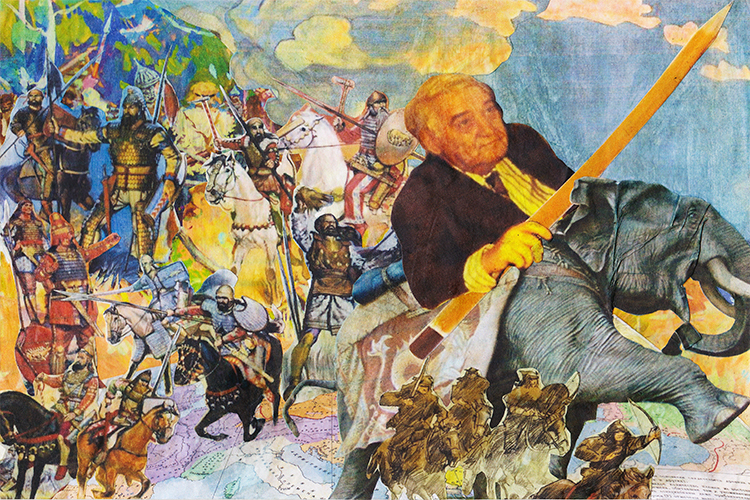
In February, two groups of scientists, genetics and linguists, in two different ways proved that the great -European language - the one that gave rise to Russian, Latin, and English, and Sanskrit - was born in the steppes north of the Black and Caspian seas. And to crush into different languages that became the predecessors of modern ones, he began from 6,500 to 5500 years ago thanks to two waves of resettlement-to the north-west and east.
Leading author of the first work , professor at Harvard Medical School David Reich, is the same geneticist who established a year ago that Neanderthals were crossed with homo Sapiens , which advanced from Africa to Europe, so that most of us have on average 2.5 percent of Neanderthal genes in the genome . But the “Exodus from Africa” is a story of a statute of 60 thousand years, if not more. And the new study of the Reich describes the means of genetics by a much later “Exodus from Russia”.
In addition to the Reich, the article has as many as 38 co -authors of 25 different scientific institutions of the United States and Europe (including five Russians). It took so many researchers to collect material for analysis to laboratories and museums around the world - fabrics samples of 69 ancient Europeans who lived and died from 3,000 to 8000 years ago. Two more dozen were genotyped earlier: this, for example, the “Tyrol Ice Man” by Ezi , who tourists found in the Alps 24 years ago and accepted by mistake for the recent victim of an accident, although he lay in the ice for five thousand years. Ezi's mummy was on the surface only thanks to the melting of the glacier - and it looks great: even clothes survived. The rest were less fortunate: this is usually skeletons dug by archaeologists from different Neolithic burials. Some 20 years ago, even the decoding of the genome of the embalmed mummy of the pharaoh-more new and better preserved-was incredible luck, and no one would have taken up to work with spoiled DNA from the old bones, so such studies were simply outside the technical capabilities.
Ezi, the “Tyrool Ice Man”, found tourists in the Alps and first took the recent victim of an accident. Although he lay in the ice for five with a small thousand years.
Scientists did not decipher full genomes, they were interested in the most talking fragments. For example, part of the DNA is transmitted only along the paternal line-this is the Y Cromosome, which determines the floor. She goes from grandfather to her father and from father to son almost unchanged. Different options for Y chromosomes are called haplogroups. As a blood type, except that the options are a little more - not four, but many dozens (and this is if you do not get involved in dividing into subgroups). The whole world can be divided into haplogroups - more precisely, all men of the world - into huge clans, where everything is distinguished by distant relatives (if, of course, you agree to consider a person who had a common male ancestor with you a distant relative of a person).
What did the Reich group find out? Until the late Neolithic - and it begins about 4,500 years ago - the haplogroup R 1 b was met almost exclusively in Russia. But then R 1 A and R 1 B is found in 60 percent of all Europeans of the end of the Neolithic and the beginning of the Bronze Age. The same pattern - ancient people from the steppes of Russia smashed their DNA (and, therefore, their culture) throughout Europe - confirms the analysis of other fragments of the genome.
Linguists discovered and described this episode with ancient migration in their own way. Four author from the University of California in Berkeley (and one of them is Professor Andrew Garrett, head of the university linguistics department) printed their study in Language magazine . Their method of comparing languages from evolutionary biology: without going into details, languages are compared in the same way as DNA of related species. Only instead of the letters of the genetic code are variants of keywords-bonfires (like “ Water- Water- Wasser ”).
Based on the comparison, “phylogenetic trees” are built - branchy circuits of kinship. There is, for example, a person, chimpanzees and gorillas, whose genomes differ from each other on a percentage of a percentage - and the algorithm finds out in what order mutations of the common ancestors should have arisen and the evolutionary branches should be separated so that the DNA turned out just like it is now. Dealing only with the views that are alive now, we are able to say how many years ago the nearest common ancestor lived and how it looked.
About the same - with languages. You can not only reason that the Russian is similar to Polish and Serbian, but also strictly count which two are closer to each other (Russian with Polish) and when the ancestors of modern Russians and Serbs could talk to each other without a translator (about 1200 years ago, and in the case of Russians and Poles about 800 years ago). And for the whole family of Indo-European languages, it turns out that the common language-subject-the same great-European-existed just 6500-5500 years ago, in the era in front of large migrations.
***
The promotion of the language on the mainland does not mean at all that after it entire nations change the residence permit. There are two dissimilar scenarios of how the language breaks through the way - with a kind word and a gun or just a kind word, explains Svetlana Burlak from the Institute of Oriental Studies of the Russian Academy of Sciences, the author of the book “The Origin of Language” and Doctor of Philological Sciences:
“Sometimes the language spreads together with the population. Some people come, kill or evict locals, all or almost everyone, settled here themselves and speak their own language. They have a different language and other genes than those who lived here before. ”
When could the ancestors of modern Russians and Serbs last with each other without a translator? About 1200 years ago. And the ancestors of Russians and Poles - about 800 years ago.
Is it true that people from the steppes between the Black Sea and the Caspian destroyed everyone in their path and eventually turned out to be the only ones who handed over both genes and languages to modern Europeans? It seems not. The greatest contribution, according to the Reich and co -authors, they made to the genomes of today's Norwegians, Lithuanians, Estonians and Icelanders, but this contribution is about 50 percent, and not 90-100. You can’t call them some “protoslavlians”: Belarusians with their 47 percent or Czechs with 49 percent are further than these ancient people than Estonians or Scots.
Svetlana Burlal continues: “The second option is the spread of language as cultural innovation. That is, some people came, there were not very many of them, and they were something so beautiful that all the locals suddenly wanted to learn their language, the language of the aliens. Something like we are learning English now. And in ancient times, for example, someone in Chinese Turkestan taught the Indo-European language-it turned out to be Tokharsky. Someone in the Japanese islands taught Altai-it turned out Japanese. He is not too similar to all other Altai languages, but how much has learned, so learned. ”
And linguists are able to distinguish these two cases without looking into the history textbook:
“In principle, this is visible in the language - it was transmitted through people who are called field linguists“ full -fledged carriers ”or not. A full -fledged medium is a person who has learned this language in childhood as a native. For example, you and I are full -fledged native speakers of the Russian language. When the language is transmitted through full-fledged native speakers, all those patterns of linguistic evolution that are known for comparative-historical linguistics work perfectly there-regular phonetic correspondences, continuity of basic vocabulary ... And borrowing-only in cultural vocabulary, in some new realities. Again, the entire grammar of the language-list is preserved. A little, of course, changes, but not so much. And when you look at the appropriate languages, it is clear that they are related. That nothing special happened to them - well, they changed a little there, but so, slightly.
A completely different matter is when the language is transmitted through an inferior native speaker. That is, through a person who has learned a language in adulthood. And he owns them quite badly. That is, he adapts the grammar of this language to the grammar of what he learned to speak in childhood, because most people do not reflect the fact of the presence of grammar in the language. Borrowings can be even in basic vocabulary, that is, in the most nuclear vocabulary. Because he, of course, learns to speak this very language of beautiful new people whom he wants to contact ... But he knows that the word “earth” is that it is. Why would he use the word “earth” from a newcomer?
And then we find pronouns that are not related to a freshly learned language, or some words such as “Earth”-and, of course, we qualify them as borrowing during a comparative historical study. But borrowings of this kind arise because some people began to learn another language. And they taught him without good access to the literary standard of this language. If you look at Japanese, for example, what they turned into Altai speech! This is generally a mother’s mother does not recognize. Because they combed Altai speech under the Austronesian comb. ” (The Austronesian family of languages is what 300 million people in Indonesia, Malaysia, Taiwan and on the islands of Oceania are currently saying; there are more than a thousand of these languages.)
Someone in the Japanese islands taught Altai-and the Japanese turned out. He is not too similar to all other Altai languages, but how much has learned, so learned.
The work of geneticists from the Reich team concerns only Europe. And he does not say anything about one of the two main routes for the spread of Indo -European languages - from Russia to the East, to India. However, here the linguists are firmly sure: Sanskrit - the language in which the Rigveda and other sacred texts of Hinduism are written - appeared by transmission through “full -fledged carriers”, explains Svetlana Burlak. That is, the descendants of people who previously lived between the Black and Caspian seas reached India and settled there.
Sanskrit is a dead tongue. And how are things with the living - which of them retained more features of the ancient title? “According to external signs, the most archaic is Lithuanian. At one time, there was even a theory that the ancestralum of Indo -European languages is on the shores of the Baltic Sea, ”says Svetlana Burlak. “Russian is also very archaic.”
Words are not the only way to verify this: “You can take other aspects of the language. What sounds are there? What are the declension-spraying? What are the word -formation suffixes? This can all be reconstructed. ” You can start with the cases: “What did modern languages do with cases? Well, for example, English left almost nothing. German is a little more. There are four cases - and then most of the endings coincide. So, German regarding cases is more archaic than English. There are six cases in Russian. In Lithuanian too. In the Indo-European, apparently, there were eight, as in Sanskrit. Accordingly, the one that has retained six cases is more archaic in this aspect than the one that saved four. ”
***
Linguists reconstructed the great -European language to such an extent that they write and tell fairy tales on it: here you can listen to one of them, about the king and God, and here - the other, about the sheep and horses.
Sheep, a source of wool, and horses, progressive transport, are the very cultural innovations that could easily include other peoples to learn someone else's speech, Gerrett and co -authors say in their article. Together with sheep and horses, they also call the third: wheel. In the disputes of linguists about where the birthplace of the great -European language is the wheel - a decisive argument. It was invented not before six thousand years ago, and such a word is in all languages of the Indo -European family. So, the tongue was divided no earlier.
The competing hypothesis, which is called the “Anatolian” (in contrast to the “steppe”), consisted in the fact that in the great -European language they spoke very south, in the territory of modern Turkey, and that it ceased to exist several millennia earlier, from 9,500 to 8000 years ago. The wheel did not fit into this scheme. But then the very first attempt to date languages as DNA, by the methods of evolutionary biology, gave the necessary numbers - from 7800 to 9800 years ago. And the team of Garrett, in order to argue with this, had to clarify the method of counting.
Svetlana Burlak explains that here to consider: “For a certain number of years, a certain number of basic words will fall out and replace. This is a fragment of a language that ticks like a clock. With a predictable speed. Uneven, but predictable. There is a formula of the linguist Sergey Starostin, which allows this speed to predict - and, in general, it is quite decent to predict. ”
Gerrett and co -authors of the classic of Russian linguistics did not read, so they had to re -inate the formula, albeit in a simplified form. The new formula takes into account that different words are replaced at different speeds - and when the calculations have already done with it, 9800 years turned into 6500 years.
If you distract from geographical conclusions, what does this figure mean? That the story, what we know her, began recently. From us to Rigveda - three with a little thousand years; If we rewind the same amount back, we will find ourselves in a situation where there are no Greeks, no Indians, nor French, nor the British - more precisely, their ancestors speak the same language. And they perfectly understand each other, sitting somewhere on the banks of the Kuban or Dnieper River.