
Translated material
Mikhail Vorontsov: Angloman in Tiflis

COLTA . RU represents a new project - “The Islands of the Empire: People and Events”, which is developing with the support of the Russian Scientific Fund. For a long time, the Russian language now knew the unusual definition of the word “island” - that which stands apart, separately from the environment. Such islands, different from the "mainland" of the state, were its outskirts. In a series of popular science essays and interviews with historians, we will try to understand how it was arranged, what lived and by whom the “archipelago” of the outskirts of the Russian Empire was controlled. The "island" heritage of the empire often penetrates into modern political discussions and remains part of public consciousness. Many are still not accustomed to the subjectivity of the former imperial "islands", while others did not realize some of them part of the new Russian state.
We begin with the history of Mikhail Vorontsov-the first Caucasian governor, who is better known as the “Semi-Milord, Semi-Ukupets” from Pushkin’s poisonous epigram. However, he was one of the most influential people of the Nikolaev era, whose power was compared with the power of the omnipotent Catherine Favorite Grigory Potemkin.
Amiran Urushadze, author of the book “Caucasian War, tells about Vorontsov. Seven stories ”, the head of the RNF project“ National outskirts in the policy of the Russian Empire and Russian public thought ”.
Who to send to the Caucasus?
Emperor Nicholas I was in a hurry to end the Caucasian war, which he inherited from his brother. But, despite all the efforts and personal participation of the king in the “Caucasian” affairs, the rebellious highlanders rallied under the slogan of the Holy War and continued to resist the huge empire.
The Caucasus ruined a lot of general quarries. The famous Alexei Ermolov went to lifelong resignation and oblivion, the favorite of the emperor Ivan Paskevich was withdrawn to suppress the uprising in Poland in 1830 and thereby saved his impeccable reputation. Grigory Rosen, accused of corruption and family, was much less lucky. At the end of 1844, the place in Tiflis - the capital of the southern outskirts of the Russian Empire - was again vacant.
If in November 1844 the bookmakers accepted bets on the new head of the military and civil administration for the Caucasus, then the candidacy of Vorontsov could attract only the most desperate players. In fact, Vorontsov was 62 years old - the age is venerable, and at that time at all. Since 1823, he successfully ruled Novorossiya and Bessarabia, turned Odessa into a flourishing shopping and cultural center, and he himself comfortably settled in the Alupkinsky Palace, where summer and autumn lived with pleasure.
But I could not abandon the proposal of Emperor Vorontsov. Not only because he was devoted to the Romanov dynasty. Nicholas I specifically under Vorontsov came up with a new position - the Caucasian governor. Unlike his predecessors, he received almost limitless power. The ministers were not entitled to control his activities, and on especially important issues Vorontsov turned directly to the king.
The idea of creating governorship belonged to Nicholas I himself and was a big surprise for the metropolitan bureaucracy. Mikhail Pozen, managing the VI branch of the Imperial Chancellery, where all important “Caucasian” affairs flocked, even tried to convince the monarch, but so unsuccessfully that he resigned.
So, on March 25, 1845, the most famous Russian Angloman Mikhail Vorontsov arrived in Tiflis.
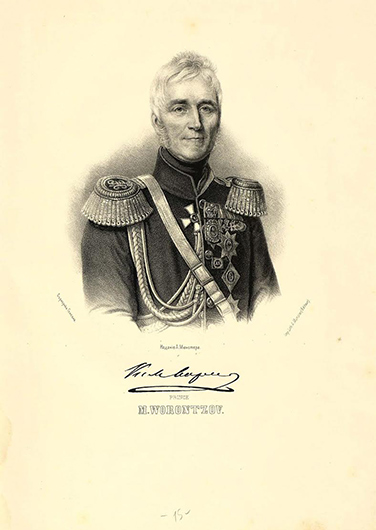 Vorontsov. Published: portrait gallery of Russian figures. A.E. Munster. - St. Petersburg: Type. and lit. A. Münster, 1864-1865
Where to start?
Such a question before Vorontsov did not stand. The emperor demanded an immediate victory over the imam of Chechnya and Dagestan Shamil. Having barely looked around in Tiflis, Vorontsov went on a campaign to the capital of free highlanders - the Chechen village of Dargo. Shamil skillfully maneuvered and, although he had to leave Dargo, he came out rather a winner. The failure of the next campaign in the mountains, the Russian authorities carefully masked under a great victory. The emperor granted Vorontsov the princely title, the officers received awards and raises, the lower ranks appointed a cash payment, the newspapers wrote about the triumph, from all sides were heard congratulations on the victory. But soon the information of another sense spread through the metropolitan salons. Secular society was doubted in a “brilliant victory”, which cost three generals lives. Even the old friend Ermolov wrote to Vorontsov ironic letters: “You, as I notice, do not like the word“ retreat ”as much as the great Suvorov; For you are intensified to assure you that, coming from Dargo to Gerzeli-Aul, you were attacking, and lead to the proof that you went directly to the enemy position. Then in all directions there were enemy positions, for the enemy surrounded you from all sides. "
Vorontsov did not recognize these, largely fair, reproaches. But after the Dargin campaign, he finally could engage in the control of the edge as he knew the best: calmly, methodically, in English.
Day of the Caucasian Viceroy
Vorontsov loved to sleep well and slept more and more over the years. The governor’s dream usually lasted eight to nine hours and ended with an awakening at about six in the morning. The viceroy cherished the early morning hours especially, as he devoted them to personal affairs. Once, having slept more than usual, Vorontsov was so annoyed that he blurted out in Georgian: “Ramdeni Madzin! How much I slept! "
Having risen from bed, the governor was dressed immediately; He never recognized his home robe, considering it impossible to meet anyone in this form. Then Vorontsov sat down at the desk and brought in the diary of the event of yesterday. After a mandatory diary entry, the governor - one of the most wealthy people of the empire - enthusiastically engaged in his finances. In a notebook divided into column, he entered his salary, dining rooms, award benefits, money from household income, and funds were in the consumable part for maintaining the house of the governor, food needs and charity.
The time of personal affairs ended at eight in the morning. The governor’s office included an adjutant, a police chief, officers and office officers who delivered service papers and the press to Vorontsov. The governor read in three languages: Russian, French and English. In addition to the founded newspaper Caucasus, he regularly read the latest Journal des D Ets Politiques et Litt E Raires and The Morning Chronicle . Breakfast, continuing to read. Tea drank in the English manner, with milk, drinking them dried bread with butter. Having completed a fast breakfast, Vorontsov returned to the desktop and continued to work with papers.
Tuesdays and Saturdays are the reception days of the governor. At noon, generals and civilian chiefs, the Tiflis aristocracy, influential merchants, as well as officers and officials who had just arrived and wanted to introduce themselves to the governor gathered. These official techniques took place in the semi -official atmosphere and were quite noisy. Vorontsov was not afraid, he himself, with the unchanging, who became a legendary smile bypassed guests, talked about affairs, was dear. After bypassing the reception, the governor went into a separate small room to receive petitioners. Vorontsov was the highest authority in the Caucasus, it was he who turned to him as the last hope. He was asked about pardon, about delaying the debt, about the restoration of justice. Vorontsov cannot be called an impeccable philanthropist, he often refused the petitioners, but at the same time he was always emphasized polite and smiling. Already after his death in the Caucasus, the saying went: "High, far to God, far away, and Vorontsov died."
At five o’clock in the evening, the governor was served a big dinner. After the soup, Vorontsov eagerly ate the fish, drinking several glasses of sherry or Kakhetian wine. The governor no longer returned to work. After lunch, Vorontsov could go for a walk along the streets of Tiflis or spend an evening after Lombert - his favorite card game. He always chose partners for the game, from which patience was required. The fact is that Vorontsov was a man of habit in everything, even in jokes that he loved to tell again and again. Once, the writer Count Vladimir Sollogub, regularly invited to the card gatherings, getting down to the chatter of the old man, began to casually throw the cards on the table.
“A dear graph,” Vorontsov turned to his guest with a smile, “if you are bored to play with us, why are you playing?”
The writer hesitatedly hesitated and began to babble an apology, and Vorontsov continued to smile. He did not invite more sologub. Ruthless politeness.
At about ten o’clock in the evening, having drunk soda water with a sherry, the governor went to bed.
Vorontsov’s style was radically different from the manners of his predecessors in the Caucasus. They tried to manage Tsitsians and Ermolov with the help of fear, Vorontsov rules, without intimidating. He managed to be popular, even remaining cruel. He put on the iron hand of the autocracy in an English like glove.
Where the East and the West met
The Vorontsov brought up in England, most likely, was well acquainted with the colonial administration of India. In 1773, the first English-governor of India was Warren Gastings, who spoke Persian and Hindi, with deep reverence, treated Indian culture. The study of the Persian language, as Gastings wrote, "cannot but reveal our mind, cannot but fill us with mercy to the whole human race that our religion inspires." The Governor-General contributed to the transfer to the English “Bhagavad-Gita” and Islamic texts: “Al-Fatava al-Hindia” and “Al-Hadaya”. In Calcutta - the center of British India - Gastings opened the madrasah. Scientific societies that studied the geography and flora of India enjoyed the high protection of the Governor General. Vorontsov in the Caucasus did about the same.
The governor opened new educational institutions, including special schools for Muslims. In 1848, the first public library was opened in Tiflis, in 1850 - the Caucasian Society of Agriculture, in 1851 - the Caucasian department of the Imperial Russian Geographical Society. Vorontsov brought the Italian opera to the Caucasus and the representations of the acrobats, French actresses and the English Zhokeev.
Tiflis and other cities of governorship turned into huge construction sites. The central streets were landscaped, new suburbs grew. The capital of governorship acquired a European gloss, but retained the oriental flavor.
... Vorontsov, who was left by the last forces, left the Caucasus in the spring of 1854. The Caucasian war lasted another ten years, but the decisive blow was the defeat of Shamil, who surrendered to Prince Alexander Baryatinsky on August 25, 1859. According to one version, the triumph once said: "I got the harvest of Vorontsov’s sowing."
* * *
March 25, 1867 in Tiflis opened a monument to the first Caucasian governor Mikhail Vorontsov. After the Sovietization of Georgia, the monument was demolished, but the memory of a smiling ruler remained. The name of Vorontsov in the modern Tbilisi is called cafes and hotels, and Georgian intellectuals indicate the need to restore the monument to the beloved governor-enloman.