
Translated material
Why not be a shame to be afraid
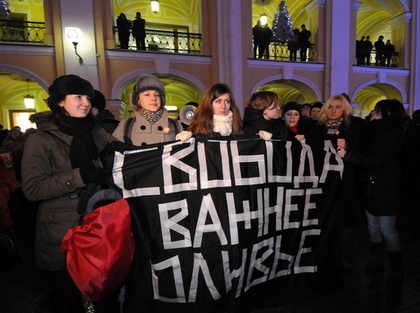
The conflict between supporters of the shares of the 31st at the Gostiny Dvor and in Palace received a new turn, the meaning of which it seems to me to think far from not only the St. Petersburg. I was one of those who signed the appeal to the Democrats on the way with nationalists. For many, including in "solidarity", it caused a reaction bordering on rage. Skakovsky answered indignant. Now I consider it necessary to speak out.
Six months ago, I wrote "liberal does not mean a coward." Now I will say why I signed the aforementioned appeal. Because I think that there is a thing that can and should be afraid. And individually and collectively. This is a militant xenophobic nationalism.
The concept of “nationalism” has a long and interesting history, and it is obvious that it did not always make a negative meaning. I wrote about this both in us and in the Western press , doing this in the politically hazardous context of modern Russian nationalism. I was friends with the nationalballs, defended them in disputes with Western friends, and even called on Kasparov not to “betray” Limonov, when the decline in the Coalition “Another Russia” was outlined and dilapidated the possibility of the formation of other coalitions. I personally, physically, are not afraid of fans (and sometimes I go to the stadium to root for Zenit); I am Russian and I sincerely love my fair -haired country, the land of my ancestors - Arkhangelsk, Belozersk, Pskov and Peter, despite the fact that 1) I see its vices very well, 2) traveled half the world and, technically, I could live and work anywhere.
One of the reasons why I consider today's power to be harmful, if not criminal, is the absence in its actions, and even in words, of real patriotism. The ideologue of “rising Russia from the knees” is not just a dummy that is not related to the real problems of the Russian people and society, but the ultra -large drug that makes us incompetent and slowly killing our people. The Putin’s collective “getting up from the knees” directly contradicts the stood from the knees (squeezing a slave from himself a drop) of a Russian citizen individually. Namely, this last is the goal of a true patriot.
Of course, the collective pride in his country is a natural and desired thing, but such pride is a hundred times sweeter if it is based on real achievements (and not on the propaganda and zombies of the population like ours); on a decent life for the absolute majority. The Germans, who were very ashamed of their country for a very long time, now have something to be proud of: where do not take a look, first -class roads, uncorompted officials, luggage, active, surviving pensioners. What are we proud of? What does it seem to us somewhere far away, they begin to be afraid? What did we win in the war for the Tskhinvalsky Pahan, living on our budget money and therefore lied to us about one and a half thousand innocently killed Ossetians?
I am using some liberal colleagues in "solidarity" in the assessment of reforms and reformers of the 90s. Although until 1996, Yeltsin was indeed a popularly chosen president, he quickly lost the confidence of voters, and the reformers lost sight of the Russian people in the slogans about democracy. Both the elections of 1996 and the voting in the Duma on the impeachment of Yeltsin with the bribery of the deputies were not honest, but the final victory over the Russian people, trying to take responsibility for their fate in their own hands, was won by none other than V. Putin. Having distinguished himself in the sex operation against Skuratov, who investigated the near-Goltsin corruption, he was appointed a uchens to the Chechens, although not Chechens, and Feesbehniki were caught while trying to explode a residential building in Ryazan.
What happens? Elisted democrats - and extremely low global oil prices - of course, did not really contribute to the restoration of the dignity of the post -Soviet Russian, but the nationalist reflexes, on which he left Yeltsinism and entrenched the neo -poet Putin, rolled this dignity into the asphalt. Nationalism against the nation. Such a dialectic is so sad for our nationality.
Putin is worse than Yeltsin precisely because, being an oligarch in law, a plowman of a large oligarchic family, he not only is ready, but also has unlimited possibilities to endlessly breed ordinary nationalist boys, as well as those less simple, who are not averse to making their first (or last) political million to increase the number of their active supporters due to anyone and anything. This last category is egoists of pure water, because nothing shines from these games even in the farthest perspective. Putin cannot be beaten on the field of street nationalism. Why? Because the essence of Putinism is to create ideal conditions for citizens to be the very cattle that we urge them (ourselves) not to be. For the cattle is not only an insulting social definition, but also the condition from which many receive high. And someone can even consider it freedom.
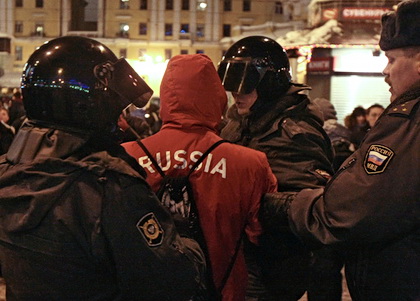
Nationalism should not be afraid of Putin. Nationalism (such as “Russia for Russians, Moscow for Muscovites”, etc.) must be afraid of a modern Russian who does not want to be an individual in the herd. He must be afraid first of all not physically, but as they are afraid of spitting in the soul, contempt from a loved one, a feeling of guilt for life. I do not believe that the problem of illegal immigration (which we must fight) is what inspires the nationalist to battle. They beat, as you know, not according to the passport, and not even according to the registration stamp. And not only Caucasians beat; They beat "in profile", which in a classic joke is not Caucasian, but Jewish.
My soul sings from the fact that so many nationalities speak in the language of my ancestors and that he, so far, unites us. Our imperialism did not have such a civilizational impact on the colony as the imperialism of the Western type, so let's not turn our grown up “younger brothers” from the good that they have left of us - our language. Someone, of course, will continue, for great need, to explain on it, but he will continue to be the language of violence, I am not love.
We have another historical feature. Despite the fact that the victory over the “fascist” (Nazi) Germany was with us something like a national religion, we did not comprehend a moral shock from a phenomenon named “Nazism”, as not only the defeated Germans, but also the victorious allies did. Shock and catharsis from the fact that the nightmare of Nazism is possible in reality, became the core of Western culture. Nevertheless, in the West today it is full of nationalism and xenophobia, but for those who do not cause rejection for moral reasons, there is, in Germany, for example, a good medicine-photographs of Dresden, Hamburg, Cologne and Berlin of a model of 1945. There is no such fund from our Nazism.
Everyone himself will decide whether there was an appeal to the “democrats on the way with the nationalists” an exaggerated reaction to the invitation of people with the ideology “A-well-ka-doai-ka-uy ...” to demonstrate a democratic opposition. We did not want to offend the democrats who, for one reason or another, came to the hotel, and not to the palace. And we did not deny the rights of fans to enjoy our civil rights guaranteed by the Constitution. These rights do not include the call “But well ...” and even the call “Russia for Russians!”. Neither according to the current Constitution, nor for the more democratic, which, as we hope, Russia will gain. By our appeal, we reacted to the fact that adults, smart and sufficiently experienced in politics are completely consciously, at the level of the action they organized, decided to join the political union with a quasinaci mass. If you like, we were scared - or not, I will say for myself: I was scared. I was frightened that with such an electorate we will find no more than a democratic constitution, and the abolition of even now current and even some ERM ä Chtigungsgesetz (the law on granting extraordinary powers to the government-it.) In addition.
Limonov, whom I sincerely consider the classic, of course, dispersed from the nazi lawyer Karl Schmitt Dugin, but we will not forget about the genealogy of National Bolshevism. For me, all these, theoretically, are very interesting things, but when the tendency is planned to realize this on the streets of my city, intellectual curiosity turns into fear. I was scared and signed the appeal. Knowing, like other signaling colleagues in solidarity, that there is a great political risk in this. But fear was stronger. And so I believe that I have committed a bold act.
Photos of RIA Novosti