
Translated material
Swedish lessons
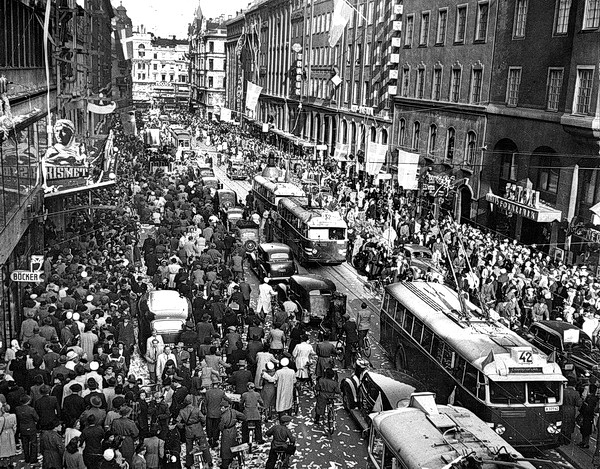
From the dialogue of the author with a young gum ...
- Olaf, why are you doing business, not politics?
- This is not necessary. The government and officials do not steal money. The taxes are reasonable. There is practically no corruption. The conditions for small businesses are favorable. Therefore, I am busy with my business. But I go to the polls, I vote for the Social Democrats.
Most of the twentieth century, like the first years of the 21st century, Sweden was ruled by the government formed by the Social-Democratic Labor Party of Sweden (SDRPSH). The motto of international social democracy: "Freedom-justice-solidarity." It was such ideals that the ruling party consistently embodied in its policy. And this is of considerable interest, since over the decades of the reign of Social Democrats, Sweden was not only transformed from agrarian into a highly developed industrial society, but also reached socio-economic well-being. Social reforms are motivated by a national interest - the expanded reproduction of the “tribe”, and social security has become part of the national self -awareness. Social Democrats demonstrated broad and reliable obligations in the social sphere.
At the same time, the Swedish society managed to solve the problem of a combination of uniform distribution of material goods with high economic efficiency, which corresponds to the interests of both the individual and the economy as a whole. It was possible to achieve a historical compromise between labor and capital, to ensure the victory of parliamentary democracy over dictatorship.
Prerequisites for the formation of Swedish Social Democracy
As an influential political force, the Social Democrats declared themselves in the 1911 parliamentary elections, taking 3rd place from 28.5%of the vote after liberals (40%) and conservatives (31%) of the vote. However, the formation of the SDRPS was preceded by an extremely important period of development of labor movements, which formed cultural prerequisites and democratic constitutional ideals in the mass strata of society.
The labor movement did not arise in Sweden in itself. It appeared organically as part of a whole wave of folk movements. In addition to the worker, the most significant were the movement of the evangelical churches and the movement of the struggle for sobriety. The struggle for sobriety was in the center of the spectrum of working movements. In turn, its activists came from evangelical organizations and supplied the labor movement by many personnel of trade union organizers. Until the First World War, the movement for sobriety was the largest popular movement.
Many members of the movement for sobriety were among the deputies of the RICSDAG. So among the elected in 1911 and 1917, 64% were in motion for sobriety in the RICDAG of members of the Second Chamber; In 1949, this indicator was 41%. Social Democratic members of RICSDAG were almost entirely organized teetotalers.
The social democratic labor movement quickly became the core of folk movements. Folk movements had a number of common features that had a powerful impact on the Swedish policy as a whole and the popular class policy in particular. All folk movements sought to arouse, organize, train and transform people, change their lives. Therefore, the “movement” acquires the meaning of a collective, closely soldered organization. Folk movements distinguished self -organized educational activities in special training circles, which were widespread. The working educational union has become a classic model of these training circles. The tradition of folk movements formed a reform, educational direction of politics, gave it an organized form. In the 1930s, the Swedish tradition of organized folk movements received important strengthening. Peasants and rural youth created their own folk movement.
Analyzing the breadth and stability of folk movements, Swedish analysts indicate the spread of these traditions in an extensive rural area. Only after 1957, the urban population exceeded half of the country's population. However, the traditions of independence and self -organization of the Swedish village that are leaving for the distant past. This was reflected in the “respected peasant class”, consisting of peasant-owners (1), with its warriors, church elders, members of the county court, deputies of the Rixdag from the peasant estate and the rural community. The active growth of working and agrarian movements was observed after 1930.
The traditions of folk movements associate the class policy of the Social Democracy with roots that are deeply going into the history of the Swedish people. This tradition explains such features of Swedish policy, at least spontaneity and militaryness in words and actions, but skillful organization, careful preparation, prudence, readiness for negotiations and compromises.
Refusal of revolutionary - a compromise policy
Social democracy formed a political agenda, covering the economic and socio-political problems of production and distribution, as well as the implementation of power. Such a set of problems unites the working class and social layers close to it, which in the conditions of the democratic system allows massive layers to use their number in the struggle for the parliamentary representation and the reflection of their interests in legislation.
At the beginning of the twentieth century. Swedish Social Democracy was a difficult choice. In the spring of 1917 and late autumn 1918, revolutionary sentiments prevailed among a significant part of the working class and soldiers of Sweden. The strict requirements of immediate democratization sounded. Those in power were concerned and prepared for the revolution. Disagreements arose in the leadership of the SDRPSH. Young leaders, led by Albin Hanson, advocated radical actions. However, more experienced leaders led by the party leader Yalmar Branting insisted that no ultimatums be presented. The leadership of the SDRPSH and trade unions did not resist the waves of demonstrations and performances, but joined them in order to give them a non -revolutionary direction, to avoid violence.
When the revolutionary wave of the spring of 1918 was asleep, the right government remained in power before the elections (held in the fall of the same year), according to which the Social Democrats entered the government. However, the opposition of the right in the RICSDAG continued to block the democratization processes. But after the revolution in Berlin (1918), the right in Rixdag at the end of the same year surrendered. Under powerful democratic pressure, but without revolutionary shocks, Sweden became a democratic country. In December 1918, the emergency session of the parliament adopted a government bill on the democratization of suffrage. Since 1921, the same law introduced universal equal suffrage, which allowed women.
The driving power of democratization were Social Democrats, but the majority of Swedish society joined these processes, with the exception of landowners and conservative intelligentsia. As a result, the SDRPS was recognized as a legitimate government party. In 1920, the success of the Social Democrats in the parliamentary elections allowed them to form a single-party government.
The strength of the SDRPSH was her desire to cooperate with all the political forces acting within the framework of the Constitution and the law - the so -called "democratic cooperation" (2). His reflection was the slogan "Sweden-the house of the people" nominated by the Social Democrats. The position of the election campaign of the Social Democrats of 1934 is characteristic: “We are responsible for the calls of the right to the separation of the nation by our call to cooperation between all democratic forces. While the right and the Bolsheviks speculate on the differences, we focus on the general and unifying. ” In fact, this is nothing more than a fundamental rejection of the odious concept of the class struggle.
Competence factor
One of the significant reasons for the success of the Social Democrats is competence. Having defeated the economic crisis in the 1930 elections, the SDRPSH carried out urgent socio-economic reforms, organizing public work with a salary not lower than the payment of an unskilled worker, and the increase in basic old-age pensions. This policy was continued as part of the anti -crisis program of the SDRPSH “Crisis assistance to workers and peasants” (1932). The core of the policy of the Social Democrats at that time was generally a successful policy of alignment of income.
In the same year, the body of the Swedish association of entrepreneurs “industry” stated: “The most outstanding quality of the new (Social Democratic-S.M.) government is its vitality ... The indicator of intellectual giftedness is at a high level” (3).
Swedish analysts especially distinguish two aspects of the Strategy of Social Democrats: a policy of complete employment and social security. "Job. Security. Development ”became the basis of the SDRPSH strategy, adopted by the 1966 Party Extraordinary Congress.
The competence of the leaders of the Social Democrats was recognized by their opponents. So in 1987, 150 exchange experts called the Minister of Finance of the Social Democrat of Chellya-University Feldt the best minister of finance. And a year later, one of the leaders of the SDRPSH, Prime Minister Ignvar Karlsson took second place in the nomination "Best Prime Minister".
At the same time, the three classic prime minister of Sweden-Social Democrats Ernst Wigfort, first Edwin Sheld and Gunnar Strelng-were economic self-taught and sophisticated politicians, closely related to the working movement. This indicates that the education obtained within the framework of folk movements ensured the disclosure and implementation of talents.
Creation of a social democratic state of welfare
It is universally recognized: the creation of the state of welfare is the most vivid achievement of the Swedish Social Democracy of the twentieth century. It was the Social Democrats that led the development of the famous “middle path” and the formation of the state of welfare coincided with the 50s of the almost continuous rule of the SDRPSH. However, the roots of this state come from the historical conditions that preceded the birth of a working social democracy-wide folk educational humanistic movements of the XIXV.
The social-democratic strategy constantly faced the problem of how to combine the parliamentary forms of struggle for power, the desire for fair equality and the need for economic efficiency.
According to experts, the set of social programs of Sweden or the amount of expenses for their implementation is not unique. The structure of the Swedish welfare model is unique. She imposes a heavy burden on taxpayers, but this is the political decision of the majority of the Swedish society. And it is precisely on him that the state of welfare is based on carefully balanced principles: equality, universalism (accessibility for all social civil rights) and effectiveness. For the practical implementation of such principles in a rich society with a growing secondary grade, the state cannot avoid burdensome expenses associated with the guarantee of high standards of social services and benefits.
The state of welfare, according to Swedish analysts, must satisfy not only basic needs - its services must comply with the tastes of the working class, which is becoming more wealthy, as well as a legible middle class. Sweden has reached such a high living standards that only a few are ready to be content with basic, especially, minimal social security standards.
The structure of the costs of the state of welfare reflects its priorities. The Swedish model is characterized by a productive preventive social policy. A relatively small share of social expenses is on unemployment benefits. Much more funds are invested in ensuring employment: retraining and mobility of labor; adult education; prevention of diseases, accidents; manuals to families. The state of welfare is created with the aim of minimizing the burden of social needs and raising to the maximum of employment. The philosophy of such a policy is that the means spent on these purposes create more significant effects in other directions.
“Productive” social policy is expensive, but the costs of non -producing expenses remain low. Therefore, the rational structure of the costs of the Swedish state of welfare reduces the burden of expenses where they are growing in others. The creation of new jobs increases the number of taxpayers, while in other countries it is reduced. Therefore, in Sweden, significant costs for welfare, in fact, are investments in economic growth.
Distribution effects are also impressive: poverty and economic non -sales are largely eliminated. Sweden is an indisputable leader in equal distribution of income and standard of living. But the most impressive results are outside the usual indicators of well -being. The economy manages to maintain full employment; Significantly reduced class differences; It was possible to create a powerful consensus regarding the existence of the state of welfare - the consent of society to high taxes and their distribution to preventive social policy. In this sense, social expenses are one of the dominant principles of Swedish Social Democracy.
The state of welfare has implemented the majority of the fundamental principles of the labor movement. But many of these principles from the very beginning had wide folk support.
Early socialist movements intended to achieve equality through nationalization, at least the "command heights" of the economy. But the Swedish Social Democracy rejected this dogma quite early. Instead of an unrealized concept of equal distribution of public wealth, she strove for a more practical ideal of social justice by democratizing life capabilities, resources and participation in production management. This has foreseen the struggle for social citizenship in comparison with the estate of property.
Theorists of Swedish socialism changed the idea of the historical mission of the working class. In their opinion, it consisted in reliably conducting Swedish society through the consistent stages of political and social democracy in the name of achieving economic democracy. The priority principle has been stated the elimination of poverty, reduction of class differences and the achievement of a fair distribution of life benefits. The company represented by the state provides guarantees of normal wages, according to collective trade union agreements.
At the same time, equality was not an obstacle to achieving effectiveness. The successes of the Swedish Social Democracy are largely due to its intellectual ability to combine these conflicting goals. Equality (4) was considered as a prerequisite for achieving optimal effectiveness: a more uniform distribution of purchasing power is a significant factor in a successful macroeconomic policy; family support - contribution to future human capital; Fair provision of access to healthcare and education is the basis for high labor productivity; Solidarity policy in the field of wages and active programs in the field of employment - conditions for modernization of industry; Establishment of income allows you to overcome the resistance of workers rationalization; A proactive social policy - its orientation is more likely to create jobs than on cash benefits, which reduces losses of human resources and economic costs.
From corporate to national solidarity
During the creation of a fair state of welfare, Swedish Social Democracy in many ways managed to solve the problem of national solidarity. On the way to political organization and unity, working movements always face two obstacles - a market and limited solidarity. As market participants, people compete with each other, subjected to social stratification. From the do -the -capitalist market, a narrow guild and fragmented corporate solidarity, local patriotism and paternalism went into the inheritance. Therefore, social democracy needed to overcome these obstacles in order to replace them with universal national solidarity.
The solution to this problem is largely related to the implementation of the concept of the “house of the people”, put forward by the SDRPSH during the 1928 election campaign. In accordance with this concept, the born social democratic state should become a single house for all Swedes, where solidarity and mutual assistance are natural. The concept of “home of the people” is the image of national solidarity, in contrast to class antagonism and the notorious “exacerbation of the class struggle”.
Such a vision of the national historical perspective, combined with the rejection of revolutionaryism, put forward the parliamentary methods of conquering power to the forefront. Уже к 1920 г. шведские социал-демократы отчетливо осознали: узко-пролетарская партия не сможет завоевать парламентское большинство. И потому необходимы широкие политические коалиции. Воплощением этой идеи стало сближение в 1930-х гг. СДРПШ с Крестьянским союзом, что стало решающим условием прорыва социал-демократии к власти. Коалиция с организацией крестьян-собственников вместо большевистской политики раскулачивания и коллективизации стала важнейшим политическим условием успеха СДРПШ.
Исторические и социокультурные предпосылки становления социал-демократии в Швеции коренным образом отличаются от российских условий. Однако изучение богатого и успешного опыта СДРПШ дает обширный материал для осмысления причин неудачи попыток создать в России на рубеже 1990-х годов современную социал-демократическую партию по европейским лекалам.