
Translated material
Year of change
The text completes the project on the Ecology "Variable" .
It is terribly inconvenient and probably strategically wrong every conversation about changing the climate to start with the weather outside the window, but this, apparently, is its inevitability. The first day of summer this year, according to tradition, was marked by snow and record colds in some regions, and the last week the weather in Moscow lags behind the climatic norm and will return to it, as weather forecasters promise, only after a couple of days.
Many in Moscow now probably recall the last summer , cool, rainy and windy, which made the townsfolk doubt the reality of global warming (unreasonably). The very climatic norm that meteorologists talk about is increasingly a reminder of some other time, when the trees were large and the weather was better. The most persistent and theoretically savvy of us know that one and even two summer is not at all an indicator. But it’s hard not to think that right now the same thing happens with the climate as with society: new norms are created right before our eyes.
Summer, for example, came the same, and what has changed in addition to the climate in a year? Perhaps the most significant change is the new Russian Minister of Natural Resources and Ecology Dmitry Kobylkin. He talked about the problem of climate change even before it became especially fashionable in the light of the Paris Agreement of 2015. For example, in 2010, while still the Governor of the Yamalo -Nenets Autonomous Okrug, Kobylkin stated that the climate change “in the long run could affect the state of economic and production infrastructures, which would entail economic and environmental risks” and could affect the traditional way of life of the indigenous population. In general, from the point of view of the “North” climate, Mr. Kobylkin is a profitable environmental minister: the consequences of climate change for Russia, both profitable and dangerous, are now most noticeable just in the Arctic. So the new minister almost certainly does not need to explain anything, he saw everything himself.
For a global climate, a year is not a deadline at all, but our “variable” project managed to grow into a small media encyclopedia: now on the Colt you can thoroughly read that the Russian president has recently put on a par with such “large -scale challenges and threats” as terrorism and weapons of mass destruction. The best authors in Russia were working with us who write about climate change and sustainable development; Together we found out what scientists and politicians think about global warming today, and told that to read, watch and do to those who are also worried about this problem. Environmental activists love the slogan “Change yourself, not climate”; It would be nice to follow him twenty years ago, but, as you know, now - the most suitable time after twenty years ago.
A year ago, starting our small climatic experiment, we wrote: “Climate change is such a global shift of the entire coordinate system that its consequences can be seen anywhere, from astronomy to nuclear energy.” They managed to write about astronomy , about a variety of energy too. And we also talked about the transport of the future , the problems of the indigenous residents of the Arctic, the consequences of the new way of the economy for Russia - and asked the director of Greenpeace why they were going to work there.
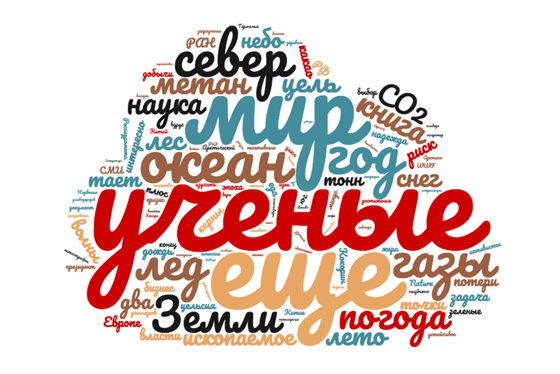
By the way, what 365 days of “variable” looked in the form of a cloud of words looked - it is immediately clear that our authors were most interested in:
In addition, for the year, Kolta and its partners in Russian cities-the Yeltsin Center, the Siberian Branch of the Russian Academy of Sciences and the Russian-German Environmental Information Bureau (RNEI) -held four seminars for journalists about how to write about the climate change correctly and interestingly. At seminars, we discussed the sustainable development of cities, the immediate consequences of climate change for Russia, the prospects for “hairless” Siberia on environmentally friendly energy and adaptation to those changes that can no longer be prevented, but can still be taken into account.
Making a cloud of words for our section, I specially left the service word “more” to show how often it was found in our materials. For us, this is the word of hopes, or something: Russia and the world have done little to avoid the serious consequences of the global climate change, but it is not yet too late to improve.
Our section is closed so far, but Colt will continue to monitor how the climate changes itself and simultaneously changes life around us - the benefit of reasons in the foreseeable future will only become more.