
Translated material
Victory Day
The day began with a parade of military equipment. On the surface of the plasma panel, the military force of Russia glided - the latest Bether Betaers and Armata tanks. The coarsely chopped plans for all types of missiles and armor have effectively changed, the voice of Neo-Levitan, who was heard from different points of the large hotel complex in Montenegrin Budva, solemnly rattled. These are Russians who returned from a plentiful hotel breakfast, watched the Victory Parade, and it seemed that all Montenegro hears with them the Soviet military songs performed in the rattling copper of the wind orchestra. Here, in the relaxed air of the province by the sea, cleared of the propaganda chatter mass media, a demonstration of deadly weapons, a political correctly called "technique for the destruction of the lively physical strength of the enemy", looked like a wild rudimentary ritual.
On the day when in Moscow they talked about guns, Lira sounded in Budva. In the literal sense-the local gusl, the closest relative of the Greek and Byzantine lira, who survived the witness of the great civilizations, who once lived in these blessed edges. The ancient Gusle voice, under which the Montenegrin Singers Skazes still sing epics and tales from gray-haired times, opened and closed the mystery Montesteppe -the final part of the Dukley festival Music Festival , the first major international musical event in Budva, in which the world of World Music from Ukraine, from Moscow, Buryatia, Tuva, Bashkortostan, Finland and monsters of progressive rock and electronics from the USA, Finland, Canada, Italy and Russia.
The Chernogorsky performer on Gusl Goran Vukovich is performed by the most famous Guslya tale "Death of the Cute Yovovich"
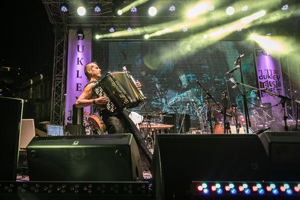
Dukley Music Festival was invented by the artist Marat Gelman, now busy turning the resort Montenegro into one of the cultural centers of Europe, and producer Alexander Cheparukhin, whose portfolio is large-scale World Music festivals “Creation of the World” in Kazan, “Movement” in Perm and Womad Russia in Pyatigorsk. At the 6-hour festival, the speeches were not pronounced either for the Great Victory in the Holy War, nor for the world around the world-the music spoke about all and about everything. The festival was opened by the Montenegrin ensemble of Zora - an amateur (in the best sense of the word) musical team, which sincerely performs local ritual songs. According to Alexander Cheparukhin, to find an authentic folk music in Montenegro was a very difficult task, for the sake of which half-blacks had to go around, and, for example, with the head of Zora - Portel electrician from the city of Bar - met quite by accident. The ensemble of the singer Inna who continued the program, interpreting ancient Russian songs in a modern sound, played the most affordable for accidental vacation music-in her diverse mood, there was a place for a playful song with a disco bass and the words “Let's go, Mary, with me on a bathing”, especially appropriately on the beach of the duckley gardens residential complex. who accepted the festival. Next on the stage of the festival, the instrumental forecast-trio KTU appeared, consisting of three virtuoso: the Finnish demon of the Chimmo Pokhonen accordion and the participants of the Great Group King Crimson , the drummer Pata Mastelotto and the bassist of Trey Gann, who covered the festival with the sound tsunami. It was a little alarming behind the GoPro camera, glued on the accordion at the Julia Pokhonen: it seemed another turn-and it would fly off somewhere in the sea surf.
The Kyiv Quartet "Dahabrah" was met in Budva as pop stars. Under their acoustic Slavic techno, combining chanting with an animal drive, the entire Dukley Gardens beach was dancing, and by this time filled with adults and children. In the front row from the stage - Marat Gelman and Alexander Cheparukhin. In one of the pauses, a gray -haired woman approached the scene, on the jacket of the St. George tape, and gave the Vocalists Dahibrahi, performing in the Hutsul caps, a bouquet of roses.
The equivalent of a 70-back fireplace on Dukley Music Festival was the performance of the Montesteppe project, in which to the performer on Gusl Guran Vukovic, the Buryat Dive Namgar, her partner Evgeny Zolotarev, the singer from the Huu Huu Tulyusha, a flutist from Bashkortostan Robert Yuldashev, singer from the ethno-technical-dwarf Angele Angela Manukyan and the young Canadian drummer Merlin, little in the inferior Patu Mastelotto, all already mentioned participants in the festival - from Zora to Dahibrahi. Alexander Cheparukhin loves to complete his festivals with massive jam-seners. They always give the impression of the enjoying enjoyment of the joint improvisation of good musicians pouring from the stage. But the Montesteppe founded on the same idea was the most successful of all - since it was previously rehearsed in detail by musicians, converted by Alexander Cheparukhin and Kimmo Pokhonen and was fulfilled without hesitation. Most of all, it was like the collective game of the World -heroes World Music , each of which had the opportunity to show his unique skill to the public and delicately dissolve in the all -consuming musical pulse. “I saw many festivals and concerts in my lifetime, but this one struck me with a combination of creative call and professional performance,” Joe Boyd, the famous producer who opened the Incredible String Band , Fairport, shared his impressions from what he saw. Convention and Nika Drake. “ Montesteppe is incredibly ambitious and perfectly executed.”
The Gala final of the project Montesteppe was based on the song of the Montenegrin Ethnic group "Zora"
The Montesteppe project, in which almost fifty musicians of different peoples were involved, sounded impossible in the idea, but took place - swam smoothly and majestically, like “Armata” in hotel plasma. This evening in Budva truly became Victory Day - one on all, united by music, on different tierful participants of the festival and its guests, who forgot about dividing into “quilted jackets” and “dill”, about sanctions and symmetrical anti -sankers. The antimilitarian musical parade, on which Russians, Ukrainians, Americans, Canadians, Finns and Montenegrins met and stuck on the Victory Day, looked if not like an elegantly invented artistic action with political connotation, then at least as a conscious “fig in your pocket” to the speeches and affairs of modern politicians.