
Translated material
Time has broken
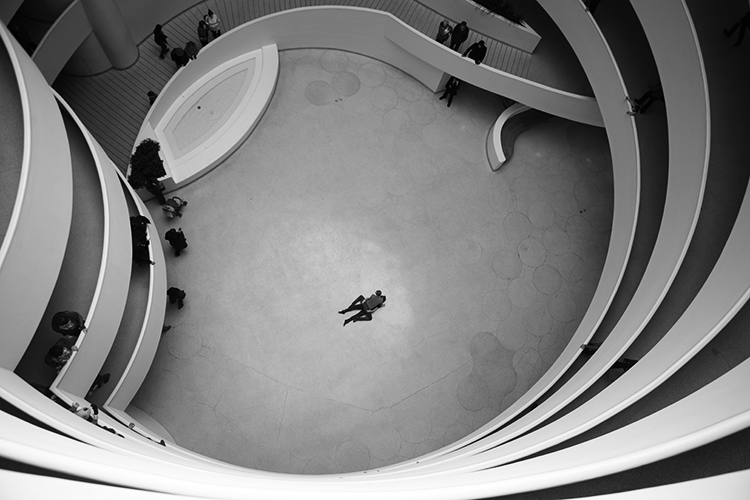
Behind the shouting curtain of glass beads stood a boy.
- What is progress? He asked everyday after a short greeting.
- Progress? -I asked from surprise and immediately began to mechanically respond with a phrase memorized at school:-This is the progressive development, the movement of mankind forward ...-when suddenly something clicked in my head, stirred and developed into a half-thought,-but always accompanied by a return. It turns out something like two steps forward, a step back ... Progress is ... a dance! I blurted out.
The boy did not find what to answer, and with a noticeable relief he handed over the baton in time the girl who led me deeper into the Parisian Palais de Tokyo . In the spacious hall, where we were a minute later, people randomly moved. A minute later, all this human chaos was surprisingly formed in the illustration of my thoughts about progress: fifteen to twenty-twenty performers with quick, sharp jumps crossed the hall diagonally, after which they slowly and smoothly returned back.
The performance “this progress” of Tino Segal and several other “constructed situations”, as the artist himself prefers to call his work, in August - September, thanks to the VAC fund in Moscow - in the Tretyakov Gallery and the Schusev Architecture Museum. But now it's not about art, but about progress.
The “constructed situation” of Segal, in the center of which I ended up in Palais de Tokyo , made me more acutely than usual to feel the limitations of my ideas about progress and, moreover, the uncertainty of its role in the current state of things. What is progress today, when not only faith in the “bright future”, but even the household “tomorrow will be better than yesterday” seem to be naive utopianism? So, which was stored by an experienced artist and the question voiced by a ten -year -old boy turned out to be no less - a phenomenological magnifier through which I clearly saw a crack in the usual perception of time.
This is not a retrospective intellectual bravado at all, as it can seem easily. A break in a temporary continuum has become obvious for many not today and not yesterday. There is no more future, and the present is full of the past - sensible metamorphoses can be reduced to such a formula. Where did the future go? Why so many past? How to live in such an unusual present?
 © New Literary Review, 2017
The analysis of this problem, the German researcher Alade Assman devoted her new book “The connection of the times broke up? The take -off and fall of the temporal mode of modernity. " Known primarily as a specialist in historical memory - in Russian, her books “The Long Shadow of the past. Memorial culture and historical policy ” (2014) and “ New Dissatisfaction with the memorial culture ” (2016), - Assman, apparently, was tired of fending the arguments of the skeptics about the oversaturation of the present by the past, commercialization of the culture of memory and dictate of the narrow layer of intellectuals, urging“ contrary to common sense ”, and decided to approach the work. otherwise. In the new book, the author rises above the discussions about the memorial culture and looks at the connection between the past, present and the future as a whole.
The main thesis of the book is already expressed in its name: "The connection of times has broken up." True, for some reason, Assman adds to a quote from Hamlet a bashful question mark-probably consciously extracted from the arsenal of an academic researcher and designed to leave the right to a mistake. This sign of the question, however, has nothing to do with the rest of the text: Assman decisively declares that decay is a fact of life, and explains that it has led to a radical change in the relationship between the past, present and future.
Thesaurus
It is difficult to understand what the book is about without familiarization with the author’s dictionary. Under the temporal regime of Culture, Assman, referring to Hartmut Rosa, understands "changes in the perception of time, in the orientation of our activity and in understanding history." The temporal regime is a “framework structure that mobilizes some values, desires and hopes, but <...> excludes others.” Time, emphasizes the author, is not an objective category, not an abstract ontological given, but a product of culture.
The term "modern" is used in the book for the aggregate designation of the new and modern time, which is more familiar to Western historiography ( Die Moderne in German, Modernity in English, etc.). Nevertheless, although in the Russian tradition, the modernity in the architecture and art of the late XIX-early XX centuries is more often understood as modern, recently in Russian-speaking scientific texts the concepts of “modern” and “modernity” are increasingly used to refer to the end of the Middle Ages to the 80s of the last century.
However, following the German historian, the concepts of Rainhard Kozellek Assman dates the beginning of Art Nouveau not by the end of the Middle Ages, but about 1770. Kozellek formulated the concept of “saddle time” - a historical cesura, a temporary gap, the result of which was a deep transformation of human life. According to Kozellek, on the eve of the Great French Revolution, as a result of scientific and encyclopedic work and a comprehensive renewal of knowledge, semantic changes occurred: “history” became “history”, “peoples”-“people”, “art”-“art” and so on. This singularization gradually led to the abstraction of time and its use as an organizing principle. “From now on,” writes Assman, “events not only took place inside this homogeneous time, but also generated by this time itself ” (italics in the original). In turn, speculative discussions about the meaning of the historical process, the internal logic of history gave rise to the idea of progress that underlies the theory of modernization.
Modernization is another important concept for the book. In fact, this is taking place in the era of modernity the process of “modernization” of Western societies, their transformation into industrial. But Assman draws a fundamentally important difference between the “theory of modernization” and the “modernization theories”: modernization is built on scientific and technological progress and the idea of omnipotence of man, ignoring the ideological radicalism, social injuries and other “dark” sides of the movement towards utopian tomorrow, and the theory of modernity tend to comprehend all these components as a whole. This difference can be illustrated by the example of the United States, which is devoted to a separate chapter in the book. The US gap with the old light, its unconditional orientation to the future (take at least an American immigration policy, which, up to recent time, demanded that they completely arrive completely forget about the past and build a completely new life) turned America into a “most important modernization engine”. However, the emancipation of the black population discovered huge gaps in the history of American modernization related to the memory of slavery and the role of African Americans in the development of the country. Modern theories allow you to comprehend this part of American history in conjunction with the rest.
It is worth noting, however, that the terms “modern” and “modernization” are repeatedly used in the book as interchangeable, including in combination with the phrase “temporal regime” - this does not at all simplify the task. The first third of the book, in principle, requires an increased concentration of attention - the easy side effect of the academic approach to the topic - but if I did not lose patience (for example, at first I could not stand it, freak out and put down the book for two months) and get through the description of the concepts of the present and elements of the theory of time, then it is not a text, but a complete intellectual joy.
Temporal mode of modernity
How does Assman characterize the temporal mode of modernity? First of all, it takes (approximately in 1770, as already noted) a fracture of time - a rupture of the past with the present and future: according to Kozellek’s expression quoted by Assman, there is a “gap between the“ space of experience ”(past) and the“ waiting horizon ”(future).” In other words, “history has ceased to give lessons”, and traditions turned into a burden, from which it was necessary to get rid of at all costs - the present turned to the past back, and to the future front.
The rejection of the idea of continuity determined the obsession to constantly start all over again: the principle of Tabula Rasa becomes the most important feature of the era. The regular start from the clean sheet is performative and implies a mandatory violation of the taboo. The brightest example of the “figure of the beginner” of the era of Modern, Assman considers the Getevsky Faust.
The third aspect of the temporal regime of modernity is the passion for the “creative destruction”, according to Mikhail Bakunin. Utopic projects from literary fantasies turn into direct guidelines for action. The rupture with the past, the literal or metaphorical destruction of the heritage is carried out not just like that, but in order to create a wonderful new world. It is important that the logic of creative destruction leads in the first half of the 20th century to an extremal violence of man over a person, as Sigmont Bauman showed in the book “The relevance of the Holocaust”.
The reverse side of creative destruction was the “attempts of reconstruction” of the past (the term Ernst Shulin) - the desire of the modernity to preserve. “Ancient traditions were destroyed as the focus of old values, but at the same time they were canned in the form of historical knowledge,” writes Assman. This is a fundamentally important aspect of the modern: the modernists separate the past from the present and give it to the complete disposal of historians, who, according to Bruno Latur, "support his artificial survival." In this regard, Assman writes about the “invention of historical”: historical science, museum, archive are born.
Finally, modernity is characterized by acceleration of time associated with the revolutionary development of transport and obsession with new principles - the present is reduced up to the Baudelaire moment. “The main context for accelerating time and changes,” writes Assman, “serves a market economy” (which is most clearly illustrated by the fashion phenomenon that instantly makes new old ones).
Compensation theory
By the 1980s, it became obvious that the five aspects described above modernized the Modern Temporary Regimen. The theoreticians of the late modern Joachim Ritter, German Lyubbe and Odo Markvard, thinking about the thinning of the binding times, turned to a rethinking of the temporal regime. Their efforts found expression in the theory of compensation.
According to this approach, accelerating time in the temporal mode of modernity, the process of slowing down is opposed to: the future is “impossible without a background”, therefore it is impossible to completely abandon the past - humanity needs, according to Markvard, “plush Mishka” in the form of classical literature and art, museums, customs, family, etc. These "ancient things" compensate for the loss of trust in a person who is too quickly changing the present.
Compensation theorists subjected to rethinking and the future. According to Hermann Lubbe, in the late modernity, “still more than enough,” but it no longer be of a utopian nature. On the contrary, now it seems to humanity rather gloomy: utopia is replaced by an apocalypse associated with the depletion of resources and environmental problems.
The connection of times has broken up
Assman does not agree with the theory of compensation: in her opinion, this approach “exposes revision and modernizes the structure of the temporal regime of modern, but does not question it in principle.” According to the researcher, as a result of the Modern Temporal Modern regime, the contours of a new temporal orientation took shape in the 1980s that began in the 1980s. However, whether this “new temporal orientation” means the coming of the new temporal regime is incomprehensible: on the one hand, Assman writes that “we are now experiencing the completion and not the collapse of the Western Temporal Regime, but the beginning of its renewal”, on the other hand, the book without habitats proclaims the “take -off and fall of the temporal mode of modernity”.
This conceptual puzzle, however, can hardly reproach the author: at this stage to declare a new temporal regime, at least early - research methodology here is clearly not enough; It is necessary, no matter how ironically it sounds, another important factor is time.
The main thing is that Assman indicates the disappearance of clear dividing borders that existed in the era of modernity between the past, present and future. The author sees nothing catastrophic in this - and in this sense, polemizes with theorists mourning the loss of the future and condemning the penetration of the past (Francois Arthom, Hans Ulrich Humbrecht, John Torpi).
Memory theory and memorial culture
According to Assman, Artog and the company mistakenly proceed from the normativeness of the temporal regime of modernity, while the main awareness of the last decades is to cultivate time. The current temporal regime, the researcher believes, is best explained by the theory of memory. This theory “understands culture as a mechanism for generating time, and cultural memory as a navigation tool that allows maneuvering within the time we generated.” Here, Assman relies on the concept of “culture as memory” by Yuri Lotman and Boris Uspensky. “A culture connected with past memory generates not only its future, but also its past,” Russian semiotics wrote. Assman reduces this concept to two provisions: “The future and the past are constructed in the present” and “The past does not disappear automatically.”
The first position suggests that "the past serves not only the subject of knowledge that can be handed over to the archive, but also the parameter of human experience, memories, feelings and issues of identity." In other words, the present, including a person’s belonging to a particular social group, and even the future (both an individual and groups of people) are formed, among other things, through the updating of one or another past.
The future should be said in more detail. The most important feature of the new temporal regime, notes Assman, - the changed meaning of the concept of “future”. This is no longer a utopia and not a cat in a bag from which you do not know what to expect. The future today does not imply a break with the present and the past - this is their continuation. In other words, in a new temporal mode, the future is constructed in the present, based on the past.
Such an understanding of the future is perfect for today's Germany, but, frankly, it is not particularly pleased in the case of Russia, where the narrative of continuity is based on political abuses of the past and is used, in the expression of Assman, for national self -affirmation.
The second position of the concept of Lotman and Uspensky - that the past does not disappear automatically - implies the need to admit guilt for the crimes committed, the return of the traumatic memories of the victims, and the study of the difficult past. Assman believes that the policy of repentance - the absolute innovation of the current temporal regime - not only does not form negative identity and does not threaten the national consensus (as Torpi claims), but is also a necessary condition for the future.
The threat of historical science?
The memorial culture is most often criticized by historians (the same Francois Artog, for example). This is due to the fact that, as a result of the increase in the last decades of forms of appeal to the past, historical science has lost exclusive law on it. Historians are afraid, on the one hand, the death of historical science, and on the other, the growth of political abuse of the past (as it is again obvious on the Russian example - starting with the use of the Great Patriotic War to justify everything and ending with the "historical" works of the current Minister of Culture). Assman rightly notes that the diversity of appeals to the past not only does not detract from the significance of professional historians, but also makes their work more important than ever - including for memory correction. Therefore, to contrast the memorial culture and historical science, according to the researcher, is at least unproductive.
By the way, the discipline of public history actively developing in Russia is engaged in the fact that it studies different representations of the past in the present and leads bridges between their creators and academic historians.
The boy was
The boy from the “constructed situation” Tino Segal made me think about the progress and connection of the times in broad daylight; The dances of the participants in this progress contributed to thoughts on the nonlinear development of mankind. The book of Aleida Assman, having pushed into my reader experience from the Segalov performance, outlined the contours of an even more important awareness: we do not see the future not because it is not there, but due to changes in the perception of time. The future is constructed in the present, Assman convinces, but the thing is that in the new temporal mode this cannot be done without working out the difficult past. The historical policy of the self -affirmation that Russia is conducting today is a miserable attempt to grab Modern by the sleeve, to maintain uncontrollable. This is some kind of non-modern modernization. Устойчивую позитивную идентичность, национальный консенсус, совместное будущее не построить на замалчивании ошибок государства. Продвижение вперед через их признание и покаяние — единственно возможный сегодня вариант прогресса.
Алейда Ассман. Распалась связь времен? Взлет и падение темпорального режима Модерна. Per. With him. B. Khlebnikova. — М.: Новое литературное обозрение, 2017