
Translated material
Epidemic of populism
With the accession of Crimea and the outbreak of war in the east of Ukraine, the entire political space of the Russian Titanic - along with tables, chairs and a ship's orchestra - went to the same side
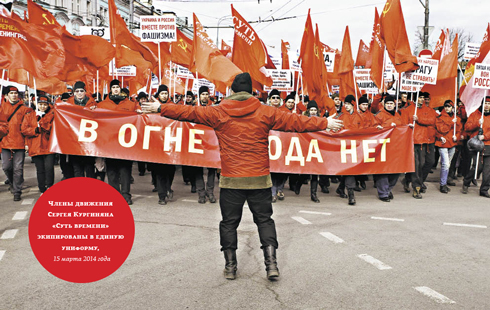
Until the beginning of the third term of Putin, that is, before the beginning of the “era of reaction”, which replaced the public rise in 2009-2012, on the Russian political scene it was possible to distinctly distinguish “reformists” and “conservatives”. More precisely, the term “conservatives” was applied to four at that time to different ideological groups.
There were the so -called “guards” - a narrow group of media workers who are fully concentrated on the fight against oppositionists who sharply criticize the Putin system of power. They continuously followed every sound produced by Kasparov, Nemtsov, Kasyanov, and immediately either gave a verbal excavation or arranged some public actions. Actually, this was exhausted by their "conservatism." At that time, Maxim Kononenko shone at that time, Kristina Podmentik and other wards of Vasily Yakemenko, the magazines "View" and "Polit-Online", the site of "Young Guard" and the hackers of the "Hell Brigade".
The second group was made up of more respectable “liberal conservatives”, first of all, the circle of expert magazine. There was really some idea. The editor -in -chief of the magazine Valery Fadeev offered the Kremlin and society as a base of political conservatism the middle class, which grew up during the Putin rule. This middle class, as it were, was the bearer of the ideas of “stability” and thereby a cautious approach to reforms.
The third group of conservatives was the “charter flights to Athos” that was strengthened in those years in the shade. It was a mix of bureaucracy of different levels, including the regional, head of Russian Railways, Vladimir Yakunin, Archimandrite Tikhon (Shevkunov), Nikita Mikhalkov and others, who at the basis of political conservatism laid Byzantium, the tea monarchy and that later received the name “spiritual scrapers”.
And finally, the fourth significant group of the so -called conservatives was the “Red Imperials”. They thought of Stalinism as the “sun at the zenith” of Russian history. What Zyuganov wrote directly about in his book “Holy Rus' and Koshcheevo Kingdom” back in 2003. And by the end of the zero - as a result of the mass edition of Stalinist literature and the TV show of the historian Yuri Zhukov and the like - this nostalgic conservatism intensified significantly.
All four groups played in different clearings of public space. And they only had a common that they were supervised by inventive Vladislav Surkov, periodically encouraging their budget applications for different sites, congresses and clubs.
Since 2003 and up to a white -open protest, the Kremlin has prevailed the concept: all these manifestations of conservatism must be rationally managed - in the interests of strengthening the vertical; The conservatives themselves were thought of as a necessary counterweight to the reformists, and Putin’s presidential chair was equipped so that he could sit on the ideological movements of liberals and conservatives, and the waves of ideological disputes should splash at his feet. This was part of the concept of "controlled democracy."
The era of change everything has changed with the outbreak of war in Ukraine. Yes, we must, of course, take into account the protest of 2012. But still, it was not the protest and its defeat had a radical influence on the change in the entire public space of Russian politics. Some experienced observers say: in the second half of 2013, Putin, having already coped with the consequences of the public upsurge of 2010-2011 and a protest of 2012, was going to conduct a different course than the one that happened as a result of the Euromaidan, the annexation of Crimea and the “Ukrainianization” of Russian politics.
Perhaps the way it is, but it does not matter. Because instead of continuing the game in the “controlled democracy”, the Kremlin committed what he systematically reproached the disagreements: “No need to swing the boat!” Unexpectedly, for everyone, Putin sharply appropriated the “agenda” of the opposition and not just “pumped the boat”, but took and abruptly tilted the entire “Titanic” on the same side.
Having captured the Crimea , the Kremlin stated that the Nazis attacked us. The ship’s roll was so cool that all the political space - along with tables, chairs and a ship's orchestra - went on board. As a result, a giant porridge from the bodies under the general name “Party of War” formed below. Upstairs, clinging to the railing, several bodies that form the "party of the world" hung. All old political differences lost any meaning, because the former reformists, and former conservatives, and even the National Boodles, and even the nationalist organization of Barkashov, and the socialists of Kagarlitsky - all in a row - ended up in one polyphonic crowd, chanting “tanks for Kyiv! Fascism will not pass! " The so -called "party of the world" in such conditions is already impossible to qualify as liberals. What liberalism in war? In the conditions of war, there can be only the “fifth column” and “traitors of the homeland”.
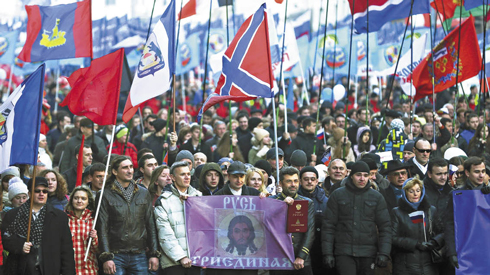
The icons have long become part of political paraphernalia, Moscow, on November 11, 2014, a populist synthesis on a tilted side formed a wide left-right populist consensus. Its structure historians are well known from the interwar regimes of Germany and Italy. In the traditions of the left political thought, it is customary to qualify as reactionary and conservative. Fascism is a policy of an extremely reactionary large bourgeoisie.
But now other explanatory schemes are much more popular. Perhaps each new stage of globalization and inclusion in the communication of new masses cause a reaction in the form of an epidemic spread of populism. In any case, it cannot be said that this is an exclusively conservative reaction. Since populist synthesis includes former revolutionaries, such as Edward Limonov, and such fierce statesmen as Ramzan Kadyrov. An elaborate mannerist, TV presenter Dmitry Kiselev is on the crest of one wave along with the radical religious traditionalist Archimandrite Tikhon (Shevkunov).
Where the curve will lead , however, the fate of this “postcrymist populist consensus” is still unclear. It can break up, and can form the basis of the new state system. Italian fascism or Hitlerism does not always get from it at all. To take shape, it must be institutionalized in a certain way. And this is a question for the next three years. Moreover, this is not easy, since we know only the mandatory elements of institutionalization in the past. But populism mutates. For example, on the history of Italy, we know that the mature, suicidal populist consensus is necessarily accompanied by the rhetoric “we are a young nation”, the cult of “heroes” (the fallen for the approval of the new state) should be “movement” (and in some cases movement and party); This consensus is accompanied by a militarization of everyday life, a certain type of mass gathering, special institutions for publicly shielding enemies, and so on.
Our "postcrymist consensus" is located in the earliest phase. So far, we see only flashes, electrical discharges in the cloud of this constellation - from “foreign agents - enemies of the people” to the application for the Anti -Maidan movement. But, of course, there is a big difference between sophisticated pressure on the Sakharov Center and the Human Rights Movement “Memorial” in 2014 and the situation in which the populist majority beats glass and smashes the buildings of these organizations when the police connivance. As of January 2015, we do not even know who Putin is going to become for this populist consensus, which he created by the capture of Crimea and the expedition of the retired colonel of the FSB Girkin in Slavyansk.
The place of the meeting-the Donbass our post-Soviet “right” were always not quite conservatives, since they turned not to the preservation of any principles in the present, but were directed to the “impossible”-to a certain conservative utopia. Be it Stalinism, Byzantium or Russian XIX century. In this sense, they are all to different extent - "conservative revolutionaries." That is why all the right ones rushed together in the Donbass - Kurginyan with the “essence of time”, and Dugin with the Eurasians, and Barkashov with his nationalist movement, and Girkin with the “white idea”. There they met with the left, since both the National Bolsheviks and the representatives of the “Left Front” moved there.
All of them perceive the war in the Donbass not just as a war for the territory, but as a struggle to build a new society in accordance with their National Socialist ideal in a single province. The National Bolsheviks in the journal "Free Press", and Prokhanov, and Dugin, and Olshansky on Facebook write about this. Donbass for them is a field of realization of a revolutionary dream. Putin's Crimean adventure opened the door to the future. Thanks to the Donbass, they got the opportunity to pick up a weapon, form units similar to German Freikoram
* * Revanchist organizations that arose in Germany after the First World War. Many of them later supported Hitler. 20s. And thanks to television, they fell into the very center of attention of the whole of Russia.
The people and television are now one right-left consensus works as follows: on the bottom it is warmed up by folk support, television on top. This mechanism lets society through itself and at the output throws a new social fabric. It is already stitched by five recognizable through themes. This is anti -Americanism, the opposition of a strong, capable of making strong -willed decisions of the leader (Putin) to the weak and limp leaders of the West, the opposition of our moral values - the decadent, degenerative values of the West, a special concept of state sovereignty and the militarization of public life. The right, like the left, dissolved in this postcrymist consensus.
“Television Ukraine” became a virtual warfare field with the West and the United States for millions, and Donbass - for a real war, several thousand citizens with Russian passports. What this new populism will become during its maturity - no one knows. Because historical experience gives only analogies. And they are always arbitrary. We only see that the rebirth of society is going quickly.
Photo: Vladimir Mashatin/ITAR-TASS, Sergey Fadeichev/TASS