
Translated material
Patriotic rise
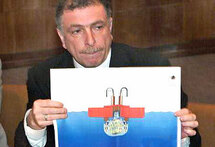
Nine months after his death, Kursk remains the task of the same number of unknown. On Friday, Ilya Klebanov admitted that it was still unclear whether the “abnormal situation of the torpedo itself or the clash of the boat with an external object” influenced the course of events. It is not known how many equipped torpedoes are in the wreckage of the first compartment, and maybe next to the body. It is incomprehensible, according to the general commander of the Navy, Vladimir Kuroyedov, how winged missiles will behave when working on a boat. Confidence in one one - the reactor is drowned out, the radiation situation is normal.
Let's start with radiation. We will proceed from the fact that automatic protection really worked at the time of the accident and the compensating lattices “packed” the reactor tightly. Let me remind you that on the K-219 atomic submarine in September 1986, the explosion in the missile compartment "cut down" the remote control of the reactors. Sailor Sergei Preminin omitted bars manually, which, as a result, was worth his life. The Kursk crew did not have time to pacify the reactor, but theoretically the likelihood that the explosion could de -energize automatic protection on this boat is maintained. In any case, the radiation "genie" is still locked in a sealed and specially fortified compartment. Free handling with the body of the fourth compartment is fraught with the most serious consequences. If only because there, in addition to the reactor itself, the first circuit is also a danger, the coolant of which is "chasing" no less than the filling of a nuclear installation. Meanwhile, according to the laws of the Sopromat, it is on the fourth-fifth compartments that the main load should be the main load when lifting the boat in the way that Klebanov speaks (fixing the entire length of the cable submarine and lifting on an even keel).
The problem of ammunition is also not resolved. Ideally, before lifting the boat, it should be rid of everything that can rush, detonate - in a word, turn the place of work into an epicenter of a new tragedy. The catch is still the same - there is no reliable domestic deep -sea equipment, there are no deep divers, who could also handle torpedoes and missiles. To attract foreigners to such a delicate operation, which is necessary to lay out all about the Kursk weapon - surrender to the “probable enemy”. To expose the life of hundreds of people, but not to give the enemy to Gostine is our way.
Of course, purely technically now it is difficult and extremely dangerous to extract cruise missiles from mines (each under seven tons of weight and more than ten meters long). But torpedoes should be neutralized under any circumstances. Meanwhile, apparently, Ilya Klebanova is still unknown how many unexploded ammunitions are there and where they were as a result of explosions.
However, it would be a delusion to believe that it was a less dangerous occupation to go through the seam of the 22nd frame (along the line of bulkhead between the first and second compartment) than the rise of this compartment along with all its explosive contents. The same walk is blindly around the minefield. In fact, this will be one of the most dangerous elements of the entire operation.
The public, which will talk about how many troubles are fraught with the destroyed first compartment, of course, will understand the government’s reluctance to touch the nasal part of the ship. And with a clear conscience, after that you can leave the main "witness" of the tragedy on the seabed. But the ability to "mine" this compartment and lift to the surface is quite real. How really for Halliburton divers was to work at the Kursk stern and open the lid of its fodder hatch. Today the picture is repeated in some ways. Norwegian experts are again ready to sink to the sunken submarine, but again the top state interests take the top. Again hopes exclusively on a patriotic rise.