
Translated material
Tigger for the revolution
Tigger for the revolution. Inequality in Russia is a traditionally big political problem. A sharp gap in income in the 1990s made a significant contribution to the formation of demand for populist budget policy and authoritarian leadership. This demand was completely satisfied with Vladimir Putin. Those who pointed out the depravity of such a policy answered: what do you want a revolution on the model of 1905 and 1917? Meanwhile, recent studies based on historical statistics show that inequality at the beginning of the 20th century was by no means as catastrophic as it is customary to think 
The income structure that developed by the mid-1990s was surprisingly stable: in the 2000s it has almost not changed. Putin's raising pensions, national projects, salaries of salaries to doctors and teachers - all this did not have a noticeable influence on the distribution of population incomes. But its structure has changed. The share of social benefits in the cash income of the population in 2011 reached 18.2%. Even in 1991, this figure was lower - 16.4%. It turns out that Putin realized the Gorbachev slogan “more socialism”, notes Igor Nikolaev from the FBK. Social payments were increased before the crisis, and as anti -crisis policy, and after the crisis.

A hundred years ago it seems that a century ago, when Russia was gradually approaching the 1917 revolution, the situation was similar. Remember the textbooks: “Polarization of the population”, “stratification into fists and not having the land of the poor rural proletariat” ... But oddly enough, inequality in 1904 was lower than in 2010. This was proved in the NBER report recently published
* * Nber - the National Bureau of Economic Research, a non -governmental and non -profit institute. This report can be seen in the original on the institute’s website, WP No. 18383. Two American economists Stephen Nafziger and Peter Lyndert (University of California).
Traditionally, they write in the work “Russian inequality on the anniversary of the revolution”, sharp social stratification was considered one of the factors that led to the revolution. The level of inequality in 1904 in 50 Russian provinces was average in terms of standards of that time and below the current level of inequality in China, the USA and Russia. The Marxists believed that the inequality in the pre -revolutionary years was very high. They proved this mainly by the distribution between peasants (then about 85% of the country's population) of cattle and land allotments. But these are property assets, not income. By their distribution, one cannot judge the financial condition of households.
What was the distribution of income, allows us to understand the database on income and land plots of residents of fifty provinces collected (they were responsible for monitoring taxable property and income). It can be seen from it that the then level of inequality in Russia was below today and did not exceed the usual indicators of other countries for that time. The then Ginny coefficient was 0.36 (the lower the coefficient, the lower the inequality), and the current level is 0.42. In other words, inequality could not become the main cause of the revolution, the authors believe.
But in the last pre -revolutionary years, the economy of the Russian Empire quickly grew, shown in the works of economic historians Paul Gregori, Boris Mironov and others. “Dividends” were distributed unevenly from this growth - as in 1990–2000. The highest inequality was where the economy was especially fast: in St. Petersburg, Moscow, Odessa. Above the average there was inequality in the Baltic, in the Black Sea cities, in the southern part of Ukraine, in the Urals, in Orenburg. The lowest is in the Volga region. It was in the cities that the revolution of 1905 and 1917 began. So, not being the main cause of the revolution, inequality certainly provoked public dissatisfaction.
Fists and poor people by 1913, the average capacity of the Gregori, was less than 20% of the Sredterbitansky, about 10% of the income of the average American and 30–40% of the income of the inhabitants of Germany and France. Now the rupture is lower: in the mid-2000s, the nominal income of the average Russian was lower than the average American four more than four times. It decreased a little over a hundred years and a break with the income of Europeans.
The most uneven was our distribution of land. It was owned by less than 4% of the peasants and only 1/3 nobles. The landowners were only 4.7% of the population - less than in the then Mexico. But the distribution of income was much more even: 5% of the richest peasants received only three times more than 25% of the poorest. The owners of 1% of the largest income received about 13.5% of national income, 20% of the richest - 47.7% of the total income (the latter - exactly as in 2010).
The average income of the household was, according to the calculations of Nafziger and Linderm, 612.5 rubles. per year. This is close to Gregory's calculations: 100 rubles. per person per year, families consisted of an average of six people. The average income in St. Petersburg (1317 rubles) and Moscow (1147 rubles), in Odessa and Kherson - 829 rubles was twice. In the eastern provinces, the income was lower than average. For comparison: a bottle of vodka (0.6 liters) then cost 40 kopecks, lunch in a decent tavern - 30-50 kopecks, a trip inside the city on a cab - 20 kopecks. The rented apartment cost about 180 rubles a year, summer boots - 2 rubles, output shirt - 3 rubles.
The extreme Russian inequality of the beginning of the 20th century was not only against the current, but also against the then background. In Victorian England (1867) and developing countries such as Peru and South Africa, Ginny's coefficient was higher (see table). It is curious that in the USA, Brazil, China and Russia over the past hundred years, inequality has grown, and in the UK and Sweden has decreased.
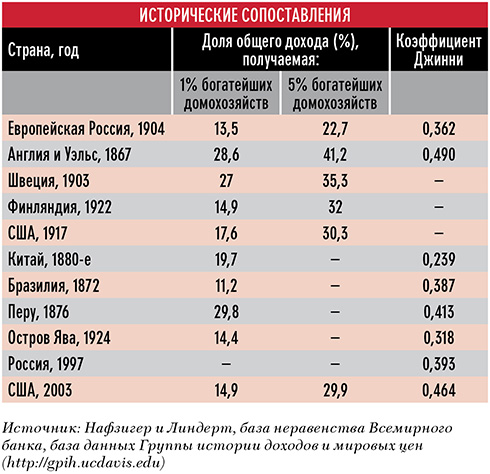
Who is to blame for one of the reasons is the role of the state. Both the current and the then Russian taxation, unlike other countries, regressively in income (that is, the richer, pay a smaller share of their income in the form of taxes than the poor). Now regression occurs thanks to a single rate of income tax, a decreasing scale of social services and the fact that the income from property is taxed less than salaries. At the beginning of the twentieth century, the causes of regressive taxation were different. Then the landowners paid relatively low rent, and in the budget revenues the share of indirect taxes (excise taxes on alcohol and other goods) was great. There was no income tax in Russia then. The budget policy and budget policy did not contribute to a decrease in inequality: the expenses of the central government for education and medicine were low - they were supposed to finance the zemstvos (as the regions should now in many respects). Perhaps this factor also pushed the country to the revolution, although it is almost impossible to measure this. But the conclusion suggests itself: to the revolution leads not so much the difference in income or the abundance of very rich people, but the feeling that the rules of the game established by the state are unfair.