
Translated material
Beat or yield?
In society
 Beat or yield?
June 4, 2009 Alexey Makarkin
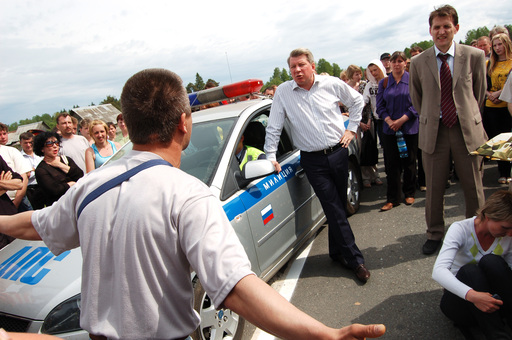 The social conflict in Pikalevo caused me a strange, at first glance, association. The French president Poincare in memoirs about the First World War told the story about how parliamentarians came to him, who decided to share fears about the presence of a large number of spare parts near Paris, in which anti -war sentiments can develop. In Russia of the same time, there was no one who would inform Nicholas II about a similar problem. Opposition deputies were not allowed to the king, the pro -government were sure that the man in the soldier's overcoat would always be faithful to his sovereign, the administrators in the uniform and without them adhered to the same point of view. As a result, a revolution occurred in Russia, but in France - no.
We give examples from our time. Last year, economist Gontmamer predicted the development of events according to the scenario close to Pikalevsky. He published an article about this in the Elitarian newspaper Vedomosti, which workers from the single -industry towns do not read. The result is a hail of accusations by pro -government publicists of provoking social conflicts, that the author does not like his homeland, etc. Probably, if the author professed the principle of Benckendorf (“The past Russia was surprising, its present is more than excellent, as for its future, then it can draw the most bold imagination”), creatively correcting him in a crisis, would earn praise for high patriotism from the same authors.
At the beginning of this year, deputies of the Legislative Assembly of the Khabarovsk Territory appealed to the Prime Minister with a request not to increase this year by energy tariffs by more than five percent. The request is absolutely polite, loyal, which is understandable - most deputies in the local parliament are "united Russia". The result is the dismissal of the speaker of Onoprienko, initiated by United Russia. I quote the head of the "United Russia" executive committee Yuri Vorobyov: "... Yuri Onoprienko allowed to involve state authorities in hasty and lightweight statements. For which he suffered proportionate punishment. ” There were no more such requests from the regions - people there are understandable, no one wants to lose their posts.
The result is a dramatic situation. If the negative forecasts of independent experts are perceived as provocations, and representative authorities are deprived of the opportunity to broadcast up the requests of their voters, if they are unpleasant for the federal government, then the authorities are faced with surprises when people suddenly begin to behave unpredictably. It turns out that when their interests are seriously affected (for example, after several months of non -payment of salaries - especially if the disconnecting of hot water is added to it, as in Pikoundyevo), they decide to go out into the street. At the same time, the Russians are still distinguished by patience and low expectations - in civilized Europe, citizens in such a situation would begin protest actions much earlier.
When power faces a fact of social protest, threatening to develop into a rebellion, then it has two options for actions - to beat or yield. The first option was used at the end of last year in Primorye, where participants in the car imported business, dissatisfied with the increase in duties on foreign cars, went out into the street. Then the protesters could be compromised by introducing on the central television channels as speculators and separatists, that is, those who can seem to be beaten. Part of the audience, accustomed to trust the authorities, believed in this-it is characteristic, by the way, which is clearly smaller (according to the Levada Center, after the seaside events, 57% of respondents spoke out against the forceful dispersal of protests, and only 16% supported power in this matter). But even for overclocking it was necessary to call a police special forces from another federal district, because the local police are not able to beat their civilians.
However, the strict actions of the authorities in Primorye, apparently, played a role in the fact that for six months of large street protest actions, no. In routine order, the Communists who habitually scolding capitalism, but nothing more, carried out their “systemic” events. People did not want to put themselves under attack, preferring to endure and quietly swear the authorities in the company of family and friends. In Pikalevo, patience was exhausted - and immediately it turned out that no one would beat women and old people. It will not be possible to give out the inhabitants of the single -industry towns for malicious troublemakers, incited by crooks. Actions according to the Primorsky scenario would become a moral disaster for the authorities. Consequently, concessions of various kinds remain - from urgent allocation of money to plug the most odious holes to emergency and very controversial plans for nationalization. Concessions capable of stabilizing (most likely temporarily), the situation in one city and call similar requirements in others - according to the same article by Gontmamer in Vedomosti.
The choice between beating and similar concessions “torn with battle” is deadly. In world practice, there are completely different procedures. Within their framework, deputies effectively defend the interests of their voters, taking advantage of the authority in their own districts (they have lost it in the next elections) - by the way, in Russia, single -mandate districts are liquidated. The authorities are not shy about conducting long and complex negotiations with public activists, trying to prevent conflict, and not to eliminate its consequences - although these activists seem to many officials incompetent amateurs. The opposition is perceived as a partner (albeit uncomfortable), not the enemy. Trade unions enjoy the real impact on decision making (in different countries its degree is different, but everywhere we are talking about a significant tool for protecting the rights of workers). It is enough to recall the recent story with the German Opel when the trade union opposed this company to acquire Fiat and reacted much more loyal to the alternative in the form of the Magna and Sberbank coalition, which was realized.
Such procedures are elementary for countries with serious democratic traditions, but unusual for modern Russia, when power is inclined to prefer a monologue, not a dialogue, imposing their will, and not a negotiation process, the desire for dominance, and not a compromise. In a calm socio-economic situation, such methods are effective (at least in the tactical aspect), but during the crisis, their counterproductiveness becomes obvious.
Author-First Vice President of the Center for Political Technology