
Translated material
Idealist and skeptic
Anton Dolin - memory of Mark Zakharov
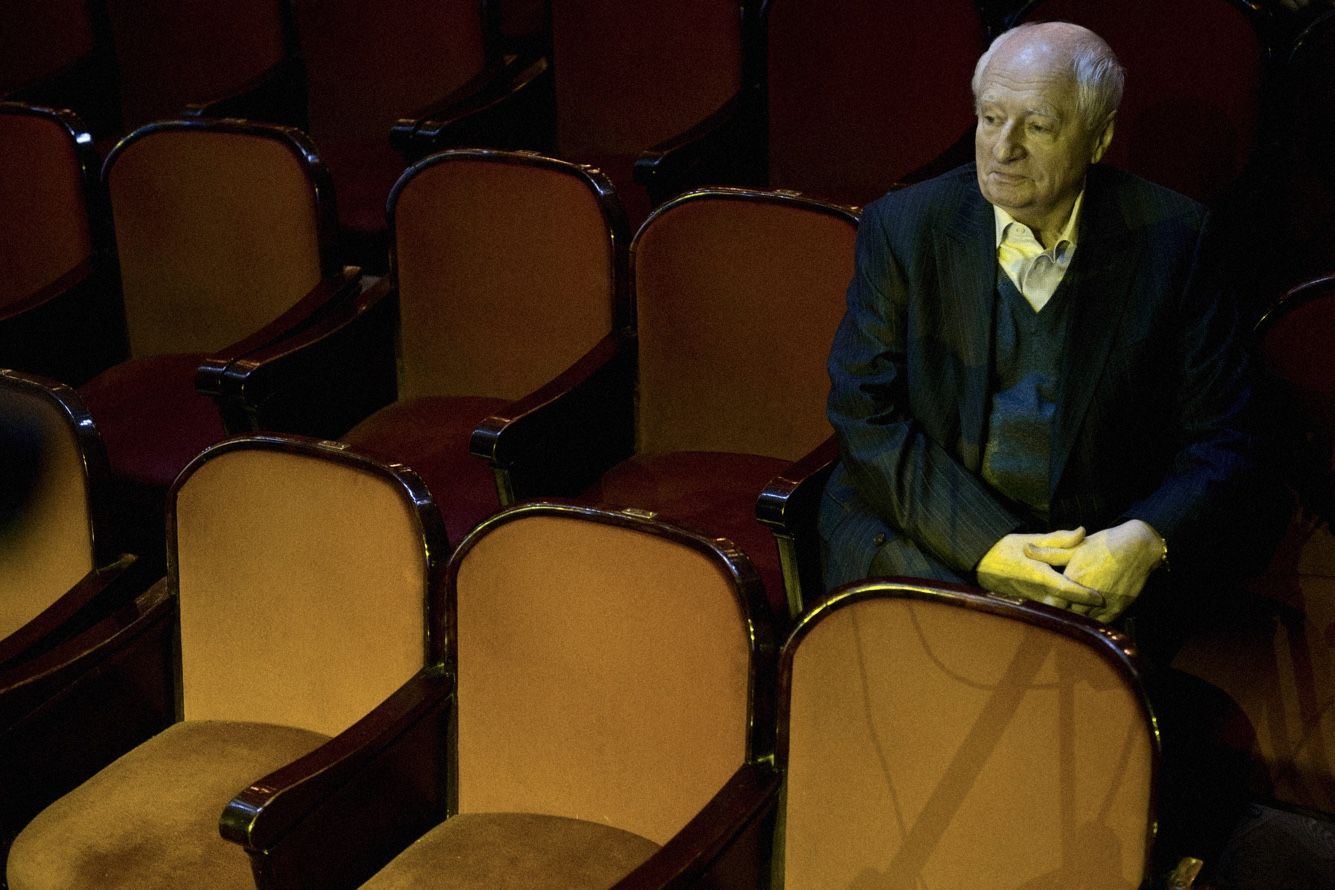
At the age of 85, the director, screenwriter and writer Mark Zakharov died. The aesthetics of his films in some were delighted, in others - rejection; The Lenkom Theater, which Zakharov headed since 1973, in Soviet times was a bastion of creative freedom, and in the post -Soviet era became the most popular in Moscow. The film critic "Medusa" Anton Dolin reflects on the place of Zakharov in modern Russian culture.
Mark Zakharov was more than the director. Not only because he staged equal success in the theater and cinema, he was a talented writer and screenwriter (his co -authorship is unmistakably felt in the White Sun of the Desert, made by other directors, “Sannikov’s earth”, “Star of captivating happiness”), and since the time of perestroika, a public figure, who burned his party, and one of the first ones called on one of the first To bury Lenin. It so happened that Zakharov’s films and performances not only reflected the era, but also determined it. On the one hand, they were an ideal embodiment of stagnation (Zakharov’s career began at the junction of the 1960-70s), since they were built on evasive metaphors, spoke in the “ezopian language”, which is understandable to the late Soviet intellectual. On the other hand, through the encoded dictionary of the fairy tale, the best Zakharov things smuggled freedom to society.
The heroes-noncontormers who allegedly belonged to other eras in co-authored by him in collaboration with the outstanding playwright Gorin Gorin did better than the most irreconcilable dissidents or writers of Samizdat. Publishers of the public-the rebellious bully Til, the ironic fantaser Munchausen, the silent paradox of Swift-were able to do what many dreamed of hidden: “Kill the Dragon” (that was the name of Zakharov’s last film, set in 1988). That is, to destroy the system of lies and suppression, which, it seemed, cannot be overturned by anyone and never.
From the “Dragon”, the most radical and deep play-short-faucet of Evgeny Schwartz-it may be legitimate to call him the teacher and inspirer Zakharov,-the director of the director, who put it in the student theater of Moscow State University, began. Then, already by a popular idol, Zakharov transferred it to the screen, taking in the main roles of his best artists. Schwartz determined the two poles of Zakharov’s work: the piercing, non -child’s lyrics of the “ordinary miracle” (the 1978 film became truly cult, obscuring the previous film adaptation, and is still considered a mandatory point of New Year's telemane) and the gloomy metaphorical satire of the Dragon. In both subjects, the usual logic of a fabulous archetype was violated with the presentation of Schwartz. Love was able to refute magic, man - to defeat the superhuman law. But the knight could not finally cope with the monster, which was essentially immortal. Zakharov and Gorin were a duet of idealists and, at the same time, skeptics.
From the first half of the 1970s, the Moscow “Lenkom” (Zakharov headed it in 1973, coming from the Satire Theater) was a bastion not so much free thought as creative freedom. There were almost Broadway shows, free both from Soviet condo and from the psychological penetration of the sixties Theater. Having mastered the fairy tale as the main genre, Zakharov did not make the difference between adults and children: in the Lenkoma orchestra pit, rock music rattled, artists knew how to dance and sing, but there were Chekhov, Arbuzov, and Petrushevskaya in the repertoire. Despite this, nevertheless, the main hits remained “Til” (1973)-Gorin’s interpretation of Roman Charles de Koster about Ulenshpigel, in which young Nikolai Karachentsov shone, and two rocks, “The star and death of Joaquin Murita” (1976)-Pavel Grushko’s play on Pablo Neruda and, of course, “Juno and Avos” (1981) by the poem (1981) in the poem (1981) in the poem (1981) by the poem (1981) Andrei Voznesensky, both to the brightest music of Alexei Rybnikov. “White Rosehip”, “I will never forget you” and “Hallelujah” from “Juno and Avos” were not just popular, but literally entered folklore - in particular, thanks to the television recording of the performance.
At the same time, Zakharov turned into a demanded director on television. First, he put the four -part “12 chairs” (1976) - many purists criticized the film adaptation, but Andrei Mironov’s charm and his organic duet with Anatoly Papanov compensated for any flaws. Then the “ordinary miracle” thundered, after him three original paintings were made in collaboration with Gorin: “The same Munchausen” (1979), “The House that Swift built” (1981) and “Formula of Love” (1984). Finally, the most high -budget and ambitious, the most dark and most ambiguous film of the tandem, was released on wide screens - “Kill the Dragon”. In these ribbons, a whole aesthetic code was formed, which caused some delight in some, from others - rejection. The emphasized conventionality, theatricality of dialogs and decorations, detachment from any specific historical context, without non -repayable memorable music (their best soundtracks for Zakharov created Rybnikov and Gennady Gladkov) ... Plus, of course, the bet on the actors - idols of the entire USSR.
Zakharov had his own troupe - or, it is better to put his word in quotation marks, the “troupe”, because not everyone played on the Lenkom stage, but were faithful to the director in his film projects. Oleg Yankovsky was, first of all, a star of films: a wizard, Munchausen, Swift, Dragon - despite the more complex and multi -layered work of Balyan or Tarkovsky, the people loved him primarily for Zakharovsky paintings. Alexander Abdulov shone on stage (he was the hero of the Joquin Murita, and Juno and Avos) and remained a permanent partner and opponent of Yankovsky in films: Bear, Doctor, Lancelot. Nikolai Karachentsov was a superstar of the Rock-Oper Lenkom and impeccable Tilel, and in the films appeared in episodes. Andrei Mironov, on the contrary, played at Zakharov primarily in the cinema - he was unforgettable in “12 chairs” and “ordinary miracle”. Evgeny Leonov became an affectionate embodiment of despotic savagery in the roles of the king from an “ordinary miracle” and a burgomaster from “killing a dragon”, and on the stage he was transformed into a good -natured Lamma Guzak; He, perhaps, played his most important theatrical role shortly before his death-in the “Memorial Prayer”, the most famous performance of the turn of the 1980-90s.
This period was another take -off of Lenkom and Zakharov, who then decided to leave the cinema and concentrate on the stage. In the post -Soviet period, Lenkom finally turned into the most popular and expensive metropolitan theater. As director Zakharov, he put on the stage sensual and spectacular show performances criticized for a lack of taste-“crazy day, or marriage of Figaro” and “royal games”-interspersing them with the interpretations of the classics: “sage” according to Ostrovsky, and “barbarian and heretic” according to Dostoevsky. The audience went “to Zakharov”, but also on the actors - the new generation stars appeared in the theater (for example, Dmitry Pevtsov), the artists of the Soviet era, in particular, Leonid Krodanova, Alexander Zbruev, Inna Churikova, also found the second wind. A particularly important place in the repertoire was taken by Chekhov, expressive and grotesque, but, at the same time, melancholy, “Cherry Garden” and “Seagull”. The last collaboration with Gorin was the Jester Balakirev (2001) - the domestic paraphrase of the legendary Tilya.
He could not return the former glory “Lenkom”, but he kept the bar. One of Zakharov’s last productions was his interpretation of the “Oprichnik Day” by Vladimir Sorokin. Having left the radicalism of the anti-utopian pawl, the director again tried to tell the story of the self-proclaimed lanzelot and caricature dragon: he romanticized the hero-specialist, entrusting his role to one of his beloved actors Viktor Rakov, and placed accents in his own way, reminding the nostalgic spectators of his early work. It is difficult to say whether this is able to feel and love the public of a new generation. But clearly definitely: she fell in love with the films of the talented student Mark Zakharov - the author "Bitter!" Zhora Kryzhovnikova, and appreciated the courage of Lenkom’s artistic director, who in recent years called Konstantin Bogomolov to his theater, where he staged his two most radical performances, Boris Godunov and Prince.
Anton Dolin