
Translated material
Forbidden education
The Dmitry Zimin Foundation “Dynasty” can cease to exist under pressure from the Ministry of Justice. The New Times reminds readers, which, in addition to supporting scientific and educational projects, enriched the Russian intellectual life
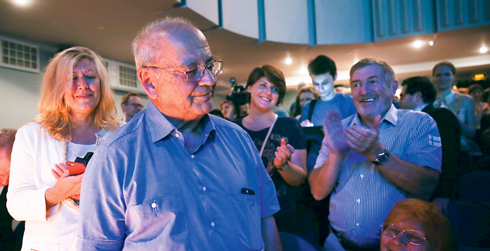
Dmitry Zimin at the presentation of the Politzesvet-2015 award, Moscow, May 27, 2015
On May 25, the Ministry of Justice introduced the Dynasty Foundation to the register of foreign agents, and on May 28 he asked him to bring him to administrative responsibility for non-compliance with the NPO-Ino-Agents Law. For the first time, an organization that does not receive money from abroad fell under the law, but distributes it. Dmitry Zimin, the founder of the Dynasty, said that he was terminating funding the fund: "Of course, I will not spend my personal money under the brand of an unknown foreign state." What will now happen to the "dynasty" will decide the Council of the Fund, the meeting of which is scheduled for June 8.
What was happening with the fund forced to react the scientific community, and not only through speeches in the media. On June 6, a rally and a procession of scientists in support of the "dynasty" may take place in Moscow. The application is submitted to the city hall, there is no answer yet.
Since 2002, the Fund has been in Russia a series of projects aimed at maintaining and developing fundamental science and education. These are grants for young scientists, symbols-teachers, as well as the Enlightener Award in the field of Russian-speaking literature non-fiction.
In addition, the fund has published scientific and popular science literature since 2006-dozens of books of the most famous scientists and popularizers of science have published in Russia.
Everyone knows about the Nigerian radical movement "Boko Haram", whose members exterminate students and schoolchildren. Its name is translated into Russian from the language of House as "Western education is prohibited." But the original word “Boko” came from the English “book” (book), and “haram” in Russia does not need translated. We have not yet been killed for reading, and the books that the “dynasty” managed to publish are exists and will forever stay with us. NT publishes a complete list of books that have appeared in Russia thanks to the Dynasty fund. There may be no new ones.
2015
Frenkel, Edward. Love and mathematics. St. Petersburg: Peter. The popular science work of one of the leading mathematicians in the world, a professor of California University of Berkeley, allows you to see sophistication and beauty in the most accurate of sciences.
Carroll, Sean. Adapt and survive! M.: AST, Corpus. The largest expert in evolutionary theory of development explains how, studying DNA, today understand the mechanism of work of natural selection.
Henderson, Caspar. A book about the most unimaginable animals. Bestiary of the 21st century. M.: Alpina non-fiction. Fictional monsters created by the fantasy of man are nothing in comparison with the creatures who live on the same planet with us.
Sasskind, Leonard, Friedman, art. Quantum mechanics. Theoretical minimum. St. Petersburg: Peter. The course of lectures of famous American scientists, focused on non -specialists.
Dokins, Richard. A blind watchmaker. M.: AST, Corpus. The world bestseller of the most famous British biologist is a full set of modern arguments in defense of the theory of Darwin.
Ashcroft, Francis. Spark of life: electricity in the human body. M.: Alpina non-fiction. Ion channels initiate the electrical activity of the cells, thanks to which we think, move, say, and, perhaps, love.
Stuart, Ian. The greatest mathematical tasks. M.: Alpina non-fiction. The popular story of the famous English mathematician about the most famous riddles of this science, unproven theorems and insoluble paradoxes.
Chaun, Marcus. Solar system: a guide to the near and distant environs of our planet. M.: AST, Corpus. The English astronomer tells how the Universe works, and NASA photos allow you to see it with their own eyes.
Hazen, Robert. History of the Earth: from star dust - to a living planet. M.: Alpina non-fiction. What happened to the ground before people appeared on it who can describe it, how the planet itself arose and why life formed on it.
2014
Wilson, Edward. The owners of the land. SPb: Peter. The sociologist from Harvard is sure: the family and group selection determined how humanity looks today, and the sources of religion and morality should be sought in biology.
Koronovsky N.V. Earth. Meteorites, volcanoes, earthquakes. Fryazino: century 2. How our planet is arranged from the inside and how it is studying its device today.
Markov A. Evolution. Classical ideas in the light of new discoveries. Moscow: AST, Corpus. The head of the Department of Biological Evolution of the Biofac Moscow State University proves that modern discoveries are not refuted, but on the contrary, confirm Darwin's guesses.
Changizi, Mark. Revolution in vision. M.: AST, Corpus. All about the structure and origin of the human eye.
Carter, Rita. How the brain works. M.: AST, Corpus. A complete and affordable set of knowledge about the structure of the main organ of the human body.
Barrow, John. The history of science in famous images. M.: Exmo. Drawings and schemes also moved science forward, helping scientists to look at the problem in a new way that previously seemed insoluble.
Sagan, Karl. A world full of demons. M.: Alpina non-fiction. Ignorance, fear or banal greed - the main reasons for the appearance of pseudo -scientific myths.
Sasskind L., Grabovsky J. Theoretical minimum. St. Petersburg: Peter. The classic foundations of the natural sciences for those to whom school lessons of physics seemed too boring.
Randall, Lisa. Knock to heaven. M.: Alpina non-fiction. The professor of physics of Harvard University proposes, having dealt with the latest discoveries in the field of physics of elementary particles, to look at the structure of the world in a new way.
De Vaal, France. The origins of morality. M.: Alpina non-fiction. The author, who has been studying chimpanzees and monkeys of Bonobo for many years, believes that the origins of morality can be found in animals.
Forty, Richard. Trilobites: witnesses of evolution. M.: Alpina non-fiction. The British paleontologist talks about the times when the trilles inhabited the earth, and why they disappeared forever.
2013
Shubin, Neil. The universe is inside us. M.: AST, Corpus. A professor of biology at the University of Chicago proposes to see the history of the formation of a planet within a person.
Butovskaya M. L. Anthropology Paul. Fryazino: century 2. How do men differ from women? Is the specificity of behavior and psyche the physiological and genetic characteristics of the sexes? Why are gender stereotypes originating in traditional societies, so tenacious?
Lane, Nick. Staircase of life. M.: AST, Corpus. Like each of the outstanding “inventions” of evolution - from the emergence of life itself to the emergence of consciousness - changed our planet.
Dokins, Richard. Capellan Devil. M.: AST, Corpus. A collection of essays of an outstanding English biologist.
Zimmer, Carl. Microcosm. M.: Alpina non-fiction. Why the intestinal stick became the most studied creature on Earth and how this microbe helped to develop biology.
Dokins, Richard. Selfish gene. M.: AST, Corpus. Can a person win the egoism of his own genes?
Kumar, cuff. Quantum. M.: AST, Corpus. Quantum physics of the first half of the twentieth century and its creators.
Ridley, Matt. The origin of altruism and virtue. M.: Exmo. The set of recent discoveries in the field of studying the social behavior of man from the point of view of biology.
Petrov A.N. Gravity. From crystal spheres to mole. Fryazino: century 2. How were the ideas of scientists about what gravity is.
Lekuter, Penny. Napoleon buttons. M.: Astrel, Corpus, 2013. Chemistry is a real engine of human history, the authors of the book are sure.
Sax J. Microbes are good and bad. M.: ACT, Corpus. What was a mistake of a person, unfolding a merciless war against microbes.
Sasskind L. Battle of a black hole. SPb: Peter. The author poked with Stephen Hawking for many years, proved that the views of the latter on the nature of black holes are erroneous, and wrote a book about his victory.
Spencer Wells. Genetic Odysseus of man. M.: Alpina non-fiction. A popular set of information about the latest discoveries in the field of molecular biology.
2012
Theodore Gray. Elements: Guide to the periodical table. M.: Astrel, Corpus. Each chemical element from the Mendeleev table can become a real hero of a fascinating story.
Vileyanur Ramachandran. The brain tells. What makes us people. M.: Career press. Is it possible, studying neurons, to explain the specifics of human behavior.
Richard Dokins. The most grand show on Earth: evidence of evolution. M.: Astrel, Corpus. Darwin’s teaching is irrefutable, because it is true, ”the famous author is convinced.
V.P. Reshetnikov. Why the sky is dark. How the Universe works. Fryazino: century 2. What can be found about the universe, analyzing only observed facts. By whom, how and when these discoveries were made,
Stephen Hawking. The highest plan. SPb: Amphora. The most famous astrophysicist in the world tells how the Universe develops and whether the hypothesis is necessary about the existence of its creator.
Shintan Yau, Steve Nadis. Strings theory and hidden measurements of the universe. St. Petersburg: Peter. What is the essence of one of the most scandalous physical theories of modernity
2011
Mitio Kaka. Physics of the future. M: Alpina non-fiction. More than three hundred leading scientists in the world told the author what problems they are now working on.
Olivia Jadson. Each creature by pair: sex for survival. M.: Alpina non-fiction. The author in a playful way, responding to fictional letters of representatives of all types of fauna, understands questions of sexual activity in nature.
Eric Kandel. "In search of memory: the emergence of a new science of the human psyche." M.: Astrel: Corpus. Autobiography of the Nobel laureate in the field of biology.
Alexander Markov. The evolution of man. M.: Astrel, Corpus. All that we currently know about the origin and evolution of man.
Jared Diamond. Collapse. M.: Astrel, Corpus. An attempt to comprehend the history of mankind, attracting the experience of natural sciences.
Karl Zimmer. Evolution: Triumph of the idea, M.: Alpina non-fiction. How evolved by scientists about evolution from the time of Darwin.
Cvetlana Burlak. The origin of the language: facts, research, hypotheses. M.: Corpus. Why did people start talking and what do modern linguists know about this?
Matt, Ridley. "Sex and evolution of human nature." M.: Exmo. British biologist on how sexual reproduction affects evolution.
Karl Zimmer. Parasites: Secret World. M.: Alpina non-fiction. It is difficult to love these creatures, but understanding the features of their life is very exciting.
Chris Terni. Bones, rocks and stars. M.: Alpina non-fiction. What methods do historians and archaeologists use to date certain events. How to understand whether written sources lie, and why a radiocarbon analysis is needed.
Jonathan Smith. Pseudo -ass and paranormal phenomena. M.: Alpina non-fiction. The head of the Laboratory of the Pseudonauki University of Roosevelt (Chicago) explains how to distinguish real science from fake.
2010
Richard Dokins. Extended phenotype: Gene's long hand. M.: AST, Corpus. Natural selection - how can the mechanisms of its functioning be explained from the point of view of genetics.
Paul Halpern. Collider. M.: Exmo. Why scientists built a large adron collider and what are they going to find.
Chris Frit. "Brain and Soul." M.: Corpus, Astrel. The British neurophysiologist about what does the brain do when we think, feel or experience emotions.
Ian Stuart. Truth and beauty M.: Corpus, Astrel. The professor of mathematics of the University of the University (Great Britain) talks about the theory of symmetry and the people who created it.
Alex Vilenkin. The world of many worlds. Physicists in search of parallel universes. M.: Astrel. Professor of the University of Taft (USA) summarizes modern achievements in the field of cosmology and sets out his own theory of the existence of parallel universes.
James Watson. Avoid boring. M.: Astrel. Autobiography of the Nobel laureate, who opened the structure of DNA.
Neil Shubin. Inner fish. M.: Astrel, Corpus. The story of how our body evolved and why today it looks that way.
John Derbishir. Simple obsession. M.: Astrel. The history of mathematicians who tried to prove the hypothesis of Riman.
Vladimir Tsimbal. Plants. Parallel world. Fryazino: Age 2. Plants from the inside - how they are arranged.
Sergey Kapitsa. Growth paradoxes. M.: Alpina non-fiction. The demographic concept of a famous physicist.
The origin of life: science and faith. M.: Corpus. Specialists of the American National Academy of Sciences act as defenders of the theory of evolution and criticism of creationism.
Arman Marie Leroy. Mutants. M.: Corpus. British biologist about how, studying mutations, one can understand the laws of the development of the human body.
Jared Diamond. Guns, microbes and steel. M.: AST. Can natural sciences explain the reasons for the uneven development of various regions.
2009
Gene Akiyama, Marie-Jo Ruis. The country of mathematical miracles. Akiyama created an interactive park of mathematical models on the Japanese island of Hokkaido, according to which the heroes of the book travel.
V.I. Arnold. The geometry of complex numbers, quaternions and spins. M.: MCNMO. One of the largest mathematicians of the twentieth century in an accessible form for schoolchildren sets out the main facts of the theory of complex numbers.
V.I. Arnold. Mathematical understanding of nature. M.: MCNMO. The structure of the world in terms of mathematics in the presentation for children.
V.I. Arnold, A. N. Varchenko, S. M Huseyn-Zade. Features of differentiated display. M.: MCNMO. An overview of one of modern mathematical theories addressed to specialists.
V.I. Arnold. Chain fractions. M.: MCNMO. A lecture for schoolchildren, read in the small Mehmate of Moscow State University and supplemented by the author.
Nikolai Copernicus. About the rotations of the heavenly spheres M .: Amphora. The main work of the father of the heliocentric system of the world.
Mitio Kaka. Physics of the impossible. M.: Alpina non-fiction. One of the authors of the theory of strings is trying to guess that from fiction fiction can be realized.
2008
Richard Dokins. God is as an illusion. M.: Hummingbird. The main atheistic work of an unbending fighter against creationist theories.
V.I. Arnold. What is mathematics? M.: MCNMO. A review of the history of attempts to answer the question whether mathematics is science in a number of other natural sciences.
V.I. Arnold. "Principles of selection and compilation of arithmetic tasks." M.: MCNMO. How to form a course of mathematics in high school.
V.I. Arnold. “Hard” and “soft” mathematical models. M.: MCNMO. Why differential equations to economists, sociologists and ecologists.
Karl Sagan. Space. M.: Amphora. The most famous popularizer of science of the twentieth century about how the Universe evolved.
Albert Einstein. Work on the theory of relativity. M.: Amphora. A collection of texts addressed including non -specialists. The preface by Stephen Hawking.
Philip Bolle. Critical mass: as some phenomena generate others. M.: Geleos. How the development of natural sciences are used in the analysis of social phenomena.
Ella Paneye. Rules for the game for a Russian entrepreneur. M.: Hummingbird. A sociologist from Petreburg about what problems await a person who has solved the business in Russia, and how the state will interfere with him.
Matt Ridley. Genom: Autobiography of the species in 23 chapters. M.: Exmo. The popular story of the British zoologist about modern genetics.
Robert Hillbroner. Philosophers from this world. M.: Hummingbird. Biographies and theories of leading world economists.
2007
Stephen Hawking. The world is in a walnut shell. SPb.: Amphora. The continuation of the “brief history of time”, an attempt to talk about the possibility of creating a “theory of everything”. 2002 Aventis Award is the best author who writes on scientific topics.
V.I. Arnold. Tasks for children from 5 to 15 years old. M.: MCNMO. A collection of tasks that allow you to teach the child to think as a mathematician.
James Trefil. 200 laws of the universe. Published on the website "Elements". M.: Geleos. Encyclopedia of physical knowledge from the university professor George Mason (USA).
2006
Bill Bryson. A brief story in almost everything in the world. Published on the website "Elements". M.: Geleos. Encyclopedia of Knowledge of Nature, 2004 Aventis Award for the best book of science.
Photo: Sergey Savostyanov/TASS