
Translated material
From soldier to Marshal
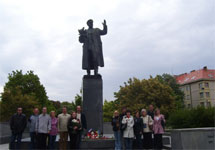
The Czech side considers the possibility of transferring the monument to the Soviet Marshal Konev, installed in one of the Prague regions. According to RIA Novosti, this was announced on Monday by the head of the military-memorial center of the Russian Armed Forces, Major General Alexander Kirilin.
“I loomed the possibility of transferring the monument to Konev, installed in the 6th district of Prague, under the pretext of some reconstructions of this area,” the general said. “At the same time, they plan to reduce the height of the pedestal, to“ push ”it a little deeper and so on.”
According to him, all these issues must be regulated, taking into account the opinion of the Russian side. “We have levers of pressure on them,” the general said. He explained that the "levers" are concluded in an intergovernmental agreement, as well as in agreements on issues related to humanitarian problems.
Kirilin recalled that in June, the Russian-Chesh and Russian-Slovak intergovernmental commissions signed protocols on the status of military burials and leaving them. It was recorded in the protocols that the continuation of work on perpetuating the memory of the fallen warriors, the preservation of monuments and memorials will serve to strengthen the relations of the Czech Republic, Slovakia and Russia and the patriotic education of the Slavic peoples. “Therefore, we hope that nothing without our participation and consent will happen,” the general added.
According to him, recently in the Czech Republic "cases of unlawful actions in relation to our monuments have become more frequent.
As the agency recalls, in early July, a memorial to the soldiers of the Red Army was desecrated at the Olshansky cemetery in Prague: unknown people abducted copper details from 48 steles on tombstones. A similar case occurred on May 20-21 - then the vandals were removed by bronze tablets with the names of the soldiers and the symbols of the Red Army with 12 graves.
Last spring, a loud scandal over the Soviet monument erupted between Russia and Estonia. His reason was the decision of the Estonian authorities to transfer the monument to the Soviet soldiers in Tallinn - the so -called bronze soldier. Mass riots arose in the Estonian capital. In Moscow, opponents of the transfer of the monument, under which the mass grave was located, besieged Estonia Embassy for several weeks.
The need to maintain Soviet monuments doubt the authorities of many post -Soviet and post -socialist countries. In particular, this issue was widely discussed in Ukraine, in Poland and Hungary. The Russian authorities every time acutely react to the intentions of other states to demolish or transfer Soviet monuments.
Meanwhile, "memorial" scandals also arise in Russia. The most noticeable of them was in Khimki, where local authorities expanded the road, demolishing a monument to Soviet pilots. The remains of the heroes of the war were exhumed and then reburied in the cemetery.