
Translated material
They did not give Moscow
On October 7, 1941, the troops of the German Army Group Center closed the encirclement ring around the main forces of the Soviet Western and Reserve Fronts, forming the Vyazemsky boiler. Earlier, the main forces of the Bryansk Front fell into the boiler. The combat -ready Soviet troops on the path of the Wehrmacht to Moscow almost did not remain. These were the results of the Typhoon Operations on October 30 - October 2, during which Hitler hoped to inflict the decisive defeat of the Red Army. Almost all surrounded were destroyed or captured - the Germans captured 665 thousand people.
The Wehrmacht has achieved such impressive success, without a significant advantage in power. In the three Soviet fronts that opposed the Army Group Center, Western, Reserve and Bryansk, on October 1, 1941 there were 83 rifle divisions, 1 rifle regiment, 1 motorized rifle brigade, 9 cavalry and mining divisions, 2 URI, 1 flammable battalion, 2 motorized rifle divisions, 2 motorcycle regiments, 1 motorcycle regiment, 1 Tank division, 13 tank brigades, 4 tank battalions. This amounted to about 104 and a half settlement divisions, or 34.9% of all Soviet forces at the front, but only 27.4% of all tank formations. The Germans attracted 49 infantry divisions, 1 cavalry division, 1 cavalry brigade, 4 security divisions, 14 tank divisions, 7 motorized divisions, 1 motorized brigade, 1 motorized regiment, 1 cavalry division. This was more than half of the number of the German Eastern Army.
In three Soviet fronts, according to our assessment, together with the rear there were 1,985,000 people. They had 900 tanks, 7,600 guns and mortars and 667 combat aircraft. The Army Group Center had 1.8 million people, 1,500 tanks and assault guns, 3,000 artillery guns, and the 2nd air fleet supporting it had about 1000 combat aircraft. In practice, the Germans did not have any numerical superiority in airplanes, since Moscow Air Defense and District Bombarding Air Defense Air Defense also acted in the Moscow direction. And the German numerical superiority in tanks was largely compensated by both the Soviet numerical superiority in artillery and the presence of a significant number of armored units and formations as part of the Moscow Military District. In addition, the Soviet T-34 and KV in their combat capabilities significantly exceeded the then German tanks. The Germans, however, had a higher level of preparation of crews and command with tank formations, and the army as a whole.
Flight from the capital
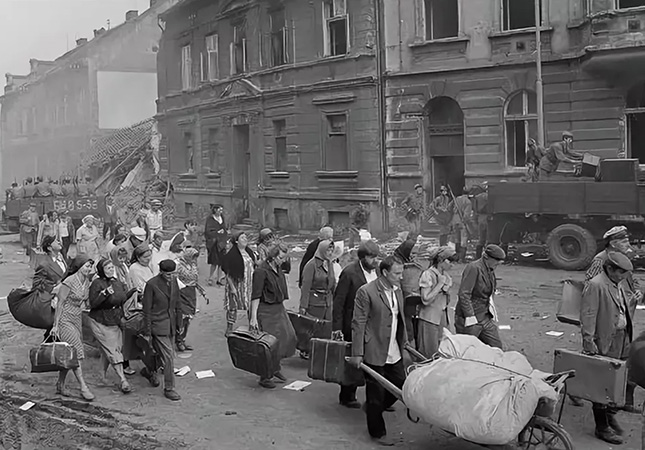
Rumors that the Red Army was defeated, quite soon, on October 15, reached Moscow. On this day, the State Defense Committee of the USSR adopted a resolution "On the evacuation of the capital of the USSR Moscow", signed by Stalin. The General Staff, the People's Commissariat of Defense and the People’s Commissariat of the Navy were immediately evacuated from Moscow. On the same day, the diplomatic corps, the Presidium of the Supreme Council and the Council of People's Commissars of the USSR left on Kuibyshev. Stalin, as said in the resolution, "is evacuated tomorrow or later, depending on the situation." The head of the NKVD Lavrenty Beria and the First Secretary of the Moscow Committee of the CPSU (B.) Alexander Shcherbakov was ordered "in the event of an enemy’s troops at the gates of Moscow ... to make an explosion of enterprises, warehouses and institutions that cannot be evacuated, as well as the entire electrical equipment of the metro (excluding water supply and sewage)."
The nomenclature officials immediately rushed to the Moscow stations in order to be evacuated to the east with their families and property. Crowds of people stormed echelons. On the east, tens of thousands of Muscovites and thousands of cars also stretched along the Vladimir tract. On the morning of October 16, the Moscow metro did not open, as preparations were carried out for its destruction. But already in the afternoon, the corresponding instruction of Lazar Kaganovich, meaningless in itself, since in the event of the fall of the capital, it would create problems not for the Germans, but for the Muscovites, was canceled by the State Committee of Defense. But they managed to blow up the tower of the most powerful in the world of the Comintern radio station, located 50 kilometers east of Moscow. This action also did not have military importance and became the result of the Soviet leadership of panic.
Industrial enterprises and institutions were closed, employees were given a monthly salary, but they could not do this everywhere, since the authorities had already escaped. The most high -ranking party and Soviet workers hastily left Moscow. A few days later, when the panic subsided, the first deputy head of the guard, the senior major of state security Dmitry Shadrin, reported the deputy -brim of the internal affairs of Vsevolod Merkulov the results of the inspection of the building of the Central Committee of the CPSU (b) on the Old Square: “Not a single employee of the Central Committee of the All -Union Communist Party of Bolsheviks (b), which could put the entire premises in order and burn the existing secret correspondence, The whole farm was left - the heating station, refrigerated installations, electrical equipment, etc. - was left without any supervision. The directives of the Central Committee of the All -Union Communist Party of Bolsheviks (b) and other documents ... Five secret packages were discovered in the office of Comrade Zhdanov. "
In Moscow, the robberies of stores began.
Riot in the city of brides
Unrest also occurred in some cities to the east of the capital. In Ivanovo, when it was decided to evacuate the factory equipment, a spontaneous rebellion in several factories broke out. A few days after its suppression, the Ivanovo Regional Committee of the CPSU (b) reported to the Central Committee "On the facts of anti -Soviet speeches", including at the Melange Combine:
“There was no explanatory work among workers on evacuation issues. As a result of October 18, workers, having come to work at 6 a.m., saw part of the disassemble equipment in the workshops ... The noise and cries began:“ The equipment will be taken away and they will leave us without work. We will not let the equipment disassemble and take away "... In order to avoid further inorganization and disorder, it was announced to convene the collection of workers. The meeting began at 14 o’clock. The secretary of the city committee, Comrade Taratynov, the secretary of the regional committee, Comrade Lukoyanov, secretary of the Kirov district committee, Comrade Veselov, director of the Complex, member of the party, member of the party. Buteneva took the floor and in her speech said: “Well, if you regret the machines, then you must first take out the family. We will not give the equipment to export the equipment. ”A group of active participants in the riots began to break boxes with equipment with axes and hammers.
On the morning of October 19, the events at the plant began to take up a more acute character. At about 9 a.m., the same group of weavers again began to break the boxes with equipment. Attempts by counteraction made by the heads of the plant did not lead to anything. Many workers began to quit their jobs. About 150 people burst into the office of the head of the spinning factory of Rastigin, who ran away from them and hid in sorting under a tarp. The head of the weaving factory Nikolaev fled home, who was frightened of the threats to kill him for rudeness with the workers. "
But how they described in the same dockdad the riots at another factory:
"On October 19, the secretary of the party bureau of the factory named after Dzerzhinsky Filippov began to explain to the employees why the equipment was evacuated, but one of the employees shouted:" Let the equipment stay in place, and if Hitler comes, we will work for him. "Then Filippov said:" We will not leave anything to Hitler, destroy the factory. " The provocatives began to be picked up. Add to dinner 100 grams of bread! Give free manufactories for free! ”Party asset, employees of the district committee and the city committee of the CPSU (b) explained to workers the incorrectness of rumors bloomed by provocateurs. In response to this, cries were heard from the crowd:“ Do not listen to them, they themselves do not know anything, they have been deceiving us for 23 years. They themselves evacuated their families, and we are sent to the labor front "."
In the Rogachev factory "A group of provocateurs and hostile personalities even threw off the slogan:" Down with Soviet power, long live the father of Hitler! "" .
For the first time after the Civil War, the Soviet government was really staggered, but resisted. There was no one to lead a spontaneous protest. All any prominent opponents of Stalin were either shot (a large group of them was eliminated before the start of Typhoon in September 41st in the Oryol prison), or were in the camps far beyond the Urals. There was no organized opposition in the USSR by that time. Yes, and it was not clear with which slogans to rebel against Stalin. The progerman slogans, although they were advanced, were not very popular. It was pointless to overthrow Stalin for the sake of continuing the war against Germany, since this could only weaken the military efforts of the USSR and lead to the German occupation of the main Soviet centers, including Moscow and Leningrad. The experience of 1917 clearly testified to this prospect. In addition, Hitler at that moment did not nominate any alternative to Stalin. Just as during the 1918 occupation, the Germans retained the Bolshevik regime as the smallest of evils for themselves and even helped him to stay in power, Hitler in 1941-1942 hoped that after applying the decisive defeat of the Red Army and Stalin, it would be possible to agree on the world on Germanic conditions similar to Brest.
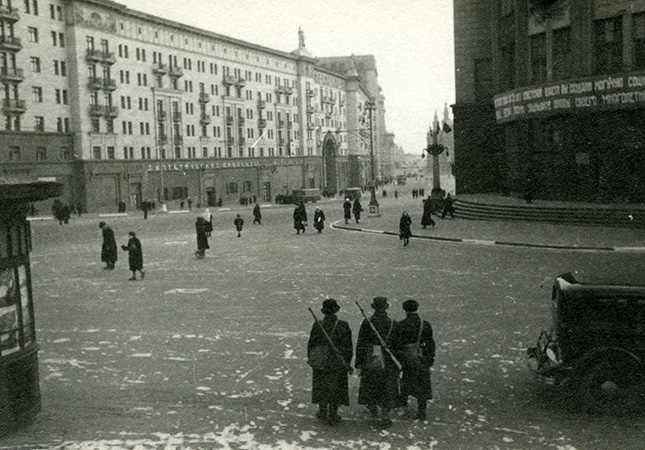
Patrol on Gorky Street in 1941
The panic in Moscow ceased after a performance on the radio on October 17 of the leaders of the capital with an announcement that no one was going to hand over the city to the Germans. And on October 19, a decree of the State Defense Committee “On the introduction of the sedimentary regulations adjacent to the city” was issued, according to which “violators of the procedure followed immediately to be held accountable with the transfer of a military tribunal to the court, and provocateurs, spies and other enemy agents, calling for violation of the order, shoot on the spot”. On the streets of the capital, military and police patrols appeared, which implemented this resolution.
Why didn't the Germans take Moscow?
The main forces of the Army Group Center until October 18 were constrained by the struggle against the surrounded Soviet troops. After October 7, the weather worsened, and the roads turned into continuous dirt, after which many German formations had to be supplied through the air. It was possible to advance only along roads with a hard coating, where the relatively small Soviet forces could restrain German tank and motorized units. By the end of October, the advance was completely stopped due to the risk. In addition, even after the defeat near Vyazma and Bryansk, Moscow was to protect. As a result of the liquidation of the Vyazemsky and Bryansk boilers, the Army Group Center for a short time reached the advantage over the Soviet troops by 1.4 times. But the Red Army achieved equality by the number of tanks and won dominance in the air.
On November 1, the 2nd fleet had only about 700 aircraft, it was opposed by about 1,200 Soviet aircraft. Between November 15 and December 5, in the Moscow direction, Soviet Air Force made 15,840 aircraft against 3,500 Luftwaffe aircraft. Soviet aircraft flew from well -equipped airfields of the Moscow Aviation, while the Luftwaffe used field airfields, which were difficult to operate in the conditions of a beginning winter. In addition, the Germans began to feel a lack of fuel.
In mid -November, the Germans undertook the last attack on Moscow, which completely stopped in early December. Well, after the start of the Soviet counterattack on December 5-6, the question of the possible fall of the capital was finally removed from the agenda.
Objectively speaking, the Wehrmacht had no chance of taking Moscow. By November 1941, all the resources of Blitzkrig were exhausted. The Soviet Union, who relied on the support of allies, resources, including human, was enough not only to win in the Moscow battle, but also in the war as a whole.