
Translated material
Ministry of Communications: There will be no censorship on the Internet
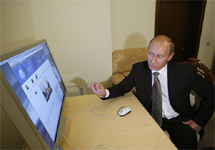
There will be no censorship in the Russian Internet, despite the relevance of cybersecurity problems. Such an opinion in an article published in Vedomosti said Igor Schegolev, Minister of Communications and Mass Communications. "There is an opinion that the Russian government is allegedly striving for greater state control over the Internet. But in our country it is not even considered the opportunity in the case of social riots to block access to Twitter or Facebook, while some European countries openly proclaimed that they would use just such a measure," the minister writes.
In his opinion, the SOPA anti-pirate bill poses a serious threat to freedoms on the Internet, in protest against the possible adoption of which Wikipedia blocked access to its pages for Internet users. “The adoption of SOPA will not only negatively affect the development of the Internet as a business space, but in fact it can become a censorship tool, which contradicts democratic principles and is not at all consistent with the position of US Secretary of State Hillary Clinton, who loves to talk about“ fundamental freedoms ”for the Internet, especially when Twitter or Facebook are mentioned,” writes Eschalev.
On January 12, Secretary of the Security Council Nikolai Patrushev said that they are actively trying to influence the opinion of Russians before the presidential election. “Say, through various non-governmental organizations and funds, and sometimes directly from abroad they try to influence the opinion of Russians. At the same time, various modern technologies are used, by the way, already tested in a number of other states, including the possibilities of social networks of the Internet,” Patrushev said. In his opinion, neither the West nor someone else won from protest activity ", but specifically the Communists win."
At the same time, the head of the Security Council believes that "despite the efforts to encourage the situation, our citizens are able to evaluate the situation themselves." "Those who come to rallies have no extremist or aggressive sentiment. Attempts to intervene in our internal affairs, they cannot cause anything but rejection," Patrushev said. “You, like me, know the leader of the presidential race - this is Vladimir Vladimirovich Putin,” Patrushev said.
In turn, the Prosecutor General Yuri Chaika said that money for many thousands of rallies and protests are coming from abroad. "It is unacceptable when individuals use people as a tool to achieve their political goals, and far from clean. After all, money for all this is often comes from the sources that are outside of Russia," the seagull said in an interview with Rossiy newspaper. He also stated that the Internet is used to spread "extremist sentiments".
On December 14, Patrushev said that in Russia it is necessary to introduce "reasonable Internet regulation." "Reasonable regulation, of course, should be carried out in Russia, as is already done in the USA, China and in many countries of the world," Patrushev said. "Attempts to stop the communication of people are in principle counter -productive and even immoral. However, it is impossible to ignore the use of the Internet by criminals and terrorist groups," Patrushev said.
On December 23, Patriarch Kirill said that the trust in the information posted on social networks makes Russians "especially vulnerable to manipulating their consciousness." In his opinion, the change of political vector cannot fundamentally change society, "if there is no attitude to the transformation of the human person." "The naive trust of the present person in the information posted on social networks, coupled with moral disorientation and the loss of basic values, make our contemporaries especially vulnerable to manipulating their consciousness," the patriarch said.
On December 8, the head of the Bureau of Special Technical Events of the Ministry of Internal Affairs, which includes the Office K, Alexei Moshkov, said that social networks, along with advantages, often carry a potential threat to the facilities of society, since extremist groups are often "organized in them." Moshkov proposes to abandon the use of anonymous nicknames on the Internet in order to protect law -abiding users. "Register under the real name, report the real address - and communicate. If you are an honest, law -abiding person, why hide? I remind you, there are no censorships on the Internet, and there will be no management and arrest for criticism," Moshkov said.
In August, the Minister of Internal Affairs Rashid Nurgaliev said that the Internet provokes the growth of extremist sentiments in society. According to the head of the Ministry of Internal Affairs, in Russia there are about 7.5 thousand extremist sites, the activities of which must be limited.
In May, that the head of the Synodal Department for the relationship between the Church and Society, Archpriest Vsevolod Chaplin, said anonymity on the Internet. “A person who communicates with others should not hide his name, just like during the conversation we do not hide his face. If a person wears a mask or nickname, there is every reason not to trust him,” Chaplin said. According to Archpriest, anonymous communication "monstrously destroys the culture and rules of the human dormitory." So, in his opinion, anonymous authors on the Internet "are many times more likely than people who do not hide behind the guise allow themselves to be obscene abuse, insults on a national and religious attribute, lies, slander, rudeness."