
Translated material
Shadows of shaved ancestors
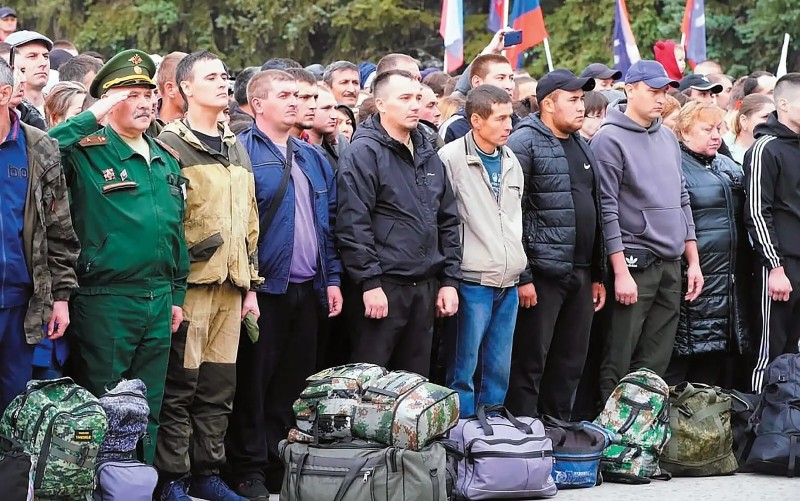
Photo: press service of the head of Bashkortostan
Sergei Shoigu reported on October 28 to Vladimir Putin about the completion of partial mobilization. That it will end no later than October 31, it was clear initially. On November 1, the next autumn appeal starts, and military commissariats, the police and the Russian Guard will be forced to switch to hunting for conscripts. But there may be nuances. There is no Putin’s decree on the completion of mobilization yet. Therefore, it cannot be excluded that at least in some regions, away from Moscow and St. Petersburg, the military enlistment offices will also be shaved out of older ages who will come across to raids on the conscripts.
According to the Shoigu report, 300 thousand people were mobilized in total, including 13 thousand volunteers, 82 thousand people have already been sent to the army. According to an alternative expert assessment of the "mediazone" , the real number of mobilized by mid -October reached 492 thousand people. However, this assessment seems to me very high, and that's why. Experts focused on the registry offices of 75 regions, including Moscow, according to which 31,000 marriages were concluded according to the accelerated procedure. Then they took the data of the latest census of the Russian population of 2021 on the number of men at the age of 18-49, who were in actual marriage, calculated their share among the male population in the appropriate age cohort for each region and extracted data on the number of conscripts who entered the accelerated marriage, for the entire male population of 18-49 years in all regions.
However, the number of men in actual marriage is an indicator that is obviously containing a large latent component. It is no coincidence that according to the results of all the census of the population of women in marriage, there are much more than men. The real proportion of men in actual marriage is much higher than the one that was shown in the 2021 census (this census itself was the most inaccurate for the entire time of Russian census, and its data can hardly be used). In addition, an accelerated marriage could be concluded not only by those people who had previously been in an actual marriage, but also those who had simply met before that and did not fall into the category of actual marriage. The story of the mobilized from the Kemerovo region is known, who is ready to conclude (and probably already concluded) a marriage with any woman, even unfamiliar, only so that in the event of his death, “grave” money went to the widow, not the state. Both of these factors - a large number of men living in an actual marriage, but not taken into account in this capacity, and men who entered into accelerated marriages but previously not in fact marriages - significantly overstate the assessment of the total number of mobilized, based on the number of accelerated marriages. It seems to me that the real number of mobilized in Russia from September 21 to October 28 really is about 300 thousand people.
The losses of Russian regular troops for the period from September 28 to October 28 inclusive, according to the assessment of the General Staff of the Armed Forces of Ukraine, 11,670 killed. If we assume that the number of wounded on the Russian side is approximately twice the number of those killed, then the total number of killed and wounded military personnel of the regular Russian army from September 28 to October 28 can be estimated at 35,010 people. Thus, 82,000 mobilized, if they were really sent to the front, could completely cover the losses killed and wounded over October, as well as previously not completed losses for September and other months. There was no doubt that such irreparable losses had no doubt - otherwise partial mobilization would not be started on September 21.
If the losses killed and wounded in the next months remain at the October level, then the 218 thousand mobilized ones remaining until the front are enough to replenish the losses killed and wounded for about six months, that is, until April 2023 inclusive. Let me remind you that mobilized and conscripts from Russia are not used to replenish the formations of the DPR and LPR and PMC "Wagner".
From the beginning of the war and until the morning of October 29, the losses of Russian regular troops killed, according to the Ukrainian General Staff, 70,250 people. Together with the wounded, general losses can be estimated at 210 750 people. Losses of the formations of the DPR and the LPR and the "Wagnerians" killed and wounded, in my assessment, are 1.8 times less than the losses of regular troops, that is, approximately 117,100 people. Perhaps the coefficient of 1.8 has slightly decreased over the past month, when Russian troops carried the main losses at Bakhmut, where the Wagnerians and Donetsk separatists fight almost exclusively. In total, this gives 327,850 killed and wounded, including 109,300 killed. The coefficient of confirmed losses in armored vehicles according to the ORYX website on October 29 was 3.52 in favor of Ukraine. Accordingly, the losses of the Armed Forces from the beginning of the war until October 29 can be estimated at 93,140 people, including 23,285 killed. With this ratio of losses, human resources of the parties are depleted approximately the same.
The level of preparation of mobilized in Russia , as well as the level of their provision of uniforms and weapons, is extremely low. Often, the equipment has to be bought by the mobilized himself, as was the case in feudal times, when a richer nobleman or citizen bought himself a more expensive and reliable armor, which increased his chances of survival in battle. According to Putin, the mobilized are trained in the rear of 5 to 10 days, and they are already in the units at the front. However, judging by numerous reports in Russian social networks, even this meager training in the rear does not bring special successes, and many mobilized before arriving at the front do not even really have time to shoot from their weapons. And at the front under the enemy fire, no more training is carried out.
The main weakness is the inability to fight in the units. Here we see a repetition of the mistakes that the Russian army made in the First World War. Then, in August 1914, during universal mobilization, the calculation was that it would be possible to win the victory during one campaign, even before Christmas. Therefore, almost all experienced non-commissioned officers from training teams and from the first stage, often not even to non-commissioned officer posts were thrown into battle. And when the war took on a protracted character, there were great difficulties with the preparation of mobilized ones, which sometimes there was no one to teach.
In the same way, at the beginning of the war with Ukraine, counting on Blitzkrieg, the Russian command threw all reserves to the front, up to the staff of the training units with their weapons and equipment. As a result, when it came to partial mobilization, there was no one to teach mobilized and nothing. And mobilized officers, without any team experience formed from mobilized companies, are often commanded. It makes no sense to form new parts of even a battalion level, not to mention the brigade level, since these new units will greatly inferior to those parts that are at the front. Units consisting of mobilized will lose the bulk of the personnel even before soldiers and officers have time to get at least some combat experience. Therefore, mobilized Russians will most likely be used to replenish existing parts, and not for the formation of new ones. Therefore, it will not be possible to achieve by mobilization of a fracture in the war.
The Ukrainian army also has its own problems with mobilization. But there, at least, even soldiers of the simplest specialties - motorized rifles - are prepared before the front for a month (during the war in the Donbass in 2014-2016 they prepared at least 2 months), and military personnel of other specialties for several weeks or months. In addition, Ukrainian troops are much better motivated than Russian, and among them there are much fewer slope.
Now mobilized Russians are directed primarily to the zones of the Ukrainian counterattack: to the Svatovo areas - Kremennaya in the Luhansk region and to the Kherson bridgehead. According to Russian commanders, their combat effectiveness is very low, but in a different way it could not be. Nevertheless, the arrival of replenishment with weapons and equipment allowed the Russian command to patch up some holes and slow down the pace of Ukrainian counterattack, although this is paid by large losses.
Now the main intrigue is unfolding around whether the Russian troops will leave the Kherson bridgehead or will conduct street battles in Kherson. So far, the Ukrainian command is publicly adhered to the point of view that the announced evacuation of the Right -Bank regions of the Kherson region and the export of all valuable from Kherson, up to the monuments to Alexander Suvorov, Fedor Ushakov and Grigory Potemkin, is more likely to pursue misinformation goals, and in reality the Russian army is going to defend Kherson. But there are some signs that make us doubt that Russian intentions are really like that. Satellite pictures show that the airfield in Chernobaevka near Kherson is almost completely evacuated. If Kherson were going to protect, then they would have been awarded with the evacuation of the airfield. And from the hospitals of Kherson and the region, all medications and equipment are taken out. Again, in case of preparation for the defense of the hospital, they would not be evacuated, but rather would be turned into military hospitals.
The abandonment of the Kherson bridgehead may be due to the difficulties of supplying on the bridges destroyed by Ukrainian artillery through the Dnieper and the damaged Crimean bridge. If Russian troops really leave a bridgehead, this will probably happen before the end of November, before the onset of frost, since in winter conditions the troops will need additional supply. The head of Ukrainian military intelligence Kirill Budanov suggested that the Armed Forces of Ukraine can release Kherson until the end of November.
If Russian troops really leave Kherson without a fight, events can develop in about the same way as it was when the Soviet troops left Odessa in mid -October 1941. Then the departure of the Primorsky army was covered by mobilized Odessa militias, most of whom fell into Romanian captivity. It is possible that the Russian command, in the event of a retreat from Kherson, will force the extension of the rear -guard battles primarily recently mobilized, having sacrificed them to ensure the removal of the residues of the personnel units for the defense of the left bank of the Dnieper and Crimea.