
Translated material
Love with interest
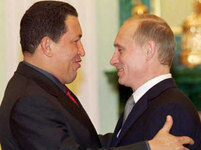
“The peaceful revolution is ongoing,” the New York Times, almost overthrown President of Venezuela Hugo Chavez, said the other day. He, like Bourbon, has not forgotten anything and did not learn anything. Such as him, rulers always know exactly the way to make people make a way. But the people for some reason go on the streets with protests, and they have to shoot at it.
What happened in Karakas on April 11 is now in general terms, although many details are still covered with darkness. On this day in the capital, a grandiose anti -presidential peaceful demonstration, which ended with bloodshed, was organized by trade unions. The supporters of Chavez shot - there is a video on which some of them were identified. As a result, 17 people were killed, more than 100 were injured.
Five independent television companies, the Chavez government forbade reporting events in the capital. The military, with whom the president ordered the army to withdraw from the barracks and stop the riots, refused to obey. The commander of the armed forces, General Lucas Rincon, reasoned that it would be much better to remove the head of state from power. Further, the versions diverge: the organizers of the coup claim that Hugo Chavez resigned, he himself says that he was overthrown by force. The interim president of the country was proclaimed the leader of the opposition, businessman Pedro Carmon, who dismissed the parliament, suspended the constitution and promised to hold the elections of the head of state in the near future.
In Washington, the overthrow of Hugo Chavez was perceived with obvious satisfaction. “Although the details of the incident are still unclear, it is obvious that the crisis has been provoked by the undemocratic actions that the Chavez administration committed or encouraged,” the US State Department said. Russia responded to the events in Karakas by a statement by the official representative of the Ministry of Foreign Affairs. It states that "in Moscow, with concern, reports of the coup in Venezuela took reports." “We express our hope,” the representative of the Foreign Ministry further said, “that the civil world, democracy and law and order will be restored as soon as possible.” Two days later, on April 14, Moscow called on political opponents "to the speedy achievement of the national world and consent." However, on the same day, Hugo Chavez managed to return to power with the help of reliable army units. He put under house arrest of active coup and said that he had information that the US government was behind the conspirators. "In Moscow, the restoration of the constitutional law enforcement in Venezuela is welcomed," said the representative of the Ministry of Foreign Affairs of the Russian Federation.
Chavez's statements about US involvement in the failed attempt by the putsch were not left without attention. The New York Times established that senior American diplomats have repeatedly met with Venezuelan opposition leaders, including General Rinkon and Pedro Carmone. The State Department confirmed this information, but denied the information that representatives of the Bush administration encouraged the conspirators for illegal actions. "The United States did not participate, did not inspire, did not encourage, did not incite, did not look through their fingers, did not nod as a sign, did not close their eyes and in no way left the impression that they would support any kind of putsch in Venezuela," said the head of the State Department of the Western Hemisphere Lino Gutierrez. A similar refutation was made by the press secretary of the White House Ari Flaisher.
At the same time, the American government does not make a secret from its dislike for President Chavez. Why did he not please the US administration? The fact that the organization of oil exporting countries two years ago urged to reduce production and thereby maintain high - “fair”, according to Chavez, - oil prices? With his defiantly warm relationship with such odious leaders as Fidel Castro, Saddam Hussein and Muamar Gaddafi? Or do Washington believe that he is simply not the president that Venezuela needs?
The vice-president of the non-governmental research center "American Council on Foreign Policy" ( American Foreign Council ) answered these questions. He believes that there was no American intervention, but unlike many of his colleagues he does not hesitate to say that he regrets this:
"I think the US government was supposed to intervene and help the Venezueans get rid of Chavez. In my opinion, many people adhere to such a point of view, although they do not talk about it out loud. Why is this position honest in this case? Because the fact that Chavez received the president’s post as a result of the election does not make him a democrat. And if he has a constitution, this does not mean that he follows the law: he uses the law: he uses the law: he uses the law: he uses the law: he uses the law: he uses the law The Constitution is against its own population, as a tool with which you can concentrate all the political power in your hands and establish a dictatorship.
Of course, there are countries where democracy is only established, where it is necessary to carry out reforms, and democratic institutions are still very weak. And you need a strong hand, a strong leader who could lead the country through the chaos of reform. We saw this in many countries at the time of the transition to democratic rule. But the problem is that Chavez does not. He had a chance to carry out economic reforms that Pinochet spent in Chiles or Leaders of Peru, but instead he used power in order to strengthen his political control and put his political views on the population. "
Mr. Waller does not see anything reprehensible in the fact that the American officials maintained contacts with the political opponents of Hugo Chavez. In his opinion, the mistake was precisely that the United States did not have an opposition more effective support:
"It seems to me that the United States did nothing to support the opposition in this country. They did only one thing - met with the leaders of the opposition. But US representatives meet with business leaders, army, political groups in different countries. So there is nothing surprising in the fact that the official American representatives, even the highest officials of the State Department, are responsible for the Latin American state policy, Meet with the opposition in Venezuela.
What is the difference in this case is that meeting with Venezuelan oppositionists, the United States did not hide what they did not like where President Chavez was led by the country. Not only in terms of domestic policy, but also because Chavez supports drug addicts in neighboring Colombia and finances the war for drugs, the civil war that goes in a neighboring country. So Chavez is a direct threat to neighboring countries.
It is one thing not to love the United States and criticize our country. This is easily accepted, this is not a problem. Another thing is when people like Chavez associate themselves with the regimes with which we are essentially hostile relations, which the US president calls sponsors of state terrorism. These countries include Iraq, Iran and Cuba. And that is why Chavez's reign becomes a problem for us, which is why Chavez becomes a destabilizing factor. Especially in the light of what President Bush stated after September 11: there is only one choice - either you are with the United States or with terrorists. And Chavez made his choice - he is not with the United States. "
Moscow comments of the Venezuelan Revolution are not just a formal expression of concern or satisfaction. Hugo Chavez and Vladimir Putin first met in the fall of 2000 in New York, where both participated in the "Summit of the Millennium". Last year, Chavez came to Moscow twice, and the second time, in October, he arrived unexpectedly, but he met a warm welcome and was adopted by the Russian president. Who else of foreign leaders dares to come to Russia without demand? Chavez had every reason to thank Vladimir Putin for "mental generosity." The Russian president, in turn, called his overseas friend his "young energetic leader of the new generation." A speech at the Kremlin meeting was, as the agencies reported, about the "alarming situation in the energy market." And in December last year, the visit to Karakas was paid by the Prime Minister of Russia Mikhail Kasyanov. In each of these cases, the parties agreed to coordinate their oil policy. What are we talking about and to what extent this coordination was a success?
Having emphasized that Russia's cooperation with Venezuela takes place outside the OPEC framework, and therefore is limited, Michael Waller recalled that Karakas coordinated his oil policy with Moscow - the supply of Venezuelan oil to Cuba: with Moscow:
"During the Soviet Union, a special program of mutually beneficial exchanges and offices was developed, as a result of which Castro received oil even at those moments when the Soviet Union could not supply Cuba’s oil directly. So that Moscow and Karakas have a long history of cooperation in the oil business - for political reasons, not only from commercial."
Russia, Michael Waller believes, has quite real strategic interests in Latin America: “I think that Russia is clearly interested in identifying its presence in Latin America. After all, for a long time, Moscow is diplomatically almost invisible throughout the continent. In many ways, this happened due to the fact that in the 60-70s the Soviet Union supported those movements that tried Countries, Communists, peaceful and armed opposition.
Latin America is a wide market for the main Russian export product - weapons. Russian weapons for Latin America are very attractive. It is of good quality and at the same time cheaper than American and European. So it is clear why Russia is betting on the development of relations with Latin America. And it is clear why she pays so much attention to leaders like Chavez, who openly declares that she does not want to maintain good military relations with the United States. And if you take into account that Venezuela is in service with F-16 decrepit fighters and other American aircraft that need to be changed, then it is clear why in the interests of Russia to do everything to sell the Chavez Russian military equipment. ”
Nevertheless, not with any leader, with all the political attractiveness of the alliance, such warm personal relations are established as Putin with Chavez were established. What is common between them? Michael Waller, who knows well not only Latin America, but also Russia, believes that these are leaders of the same type:
"Both want to destroy some of the obsolete foundations and elements of the old policy and improve the situation in their countries as they see them necessary. Both use political and legal instruments to limit human rights, freedom of the press and freedom of denominations that they do not like. Both use all the instruments of the state and state power - and legally, through the system, the creation of which they have achieved - to strengthen their own power and the same To be called a democrat, although it is hardly possible to consider them democratic leaders.
Informburo: Revolution in Venezuela
President and his rating (dossier faces)
Weapons trading (Grani.ru dossier)