
Translated material
Squirrel, or underground metaphor
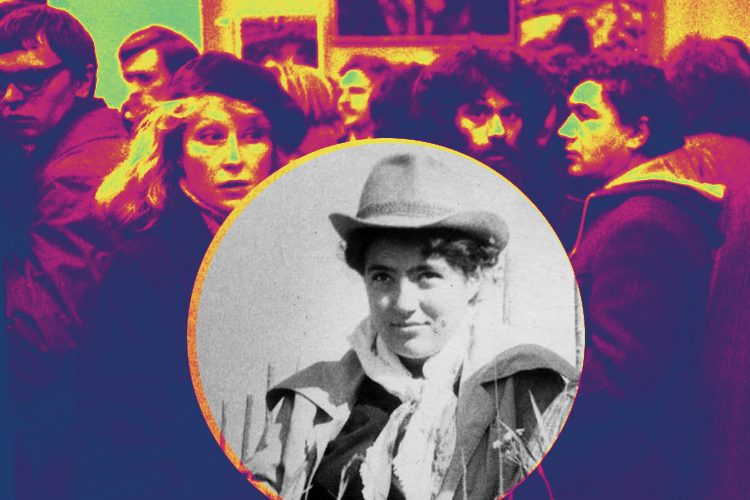
... Rainy autumn of 1972, the search for alternative ways of development (crushing) of the psychedelic revolution brought William Burrose to the hero city of Leningrad. The person, behind which was the manufacture of “orgon chambers” in New York, the cultivation of marijuana in Mexico City and the search for hallucinogenic vines at the mouth of the Amazon, of course, were not interested in the shooter of the Vasilyevsky Island and not the cruiser of the Aurora-but a certain remarkable appearance of Magic Mushroms , which is abundantly found in the vicinity of Ladoga. The searches were not in vain: on one of the October days, a young woman with a gun on her shoulder appeared between the dreary editor-in-chief under the Vsevolozhsk experimenting Burrose, which for some reason called herself “Squirrel” . The woman was a hunter, the woman was a writer, and Burrose, without revealing incognito, decided to tell her about the Cut -up method, invented by him together with Brian Gaisin and continuing the strategy of Dada's collages ... Perhaps he simply dreamed of all this in the tanger or Paris; Although - is such a story so irreened? Allen Ginzberg used to go to the USSR earlier, but Bella Ulanovskaya met in the forests near Leningrad Andrei Sinyavsky and Maria Rozanov [1] . However, the meaning of the Apocryphe’s cited is not to place an original writer in a wide context of international modernism, but rather, to try to understand some purely formal features of her works.
Let us take as an example one of the best things of Ulanovskaya - the story “Albinos”, which was originally called “Seasons” and logically having a consistent change in the latter with its background. In this remarkable text, an attentive reader constantly stumbles upon strange phenological inconsistencies: August days are unexpectedly discovered in October, and December days in March. The possible use of Bella Ulanov's Cut -up method logically explains such malfunctions -just like the radical fragmentation of “combat cats” and “listening to Kanko’s instructions” or whimsical looping of the time in the “autumn campaign of frogs” and “who saw a crow”. But even if you distract from specific techniques for preparing the text, to enclose them in skeptical brackets, it can still be noted: a fundamental rejection of a coherent narrative, the need to eliminate plot of plot as such is very characteristic of the mature work of Ulanovskaya - here it really meets with Burrose. However, why does she need such a cult of a fragment? Then, during fragmentation of the whole, an excess of free space is always formed. In this free (released) space, the most important thing happens: they unfold, accelerate, take off, soar, stick, fall and die, the famous metaphors of Ulanovskaya - a close series of risky comparisons, cunning comparisons, hallucinatory convergence. Actually, the whole prose of the writer is nothing more than an assembly of diverse metaphors, a variegated collection of whimsical displacements of meaning. Periodically glancing his texts, Ulanovskaya notes: “A lonely hunter for metaphors respects someone else's territory!”, “My metaphor of Albinos is built in accordance with the scientific hypothesis”, “You can’t run there and back along the metaphors long into life”. And immediately the question arises: what kind of metaphor “length in life” did Bella Ulanovskaya occupy?
Ulanovskaya never wrote about nature. The whole power of her metaphorical writing is aimed at studying and clarifying a single phenomenon: the Leningrad underground.
To answer, first recall the material conditions of literary production in which Ulanovskaya was located: the late USSR, provincial Leningrad, the “second” (unofficial) culture. The influence of the underground community on the writer is difficult to overestimate: she was published in the “clock” and in the “Obvodny Canal”, was part of the legendary “Club-81”, talked with Viktor Krivulin, Sergey Stratanovsky, Elena Schwartz and many others. And, undoubtedly, Ulanovskaya knew about the paradoxical call, which had long stood in front of the community of non -certificate authors - the call of autographs, the needs of determining the exact place in the cultural hierarchy of the USSR. The fact that this issue was far from idle, at least the abundance of self -support convinces us: “underground”, “unofficial culture”, “non -certificate culture”, “second culture”, “other culture” - for many years the theorists of the community have been served to clarify the oplical meanings implicated in these names. Since it was precisely about finding the place , it seems seductive to compare the consistent change of the listed terms with various versions of the topics of consciousness in Sigmund Freud. The name “underground” is unsatisfactory for the same reasons as the “subconscious” discarded by Freud, as it introduces the idea of a vertical hierarchy, mutual locations “above” and “under”; More sophisticated options - “unofficial culture” and “non -certificate culture” - eliminate hierarchy, but define themselves only negatively, as the phenomena “without” (censorship, officialdom, etc. - cf. “unconscious”), and, therefore, are dependent, non -self -solid areas; Therefore, the most successful are the terms “second culture” and “other culture” in the end, insisting on their fundamental and irrespective insufficiency, like the famous concepts of “it” and “other scenes”. In other words, today's terminological consensus is the result of a long ideological evolution in the self -awareness of the Soviet “second culture”; And a painstaking theoretical search, headed by such figures as Viktor Krivulin, Boris Ivanov and Boris Ostanin, at one time turned out to be one of the necessary conditions for the formation and existence of this culture. But the situation is remarkable in that the work was almost the same unfolding in the metaphorical, fragmentary, cut space of the texts of Bella Ulanovskaya.
And this means that Ulanovskaya never wrote about nature. The whole power of her metaphorical writing is aimed at studying and clarifying a single phenomenon: the Leningrad underground. The whole power of its distant rapprochement and unexpected comparisons is spent on analysis of the well -being and mood of the “second culture”. Underground chic, basement nonsense, underlying fear; the desire to hide from other people's views, to lie on a distant bottom; ejections of strange pride, a nicer sense of danger, dark longing for renegovence; Daily tricks of the uniquely deformed psyche and somatics - the whole world of features and quirks from the life of the unquestioned community is recorded in Ulanovskaya metaphors: “Eh, and it has managed you, you would climb into the underwear and the fire in the stove would have poured as soon as possible so that not a haze over the village”; “However, I will remember that the invasion is possible, the threat exists. What is the matter to someone else's unrighteous life? ”; “Sitting at the desk in front of the window, a tied grate, and the look on the street deprives many illusions”; “Growd with your head into this warming dirt, thaw, warm up, sniff evenly, to the beat, listen to the whisper of rain”; “Everything was tightly captured, all vessels were sealed, bubbles and cracks moved in their depths.” But it should be noted that in front of us is not at all the trivial “Aesopov Language”, not at all an attempt under the guise of “hunting stories” to illegally drag psychological sketches on the theme of the Leningrad underground into literature. The work of Ulanovskaya is more likely reminds of the conceptual course of Viktor Shklovsky, implemented in Zoo : just as Shklovsky, due to the ban on writing about love with the metaphors of this love, became anything, and Bella Ulanovskaya, not wanting to directly talk about the Soviet underground, everything is done by the underground metaphor. Ulanovskaya Senses the signs of the “second culture” in the images of the Leningrad Metro (“Cable kilometers in the tunnel behind the window are rushing, the numbers of tubing rings are flashing, the windows, behind which Cambrian strata and dumb faces, God forbid to come to someone's eyes-greedy, but also cowardly examination of their own kind”), a rustic underground (“a cat who loves the host of the host For the fact that he is pleased to pour milk in a saucer, or because he appreciates the lonely clock of her wanderings on the labyrinth of the underground, where she sometimes met with a rat of Sivilla and heard her howls of long hours of ambush ”), the museum of F.M. Dostoevsky (“The dampness, stinking on the walls, the tickling of“ nipes ”, fragments of conversations from the street, rumbling swearing somewhere on the stairs. Well, having delved into two meters, you can regret only about their temporarily heavy head”), abandoned villages (“The authorities simply do not reach the same. vision, as a result of such administrative gaping, a niche is formed, in which there is a special space and time ”), potato beds (“ it has grown, disfigured, strange shoots, just never dismissed, not to be extended among the valley, do not dwell in this lowland in this lowland ”), marine fish Fit -busters will take a flounder, her eyes are on one side, and she can closely study the individual phenomenon, however, if she survives before the end of her research ”), autumn frogs (“ And what can wait, except for hibernation, where they glaze, and possibly suffocate, if there is little oxygen in the water ”), rock climbing (but for which this strange art flies - Upstairs is empty and there is nothing interesting ”). And so all his life - as if not knowing how to stop! - Bella Ulanovskaya metaphorical descriptions of the same strange phenomenon, approaching him from different sides, looking around from different points of view, passionately trying to understand where and with whom she found herself together, how to be now and what to do next.
So, for many and many years, an author has been working next to the leading theorists of the “second culture”, engaged in exclusively understanding the position of this culture and doing this within the framework of his art project no less, and possibly more successfully. The metaphor used by Ulanovskaya as a cognitive tool allows us to achieve much more flexibility and diversity in the study of the object, to get much more nuanced and exciting results. Reading Ulanovskaya, we undoubtedly begin to better understand the artistic life of the underground of the Late USSR. It could be said that we have a kind of Leningrad analogue of Moscow conceptualism, an exquisite meta -description of the non -certificate community, the place of his meeting with himself. That is why Ulanovskaya is important today: if it seems to us that some of her metaphors are not at all about the “second culture”, this means only that we do not know well and understand the latter. A lot of stylistic, theoretical, anthropological practices that have developed in the Soviet underground should have been studied and investigated - but almost all these practices can find correlates in the metaphorical, whimsical mixed fragments of Ulanian. The ghosts of the “nature studies”, obsessively hovering over the “albinos” and “combat cats”, must be expelled forever; This prose is really much closer to William Burrose than to Yuri Kazakov: smart modernism, turning into a conceptualist study and only disguised as notes of a hunter and fisherman. The disguise, undoubtedly, was good; But today we are finally beginning to understand what the girl’s wandering described by Bella Bella Bella between the Chinese reeds, the vegetation of young oaks in the dusk of the northern forest or light flax, which cannot be seen under the snow.
[1] See: Nikita Eliseev. Non-Fixen Bella Ulanovskaya. // B. Ulanovskaya. Lonely letter: unpublished prose. About the work of B. Ulanovskaya: articles and essays. Memories. - M.: New Literary Review, 2010. S. 342-347.