
Translated material
Olympic hard labor
Juan Antonio Samararanch did not seem to have chosen a place for the triumphal end of his career

The Olympic fire relay race took place throughout Australia. (Photo: ERA )
The 2000 Olympics are crowned not only by the sports age, but also by the Juan Antonio Samaransha era. The elderly president of the International Olympic Committee gathered in peace and is considering games in Sydney as an apotheosis of his 20-year works. It is not surprising that his February report of the IOC on the progress of the preparation of the Olympiad was withstanding in bravura tones: the budget - "balanced"; Marketing - "outstanding; Australia attracted $ 25 per inhabitant, while during the Olympics in Atlanta, 1.6 at the American was received"; Sale of tickets - "some mistakes were made, but they are fixed"; Structures - "For the first time, everything is ready six months before the start, this is another record!" However, there are several circumstances that do not allow many observers to be imbued with the optimism of Samaranch.
Geography
The Australian Organizing Committee, affirming the deadlines for the last games of the millennium, faced a serious problem. Sydney, as you know, is in the southern hemisphere, and in the traditional Olympic time (the last quarter of a century, all summer games, with the exception of the Seoul, invariably held in July -August) on the fifth continent - the height of winter. Moving them to December (as was done during the First Australian Olympiad in Melbourne 44 years ago) - it would be to break representatives of summer views of the entire sports season.
Therefore, the Sydneys had to take a chance and conduct the Olympics with an early Australian spring, when the average temperature on the southeastern coast is 16-20 degrees. It would be half a bastard, but spring here is rainy and windy. The largest troubles to the organizers and athletes (primarily at all -auditors) can be delivered by the wind. According to weather forecasts, its speed on the shore of the Pacific Ocean, where the Sydney athletics stadium is located, can reach 10 meters per second. Fixed athletics records recorded in such conditions can be called into question.
Among other things, the difference in time with the Middle European at 9 o’clock makes almost meaningless a direct broadcast of competitions to Europe and North America (where the most solvent fans live).
Meanwhile, games 2000 are the most expensive in modern history. Their budget is 1 billion 320 million dollars, and about one hundred million were spent “over the plan”. And this is without taking into account the costs of the government to maintain law and order during games and additional payments to overtime.
Games in Sydney are held at a time when the season of mass leave in Europe and America is already ending. Most fans from poor countries have a trip for distant lands simply not affordable. Until the very recent time, in Sydney there were serious problems with the sale of tickets - only five million out of seven were sold. And the conversations that the 2000 Olympics will help stabilize the Australian national currency and generally achieve economic prosperity, now look simply not serious. 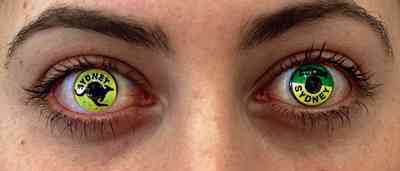
The novelty from the optics is contact lenses, on one - the main symbol of the fifth continent is the kangaroo, on the other, the Harbur -Sydnean bridge. The lenses are painted in the colors of the national team. (Photo: ERA )
Ethnography
On the one hand, according to the Australians, the future Olympiad should put an end to cultural isolation in which their country is due to its geographical position. On the other hand, local residents are cautiously awaiting the invasion of the secluded hordes of foreign fans on a secluded continent. Even though tourists will be less than originally expected, all the same, for three weeks, the population of the four millionth Sydney will increase by a quarter immediately.
No major sporting event is now complete without any emergency. Four years ago, in Atlanta, terrorists blew up the Olympic park. And although the Sydney authorities assure that emergency security measures have been taken (more than a dozen thousand volunteers will help to ensure the police order), residents of the city are still worried.
The alarm intensified three months ago, when the Sydney police found in one of the residential buildings located in the immediate vicinity of the Olympic village, an entire warehouse of explosives. The Sydneys received additional grounds for fears after the arrest in New Zealand of Afghan illegal immigrants, who allegedly, at the direction of the godfather of the international terrorism of Osama Ben Laden, prepared an explosion of the Sydney nuclear power plant. Australia authorities were forced to make a statement that the Sydney nuclear power plant is the most reliably protected object in the country, and it is impossible to carry explosives into its territory. In the sky above the power plant, patrol helicopters are now constantly circling.
In addition to terrorists, various kinds of public activists represent a serious threat to the calm competition in Sydney. For example, the Australian "green" do not leave almost no large event without their extravagant exit. Already ordinary business was the self-configuration of members of the environmental movement to the fence of the Avtodrod in Melbourne during the stages of the Formula-1 car races, as well as the races of naughty on the courts of the Australian Open Championship in tennis.
A special environmental program, which was carried out by the Olympiad-2000 Organizational Committee, did not soften the "green" souls. In the pre-Olympic Sydney, the representatives of Greenpeace were already noted by the action at the main arena of the Hombash-Bay games, which is located on the site of the former dump of radioactive waste and, according to the Green, still poses a threat to human health. A few kilometers from the stadium, activists were not too lazy to cut on the grass with agricultural secateurs a 50-meter arrow with the inscription "Infected", which all passengers of aircraft flying to the seat should see.
Acorgen rights activists will also not miss the chance to declare their problems to declare their problems. True, the indigenous people of the fifth continent promised that their shares would be exclusively peaceful.
Although during recent surveys, 16 percent of the Australians and 31 percent of the inhabitants of Sydney expressed a desire to attend competitions, most likely, far from all of them will be in the stands. Among other things, the tastes of the local fans are very peculiar. Of the Olympic species presented in Sydney, only swimming and tennis can cause the hype of local sports lovers. The popular cricket in Australia was the last time in the Olympic program 100 years ago, Rugby is not an Olympic look since 1924, but an indicative tournament in Australian football (a very tough, contact game without any protective equipment - a unique mixture of regbi, American and ordinary football), arranged in Melbourne -56, did not impress either the IOC or other powers. And in 1972, the IOC forbade the organizers to include demonstrative competitions in "national" sports in the program.
It is not surprising that many Sydneys - about 500 thousand people - are generally going to leave the city during the Olympics. For their convenience, even the terms of school holidays have been postponed.
Medicine
There is no doubt that the next doping scandal will erupt in Sydney. Recent IOC attempts to besiege excessively zealous wrestlers with sports stimulants came across a fierce opposition to the Olympics of the 2000, which is determined to fight doping to the end. More than 2000 doping tests will be taken in Sydney (in fact, every fifth athlete) - the budget of the anti -doping program exceeds the budgets of the competition in some sports.
The Australians previously showed unprecedented firmness in the struggle with any infection. For example, in 1956, even for the Olympics, they did not go to revise their quarantine laws regarding animals, which essentially foiled the Olympic equestrian tournament. This time, the Australians insisted on the use of a new test on erythropoetin during the Olympics (a doping agent "thundered" two years ago on the "Tour de France"). The reagent for the test has just passed clinical trials and has never been used in competitions. Many athletes are in doubt about his reliability and are sure that the organizers of the games were needed in order to keep almost any athlete on the hook.
So the choice of the capital of the new South Wales for the triumphal end of the career of the Spanish Marquis, perhaps, is really not too successful. 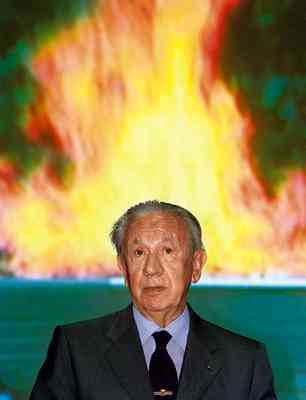
Samararanch is the owner of the Olympic fire. (Photo: ERA )