
Translated material
The last chance of a technocrat
Each time, making concessions to the opponents of military reform, the Minister of Defense actually allowed it to lower it on the brakes

(Photo: Alexey Kuznetsov )
The Minister of Defense Marshal Igor Sergeyev, who is a highly professional and progressively thinking person, is obviously not easy to get along with the chief of the General Staff Anatoly Kvashnin. Nevertheless, the most acute conflict that broke out between the two military leaders is, first of all, a consequence of the most difficult position in which the army is located.
The truth in this conflict is clearly behind the Minister, but if all three years that Sergeev occupied the highest military position, he consistently held his line, the country would already have in many ways other armed forces, and Kvashnin would not have a single strong trump card in his arms. After all, when today the chief of the General Staff speaks of the plight of the army, there is essentially nothing to object to the minister. Another thing is how Kvashnin wants to save the armed forces. According to information leaked to print, he proposes to remove about 600 ground-based strategic missiles from combat duty, five times to two missiles per year to reduce the production of Topol-M missiles and essentially liquidate strategic missile forces. All this allegedly releases a significant amount, sufficient to raise general forces. But the figures with which the General Staff operates can cause only a smile - 19 billion rubles of savings for 15 years, that is, a little more than one billion per year, or about 0.7% of the military budget. To destroy for the sake of such nonsense the only completely combat -ready type of armed forces is certainly to burn the house to fry the eggs.
Even the fact that the chief of the General Staff goes to the president in favorites did not save his idea from crushing criticism. Moreover, behind the proposals of Kvashnin, the author’s desire to pull the ministerial chair from under Sergeyev is very clearly visible. At the Board of the Ministry of Defense, Deputy Minister Nikolai Mikhailov, the head of weapons Anatoly Synov, the heads of the Duma defense committee, opposed the destruction of the Strategic Missile Forces. Extremely sharp objections came from the Foreign Ministry.
It seems that the attack of the General Staff on the Strategic Missile Forces managed to recapture, but the question: "What to do with a collapsing army?" - From this he did not lose his sharpness. Great is seduced by all today's troubles to blame the government. After all, Sergeyev, when he came to the ministry, was promised that the armed forces would receive at least three and a half percent of GDP. In practice, the last three years they gave them a little more than two percent. As a result, debts for the cash, payment of utilities and procurement of military equipment today are a giant amount of 60 billion rubles. This is almost half of the military budget. Even now, when the economy began to recover somewhat, the state continues to delay the belt on the army belt. By announcing the completion of "large -scale hostilities in Chechnya", it stopped the payment of front -line allowances, although the war in the rebellious republic is in full swing. The Duma has already canceled the law according to which the salary of officers and warrant officers is automatically increased with the growth of the minimum wage. Now she wants to deprive the military for another benefit - exemption from income tax.
All this is so, but Sergeyev, when he took up the guzh, could not help but understand: the army would not receive the promised. Moreover, at the beginning of the ministerial career, he has repeatedly said that in his plans he takes into account the most pessimistic financial forecasts and considers his main task to optimize the army, that is, achieving the highest possible efficiency within the framework of released funds. This task was not solved, in fact, in this direction there was no significant steps.
Expectations
Having tricked with a brave paratrooper and land retrograde, the first Russian president finally made a decisive choice in May 1997 - he appointed Igor Sergeyev’s missile defense commander to the post of Minister of Defense of Russia. If one of the generals could reform the army, then only a native of the Strategic Missile Forces. These are the only troops in our armed forces that at least somehow meet the requirements for the modern army.
They were created in the 1950s, the experience of the Great Patriotic War did not reach them, which, whatever one may say, teaches to win not so much by skill as in number. From the very beginning, these troops lived in a slightly different coordinate system than all the armed forces. In matters of military planning, they were forced to rely not on the principle of decisive quantitative superiority, but on the "imperialist" theory of containment, which teaches just that absolute superiority does not give guarantees of security, moreover, even dangerous, since it provides a potential enemy to carrying a preventive blow.
The extreme complexity and enormous power of the missile-nuclear weapon forced to pay special attention to the education and formation of everyone who was assigned to him. The Strategic Missile Forces followed the path of professionalization, more than half of the personnel of these troops - officers and warrant officers.
When the commander of the strategic missile forces, Igor Sergeyev showed himself as an effective, and most importantly, soberly, in a modern way, the thinking leader. He was the first to understand that the time of unreaded money was over and took up the reduction and optimization of his economy. As a result, he managed not only to protect the Strategic Missile Forces from the collapse, but also to maintain their combat effectiveness. Many expected that the Minister Sergeyev would act as decisively and purposefully as well. At first, he really actively took up the reform of the armed forces. The reduction of the army began, the formation of constant readings.
Retreat
But it is one thing to work with a team of like-minded people, high-educated lady officers, and another-to overcome the resistance of the generals who, starting from the school and ending with the Academy of the General Staff, were driven into the head that the guarantee of Victory-quantitative superiority of the enemy and that the state should not regret the funds for defense.
Being a non-conflict man, Sergeyev was inferior to each time and, as a result, for three years of his reign, he did not advance any significantly in the most important directions of military reform. He did not complete the abbreviations of the army to those 800 thousand people that the country may contain. As a result, general -purpose forces were not reduced to 600 thousand and were not transformed into constant readings. Halfway was stopped by the reform of military education. Having promised not to purchase before the onset of better times, small batches of weapons, which are “golden”, but modernize the old systems, Sergeyev, as a result, lost the pressure of directors of the military -industrial complex. The main thing - the minister chose not to draw into a dispute with the generals who proved that the transition to the contract principle of the formation of the armed forces is impossible today.
If Sergeyev, having occupied the ministerial chair, would put up a new people thinking in the key posts, and there were many of them among the rocket launchers, he would probably have untied his hands, but Igor Dmitrievich had no determination for this. Instead of breaking the resistance of the generals, Sergeyev chose to leave his head in the affairs of his favorite missile troops, which only weakened his positions. He achieved that, with all the limitation of funds, a new Topol-M intercontinental missile was put on the flow. Most likely it was the right decision. If only because nuclear forces are the basis of Russian defense. But Sergeyev’s enemies immediately accused him of fed the Strategic Missile Forces due to other types of armed forces.
The same reaction also followed the minister’s proposal to create a united main command of the strategic deterrence forces, which was supposed to collect a nuclear triad under his control: ground -based missiles, underwater missile carriers and strategic bombers. The missilers argue that in conditions when Moscow has not ten, as before, but only three thousand warheads, a single combat control system (which can only be created on the basis of the Strategic Missile Forces) is vital. However, the General Staff and the leaders of the species of the Armed Forces presented the case so that Sergeyev seeks to transfer the Strategic Missile Forces all the warhead forces of our army.
Yugoslav and Chechen wars only strengthened the positions of Kvashnin and others like him. These wars, each in its own way, once again demonstrated: one nuclear weapons of Russia cannot be dispensed with.
In all directions
This week a meeting of the Security Council should take place at which the problems of the armed forces will be discussed. It is unlikely that the head of the General Staff will risk again raising the question of a radical reduction in the Strategic Missile Forces, but others, no less crazy plans, which finally put a cross on military reform, he will probably push. In particular, the Kvashnin group, creatively developing the thesis of Vladimir Putin about the growth of the danger of terrorism in the North Caucasus and Central Asia, proposes to deploy new military associations with a number of about 50 thousand military personnel (in reality, apparently, about twice as much as a number) in the Central Asian and southwestern directions.
If you look at the map, it is easy to find that the Tajik and Uzbek borders with Afghanistan, which the General Staff plans to cover, are removed from the Russian territory by thousands of kilometers. Therefore, where the troops are preferable for this purpose, in the far south of the country or in the Nizhny Novgorod region, is completely unimportant. The main thing is whether they have high mobility or not.
Today, Russia has practically no mobile formations. It is enough to recall what confusion reigned in the Ministry of Defense, when a year ago it was required to transfer only one airborne brigade to Kosovo to participate in a peacekeeping operation under the auspices of the UN. It turned out that military transport aviation cannot fulfill this task. They delivered troops by sea and railway, and even then the transportation schedule was constantly breaking away. When the Chechen militants invaded Dagestan, it was possible to begin the transfer of troops only a few weeks after the start of hostilities.
It turns out a vicious circle: Kvashnin intends to compensate for insufficient mobility, increasing the number of troops. The large army is the army by definition of the draft. And the draft armed forces in principle cannot be mobile. After all, before they are sent to battle, they must be reorganized in order to remove untrained recruits. France, for example, understood this when, participating in the "storm in the desert", she could not transfer the agreed number of troops to Kuwait, unlike England and the United States.
Today, Kvashnin’s positions, not least due to Sergeyev’s passivity, are quite strong. The failure that he suffered from the Strategic Missile Forces did not shake them too much. It is possible that the plans of the head of the General Staff related to the deployment of new groups will be supported by the president, and then Russia will not receive a small, mobile and effective army very soon. But if God has mercy, the minister will have another, apparently, the last chance to move the reforms for real. 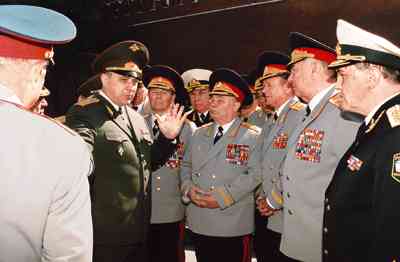
Soviet veterans marshals easily find a common language with the chief of the General Staff Anatoly Kvashnin. His plans for increasing the ground forces in “threatened directions” fully correspond to their ideas about the effective defense that developed at the time when the country had a huge army. (Photo: Alexey Kuznetsov )