
Translated material
Victor Pelevin

On November 22, 1962, writer Viktor Pelevin was born.
Personal business
Viktor Olegovich Polevin (55 years old) was born in Moscow in the family of a teacher of the military department of MSTU named after Bauman Oleg Anatolyevich Pelevin and Zinaida Semenovna Polevina - the factory (according to other sources - director) of the gastronom on Dobryninskaya Square in Moscow.
The Pelevin family, along with her paternal grandmother, lived in a communal apartment in a house on Tver Boulevard near the TASS building. In the mid-1970s, Pelevins moved to a separate three-room apartment in the North Chertanovo area.
In 1979, Viktor Pelevin graduated from the average English special school No. 31 (now the gymnasium named after Kaptsov No. 1520). The school, located in the very center of Moscow, was considered elitist - children and grandchildren of celebrities and large bosses studied in it.
After graduation, Victor entered the Moscow Energy Institute (MAI) at the faculty of electrification and automation of industry and transport, which he graduated in 1985. After the institute, he was admitted to the post of engineer of the Department of Electric Transport of May. In 1987, he entered the full -time graduate school of MASI, in which he studied for two years, but did not graduate, deciding to change his occupation. In mid -August 1988, Pelevin filed an application for admission to the Gorky Literary Institute, to the correspondence department.
In 1989, he entered the Library (the seminar of the prose of Mikhail Lobanov), but did not study long: in 1991, Pelevin was expelled, in his own words, with the formulation of “as lost in touch” with the university. According to the writer himself, studying at the Literary Institute did not give him anything.
At the Lobanov seminar, Pelevin made friends with the prose writer Albert Egazarov and the poet (later - literary critic) Viktor Kull. Egazarov was engaged in business, traded even rare computers in Moscow. Subsequently, Pelevin will make some moments of Egazarov’s biography part of his own mythologized biography. So, when the publication of his story “OMON RA” was prepared in the magazine “Banner”, the writer was asked what to indicate in the biographical certificate accompanying the publication. “Write - speculated by computers. Computer speculator,” Polevin answered and neighed, ”recalled the editor of the prose department Victoria Shokhina.
Egazarov decided to establish his publishing house on the money earned by trade (at first it was called “Day”, then “Raven” and “Myth”). His two deputies, in prose and poetry, became Pelevin and Kull. Pelevin was prepared for the publication by the three -volume of the American writer and the mystic of Carlos Castaneda. As a basis, he took the translation of Maksimov, known for Samizdat, but almost completely rewrote the source text, which he won very much.
From 1989 to 1990, Pelevin worked as a full -time correspondent for Face To Face. Also since 1989, he collaborated with the magazine "Science and Religion", where he prepared publications on oriental mysticism. In the December issue of the magazine for 1989, the first story of Pelevin “Sorcerer Ignat and People” was published. And in the next issue, his article “Gasing on the Runes” was published.
In 1991, Pelevin released his first collection “Blue Lantern”, which, in particular, included the famous story “Prince of the State Planning Commission”. At first, the book was not noticed by critics, but two years later the writer received a small Buker prize for it, and in 1994 - the Interpreskon and Golden Snail Prize.
In March 1992, the Banner magazine published Polevin’s novel OMON RA, who attracted the attention of the public and critics and was nominated for the Buker Prize.
A year later, the following Roman Pelevin was published in the same magazine - “The Life of Insects”.
Having become a laureate of the Small Buker Prize for the collection of stories “Blue Lantern”, the writer, in addition to a small amount of money, was awarded a charity trip to England. He told his acquaintances that he would live there with the famous writer John Fauls. In fact, at the request of the chairman of the Buker Committee, he lived in London for about ten days with the art critic-emigrant Igor Golomstok.
In 1993, Pelevin published in the “independent newspaper” the essay “John Fauls and the tragedy of Russian liberalism” in response to the disapproving reviews of some critics for his work. This essay was subsequently called "programmatic". In the same year, Pelevin became a member of the Union of Journalists of Russia.
In 1996, Polevin’s novel “Chapaev and Emptiness” was published in the same “Ban”, which critics called the “Zen-Buddhist” novel in Russia. The novel received the Wanderer-97 Award, and in 2001 he entered the short list of the largest in the world of the Literary Prize of International Impac Dublin Literary Awards.
Three years later, in 1999, Pelevin’s postmodern novel “Generation P” about the generation of Russians, which was formed during the political and economic reforms of the 1990s, was released. Unlike previous things, the novel was not in the magazine, but immediately a book that quickly acquired the status of a cult. More than 3.5 million copies of the novel were sold in the world, the book received a number of awards, in particular, the German literary prize named after Richard Shengepeld.
After the Generation P, a rather long break in the work of the writer followed. Only in 2003, a collection of Pelevin "Dialectics of the Transition period was published. From nowhere to nowhere ”(“ DPP. NN ”), for which the writer received the Apollo Grigoryeva Prize and the National Bestseller Award. In addition, “DPP (NN)” entered the short list of Andrei Bely award in 2003.
In 2006, Eksmo published Polevin’s novel “Empire V”, which entered the short list of the Big Book Prize.
In October 2009, Pelevin’s novel “T” was released. The writer became the laureate of the fifth season of the National Literary Prize "Big Book" (2009-2010, the third prize) and the winner of the reader's vote.
In December 2011, Pelevin released the Roman Snuff in the publishing house, which brought him the Electronic Book Award in the nomination of Prose of the Year.
After that, one after another, the novels Batman Apollo (2013), “Love for the Three Tskerbrins” (2014), “Careriner” (2015), “Mafusail’s lamp, or the extreme battle of the Chekists with Masons” (2016) are released.
On September 26, 2017, the fifteenth novel by Viktor Pelevin’s fifteenth novel “iPhuck 10” was published in the publishing house about a computer police and literary algorithm named Porfiry Petrovich, who is investigating crimes and at the same time writes a novel. According to the literary critic Galina Yuzefovich, this is "definitely the best text of the author in recent years - in any case, the most intellectually exciting." The novel entered the short list of Andrei Bely award in the nomination “Prose”, whose winners of which will be announced on November 30, 2017 at the 19th Non/Fiction Fair in Moscow. The material content of the award is one ruble.
Victor Pelevin is not married. According to the early 2000s, he lived in Moscow in the Chertanovo area.
What is famous
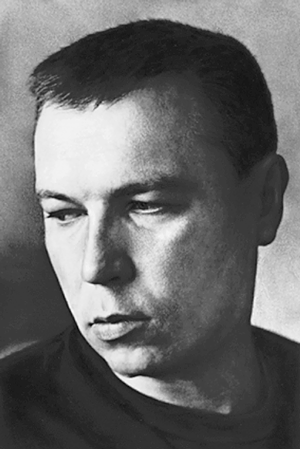 Victor Pelevin
One of the most popular modern Russian writers, the author of the cult novels “OMON RA”, “Chapaev and Emptiness”, “Generation“ P ””.
“A man -hand, Mr. X Russian literature, a writer whose novel becomes a bestseller” - so called the media of Viktor Pelevin.
Few people leave the writer's work indifferent - they either admire them or are sharply criticized. “Pelevin is generally the lakmus paper of modernity, in relation to people can already be judged - it is worth building relationships with them and, if so, at what level,” one of the Internet users wrote about him.
Pelevin's books are translated into many languages of the world, including Japanese and Chinese.
What you need to know about
One of the existing myths about the writer is that Victor Pelevin is a drug addict and that is why he knows what a state of altered consciousness is. However, the writer himself repeatedly emphasized that although his heroes take drugs, he himself is not a drug addict.
“I have not been using drugs for a long time. The only stimulator in my life is Chinese tea. I learned to appreciate a simple, clear and sober state of mind. I don’t want to leave anywhere, this is my house, I feel good and comfortable in it. I don’t drink or smoke for many years. For me, taking drugs or psychotropes - it’s like in the winter to undress naked, go out into the street and run somewhere with a coward along the slush. Theoretically speaking, you can do this, the body will withstand, but I don’t see anything attractive in such a walk and I don’t expect any insights from it, ”the writer said in an interview.
By his own admission, he quit drinking alcohol after he was “treated with clofelin” and he lay 16 hours in a coma in the hospital. Sklifosovsky .
Another of the existing myths about Pelevin says that he controls the network of commercial stalls. The roots of this myth are growing from 1991, when Viktor Kull's wife Olga opened several commercial tents. Kules arranged for this work his friends in the Literary Institute: writers Julia Gugoleva, Dmitry Schkova and Viktor Obukhov. According to Kules, Victor Pelevin quite often drove there "just sit and drink wine and vodka."
Interestingly, after a while, the poet Julia Gugolev Pelevin met at Gleb Pavlovsky the “Effective Policy Fund” at Gleb Pavlovsky. It is believed that it was Gugolev who became the prototype of Vladilen Tatar in the novel “Generation P”.
Direct speech
About creativity: “Writing a book behind a book is the same as squeezing vegetables from the Earth with the help of chemical growth accelerators. They will be dummy, although they can look like real ones. It is important for the writer not only to write, sometimes it is important for him not to write. And this is important for his books. There are also cycles, winter and summer in life. ”
About Internet piracy: “A person is kind by nature and is ready to pay for what he uses, but only if he has the opportunity to do this without trouble and headache. And the Internet business in Russia today is built in such a way that it is easier to steal than to buy, even if you are ready to pay. All this, of course, is not particularly important - the book is written not for the market, but for the beautiful reader, if you rephrase the block. The cucumber is not growing in order to be sold, but in order to eat it. But the sediment remains even in the cucumber. Astafiev had a book based on military experience, which was called "Cursed and killed." And I could write a piercing novel called "Download and Ozran." Just won’t - all the same, then they will download it and open it. ”
On the influence of the social system on literature: “The horror is that the dictatorship has never harmed literature, rather the opposite. Stendhal said that tyranny contributes to the appearance of great art, and democracy, on the contrary, kills it, because the artist is forced to indulge in the tastes of his shoemaker. "Masters and Margarita" cannot be written in an open society. But this does not mean that I would prefer to live with tyranny - in the end, "Master and Margarita" already exist. "
About the addiction to the Happy Endam: “In my opinion, Happy End is the best thing that can only be in literature and in life. In principle, I have a stable desire for Happy Endu. The fact is that literature is largely programmed by life, in any case, the life of the one who writes. I have experienced this many times on myself, and now I’ll think about ten times before sending some secondary hero somewhere. ”
8 facts about Victor Pelevin
- Pelevin leads a life closed from the public, does not enter the “literary party”, rarely gives an interview and prefers communication on the Internet. This became the reason for numerous speculations, in particular, it was argued that the writer Viktor Pelevin does not exist at all, and a group of authors or a computer works under this name. The last novel of the writer “iPhuck 10” can be interpreted as a kind of answer to this assumption.
- Pelevin used his article “Fortune -telling on the runes” written for “science and religion”: he handed over it as a coursework at the Literary Institute “Foreign Literature of the Middle Ages and Renaissance”, and also sold the cooperative as instructions for the recruitment of runes.
- Pelevin sees himself as an insect as a “praying aircraft-agility”.
- Pelevin is fond of Buddhism, often happens in the East: in Nepal, South Korea, China and Japan.
- The text of Roman Pelevin "Empire V" appeared on the Internet before the release of the book. Representatives of the Exmo publishing house claimed that this happened as a result of theft, but suggested that it was a marketing move.
- Victor Pelevin has no and never had accounts on social networks (Facebook, Twitter, Livejournal, VKontakte, etc.). Any supposedly his accounts are falsifications.
- Exclusive rights to the works of Viktor Pelevin in Russia is possessed by the Eksmo Publishing House.
- It is impossible to contact Viktor Pelevin. This was reported on his website.
Materials about Victor Pelevin:
Real Pelevin . NG, 08/29/2001
“Writer Viktor Pelevin:“ Oligarchs work as the heroes of my books ””, Izvestia, 10/20/2008
Virtual conference with Victor Pelevin
Victor Pelevin: “I shoot only 30 seconds and with glasses!” KP, 11/22/12
Viktor Pelevin Creativity Site
Article about Victor Pelevin on Wikipedia
.