
Translated material
Forbidden archives
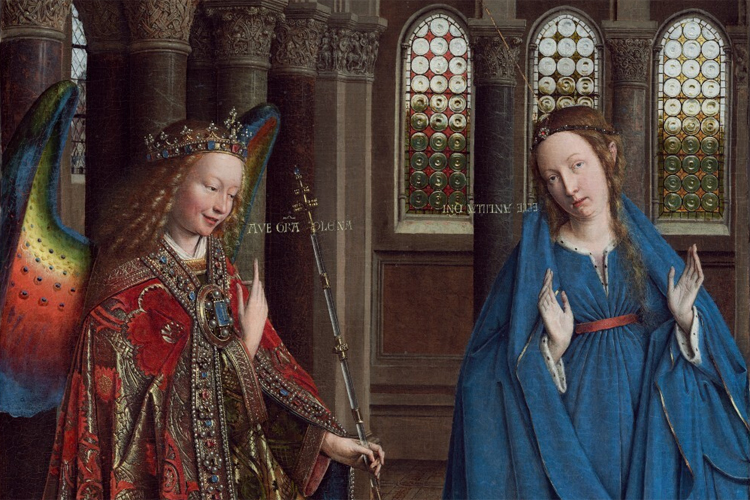
On April 13, 2017, a senior researcher at the Western European art department of the Hermitage, the keeper of the Dutch, Flemish and German drawings until 1800, Alexei Larionov, published a post on Facebook that stirred the Internet community:
“A couple of weeks ago, another verification commission worked for us. Formally from the Ministry of Culture, but, they say, there were mainly representatives of another department. Based on the results of the audit, the Hermitage has been claimed that the museum for many years illegally published documents related to the “secret”. We are talking about a series of collections on the materials of the Hermitage Archive, dedicated, for the most part, museum sales of the 1920s and 1930s. ”
Many publications, even the Interfax news agency , published a link to the post of respected Hermitage employee. The museum administration did not force the answer, refuting the existence of any secret archives and official prohibitions on their publication in the museum archive. It also follows from the official publication of the museum that the decision of the “commission” does not exist, as does not exist even the “verification commission” itself.
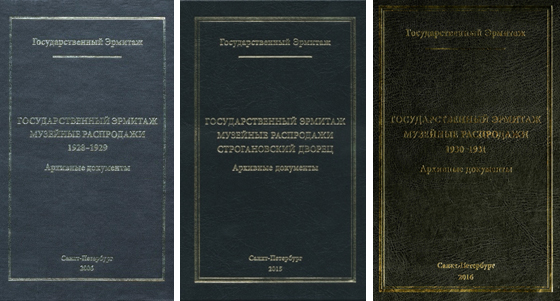 Books from the series "Pages of the History of the Hermitage"
The series “Pages of the History of the Hermitage” is a project of a museum publishing house, begun with the support of Interros. The first release of the series was the "Journal of meetings of the Council of the Hermitage. Part I: 1917-1919. ” Researchers offer to immerse themselves in documentary evidence of the museum’s survival and the museum of the imperial residence after the revolution. In the first years of the existence of the Soviet Republic, the main tasks were the preservation, inventory and nationalization of treasures belonging to the Romanov and Russian crown family. The first two volumes are devoted to this topic, the second part of the series is devoted to the publication of the minutes of the meetings of the Council of the Hermitage in 1920-1926.
The period from the late 1920s to the early 1930s was a turning point for the policy of the new state. For the first five -year plan, the launch of which was planned for October 1928, large funds were required. The government decided to use ideologically alien treasures from monarchical collections to strengthen industry. Jewelry, Western European painting, numismatic rarities, meticulously collected by the Romanov dynasty in the treasury of the Hermitage, - all this went to Europe and America for auction trading and in private collections through intermediaries. The largest buyers were the commercial adviser to the Iranian Embassy in France, the oil magnate Kalust Sarkis Gulbenkeyan and the Minister of Finance of the United States Andrew William Mellon. The first presented the Soviet government with a proposal for the acquisition of the best things, including Madonna Alba Rafael and Judith Georgon.
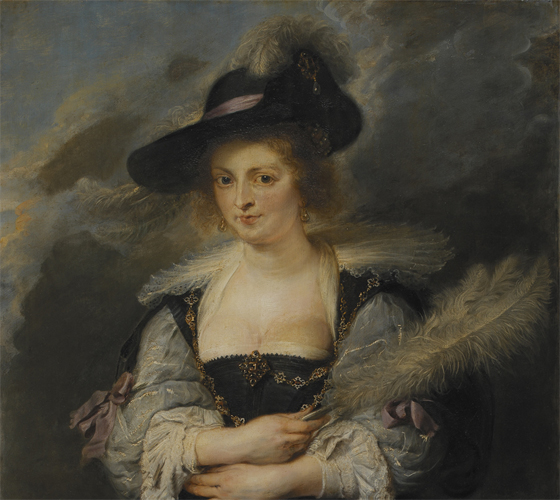 © Fundaçander Calouste gulbenkian Peter Paul Rubens. Portrait of Elena Furman. 1630-32 (fragment)
Fortunately, the Judith remained in Russia and to this day decorates the exposition of the Winter Palace. But one of the best portraits of Rubens Elena Furman, acquired under Catherine II, left the museum collection of one of the large parties of the masterpieces intended for Gulbenkyan. Andrew Melllon was no less successful: Botticelli, Van Eik, Veronese, Titian, Rembrandt - and this is far from the whole list of famous authors, whose works left the Soviet Union. The chairman of the intermediary from the Soviet side of the company "Antiques" I.I. Ilyin also conducted negotiations on the sale of masterpieces with American billionaires G. Frick, V. Hurst, J. Rockefeller. The compilation of lists for the requests of masterpieces from the Hermitage was engaged in the largest art critic of the late XIX - the first half of the 20th century Bernard Berenson.
The Hermitage was not the first injured museum to give its wealth to rise in agriculture and strengthen the country's defense capabilities. The result of the creation of the state storage of the values of the RSFSR (Gokhran) was a consistent sale of confiscated jewelry of the deposed imperial family: for example, at the Christis auction, the crown of Alexandra Fedorovna, created by the Bolin company, was sold at the Christis auction [1] .
Employees of the Hermitage, who mainly occupied managerial posts, did not escape the fate of appraisers and participants in shameful sales of national values. Already in November 1917, the main keeper of the Hermitage Ya.I. Smirnov was sent to Moscow to clarify the degree of preservation of crown jewelry. Such scandalous, awkward, detective stories can be collected for several seasons of the action -packed series called “Museum Sales”, and the ideal source will be published documents from the Hermitage archive.
The scandal with the seizure of museum archives is opaque from both side. Almost three weeks have passed since the unconfirmed visit of the so -called commission. Each museumman knows that during this time even Hermitage cats will learn how to pronounce the name and position of each member of the secret delegation, not to mention the authority, which has come out with the initiative to seize the circulation from stores. As far as we know, Alexei Larionov did not specify for what purposes and who sent a commission to the Hermitage. On the other hand, the official statement on the museum says that "there are no official prohibitions on the publication of archival materials stored in the State Hermitage." Nevertheless, if you carefully study the documents, we will meet materials under the stamps of “Secret” and “Top Secret” with the initial data of the AGE, that is, from the archive of the museum.
It also follows from the official publication of the museum that the decision of the “commission” does not exist, as does not exist even the “verification commission” itself.
The compiler of the series, art critic, senior researcher at the Archive of the State Hermitage Elena Yuryevna Solomakh, according to MB Piotrovsky is an exceptional professional, writes in the entry to the collection “Museum Sales: 1928-1929”, that part of the documents (“Our Archive”) was transferred in 1941 to the State Archive of the October Revolution (now the Central Department Store of St. Petersburg). Then, in 1969, this part was transferred to the Leningrad State Archive of Literature and Art (now - TsGALI SPb). Thus, part of the documents entered the statearchy and fell under the federal law “On Archival Affairs in the Russian Federation”. However, the other part of the archive remained in the museum, that is, de jure retained belonging to the departmental archive. The fact is that the statute of limitations to documents from departmental archives does not apply. And this means that the claims to extract the circulation from the sale, even if they were not, have legal soil.
But is it possible to undergo criminal prosecution a whole publishing department, which, as a result of the publication of documents, did not essentially report anything new? The bibliography on the issue of sales of museum values in the first years of the existence of the Soviet Republic amazes the names of authors and compilers. Of course, the first publications were abroad. So, in 1980, Robert Williams “Rossian Art and American Money was published by Harvard University. 1900-1940 " . Inspired by the labor of the American colleagues, Nikolai Ilyin and Natalya Semenova release a chic monograph “Sold treasures of Russia” with archival photos, including sold works. Then, in 2000, the work of B.B. Piotrovsky "History of the Hermitage." It was he who belonged to the idea of starting the release of a series dedicated to the publication of archives, the forces of the Hermitage employees. A brief historical essay begins with the formation of a collection of the Hermitage before the formation of a museum (that is, starting from the founding of the Academy of Arts in 1758 and the creation of a picture gallery under it, mainly from the collection of I.I. Shuvalov). However, the lion's share of the book is the publication of previously unpublished documents, including under the heading “Top Secret”. Bibliographers pay great attention to the work of Yu.N. Zhukov “Stalin: Operation“ Hermitage ”” (Moscow, 2005). These are only the main publications, not counting articles in scientific periodicals and journalistic publications. Thus, we are dealing with the “Secret of the Overloil”, which, in turn, was already announced by commentators from a number of media, such as “Medusa”, the Rain television channel, the Echo of Moscow Radio, and the author of the scandalous post, Alexei Larionov.
In conclusion, I must say: we sincerely hope that reality coincides with the official statement on the museum’s website and the archive is “working to improve the archival storage system of all documents in accordance with applicable law”.
The author thanks the candidate of historical sciences R.A. Gorodnitsky for a consultation on legal issues of archival affairs.
[1] N. Ilyin, N. Semenova. Sold treasures of Russia. - M.: Trilist, 2000. S. 37