
Translated material
Domain address
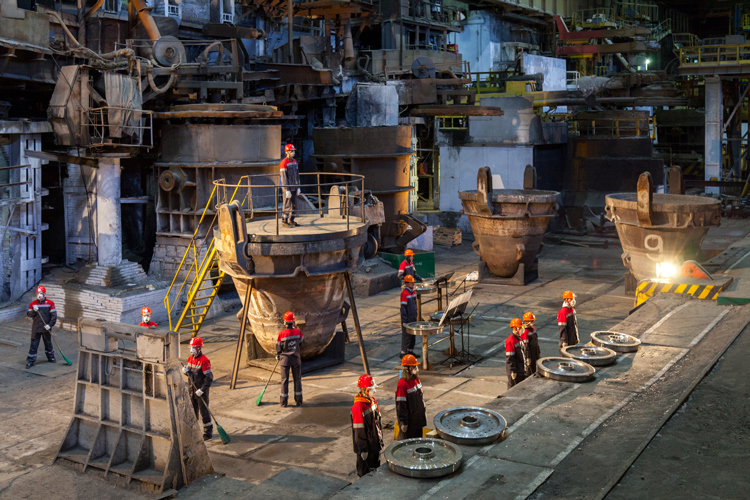
Four months ago, the last Big Marten’s stoves in Europe stopped - this happened in the Nizhny Novgorod region, at the Vyksa Metallurgical Plant. In June, the Marten's workshop opened again - but not in order to melt steel. The factory building for several days turned into a theater platform: choreographer Anna Abalikhina, composer Alexei Sysoev and artist Ksenia Peretrukhina put here the performance “Passion for Marten” in memory of the obsolete production.
The eighth year has been accepting the festival of city culture "Art Ovor" for the eighth year. Its founder is the owner of the plant, the united metallurgical company. The leadership of the “art-Ovors” has been changing every three years, recently it is the curators of the “Arch of Arch” Julia Bychkova and Anton Kochurkin. Specifically, “Passion for Marten” was oversaw the director Yuri Muravitsky, the head of the theater program.
 © Julia Abzaltdinova
* * *
The current festival was held under the slogan “Useful Art” - although, by and large, the project used to follow this motto. To paint the facade, put an installation, carry out a performance - all this for curators is not a goal, but a means. The real goal is to find the use of local resources, material and symbolic.
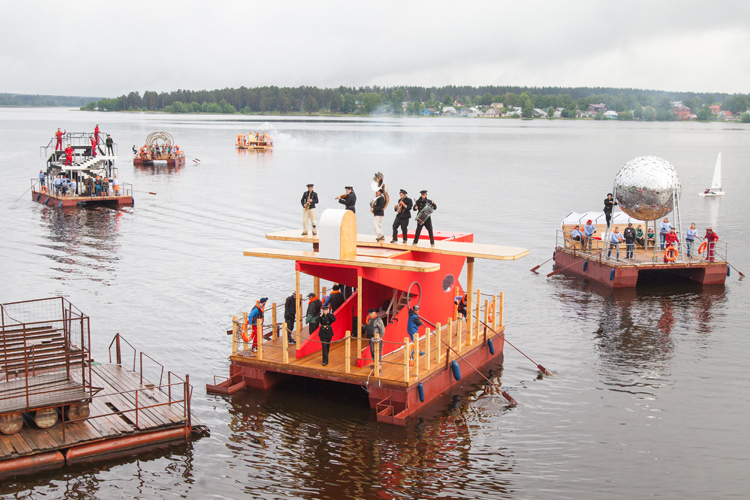
Say, a year ago, the Art-Roval mastered the city water area. Once, in order to nourish the factories with energy, eight ponds dug up around the signs. But it was worth the production to go to steam vehicles, huge aquatic spaces were useless. Last summer, the festival ordered five floating sculptures to architects and artists, and then presented them to Pisks. Now these rafts are skating for vacationers, and the city earnly earns on them.
 © "Art-Revolution"
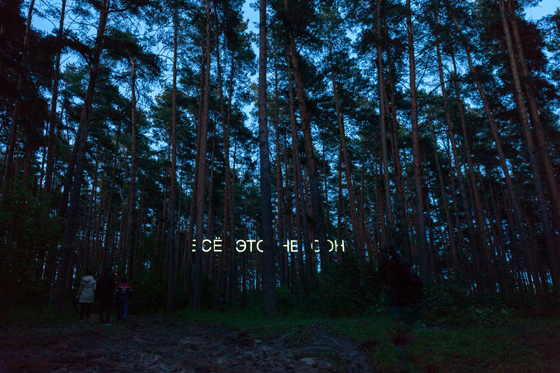
Or another, completely fresh, example: right in the middle of the city, a forest park is broken, which the locals call the “landing” - after sunset, it is dark, uncomfortable and there is no one but drunken companies. On the first day of the festival in the park, the neon inscription "All this is not a dream" caught fire. Its creator is the street artist Timothy Radia, the author of the legendary billboard "I would hug you, but I'm just a text." If everything goes according to the plan, in the evenings the installation will attract the ragsuns and the “landing” will cease to be a hole on the city map.
In the performance of Abalikhina -Sysova - Peretrukhina, the history of the industrial city turned out to be such a resource. Marten's workshop - natural local screening. Vyksa stoves smelted steel since the 1930s and experienced their term for several decades: the technology has long been outdated, environmentalists call it harmful, and economists-unprofitable. The metallurgical plant itself is much older: it is more than 250 years old, it is the same age as the city.
 © Julia Abzaltdinova
* * *
The composition of the "Passion ..." set the order of work of steelmits. The audience walked along the path of metal - the action began at the stove gate, where the scrap was laid, and ended where the trolleys with the finished steel left. The authors divided three flights (halls): in the first, the composer took the main role on themselves, in the second - a choreographer, and in the last - an artist.
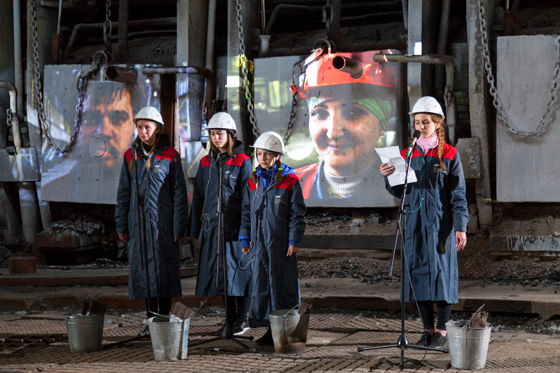
At first, the girls in robes and white helmets became an intermittent line along the length of the entire span and sang labor instructions. The vocals interfered with the cries of rooks: these birds nested in the rafters of the abandoned building in dozens. Sysoev’s music caused Christian chorals in his memory, but in fact it was a spell, something like “sesam, open”: the workshop came to life from chants-both stoves raised a gate with a roar, five for each. It is no coincidence that the most distinct word in this production choral was “affirming”: production does not begin with the start of the machine and not even with the construction of the workshop, but with the expressing of the will.
Robert Lepage - and he would envy.
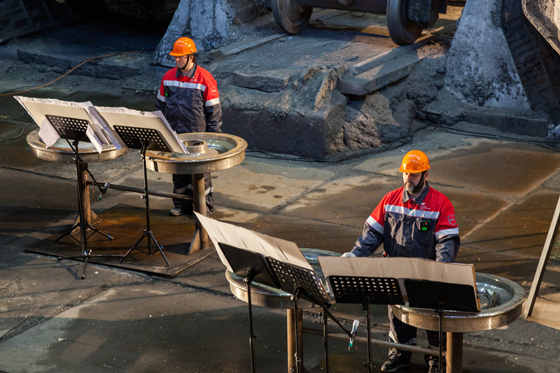
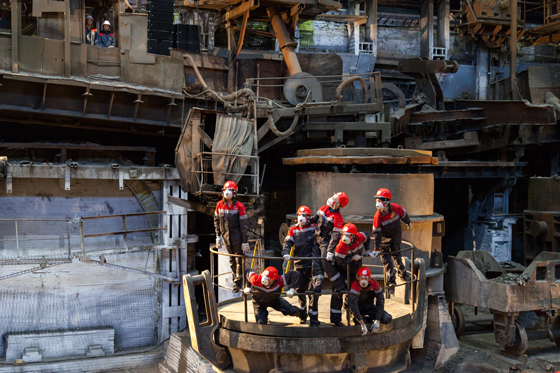
After orders, plans and estimates, there is a turn of physical labor - therefore, choreography prevailed in the second flight. Dancers in scarlet helmets and working overalls were falling, then circled, then froze in a general aspiration, recalling a group of characters on some of the michelangelo frescoes, then synchronously waved with flags-white, like smoke from cooling steel. All this - to the accompaniment of the choir and drums (the percussionists played on carriage wheels cast from Marten steel in the next workshop).
Abalikhina was happy to live up local equipment - like huge, above human height, buckets, which served as dance tumbers. For the choreographer “Passion ...” is a visit from a well -known post -industrial world to unfamiliar industrial. One of the favorite plots of Abalikhina is a person and a figure: a movement born by the body of a dancer continues in computer animation (as in these productions for the Big Ballet television project). Spermaters in the Martinovsky workshop do not interact with virtual entities, but with completely material means of labor.
The culmination of “Passion ...” is the dance of the factory cranes: gigantic cars move over the heads of the audience under the terrible howl of sirens, aimlessly dragging the goods from place to place. Observing these giants in action is a fantastic spectacle in itself, but in the context of the performance it is impressive even more than in everyday life. Having lost the utilitarian meaning, the mechanisms became a grandiose kinetic installation that you will not see in any theater. Robert Lepage - and he would envy.
 © Julia Abzaltdinova
If the singing corresponds to the engineering plan, and the dance is the work of steelmits, then the products of the workshop are symbolized by the forest of molds, which occupied half the last span (the mold is a large cast -iron glass, where steel hardens and becomes an ingot). In the heroic ballet, Abalikhina, the workers seemed to be a single organism. Ksenia Peretrukhina chose another optics - she got a monument to private destinies. While the rest of the team composed a performance, playwright Ekaterina Bondarenko asked metallurgists about working on Marten, fixing memories on the recorder. Everyone who went on installation instantly covered the voices in chorus. Standing under any of the speakers, the viewer could hear someone’s story from beginning to end.
“Passion ...” ended with a promise of a new life: the composition of the wagons loaded with live green seedlings came into the flight, and took the performers to fresh air. The trees, according to Peretrukhina, did not appear by chance: the factory is going to break the park on the site of the disassembled Marten.
 © Julia Abzaltdinova
* * *
The performance of Abalikhina and the company is, in essence, a farewell ceremony with a workshop that has served the city for more than eighty years. The creators of “Passion ...” are not the first to work with local historical memory: local culture is an enduring theme of the festival. The wooden unicorn of Gabor Miklosha Syok reminds of the emblem of the Batashev industrialists, the founders of the Oaksa. Installation of Peter Vinogradov "Pro. The Christmas tree ” uses the designs of Vladimir Shukhov, who gave the city a place in history: the engineer tested a new floor technology at the plant and built one of the first hyperboloid towers. And on the colossal fresco of Misha Most 'A “Evolution-2” -the largest murali of one author in the world-Vyksun metallurgists represent scientific and technological progress along with scientists and cyborgs.
Each city, whether it is a millionaire or a tiny district center, is trying to talk about himself - not only to businessmen and tourists, but also to his own residents. In Russia, it is usually tight with this: it is difficult to imagine a person who, at the sight of all these granite steles, patriotic banners and faceless souvenirs would have felt something other than boredom. Vyksa is a happy exception: not unknown firms, but talented artists work on its identity.