
Translated material
Goodbye, thaw!
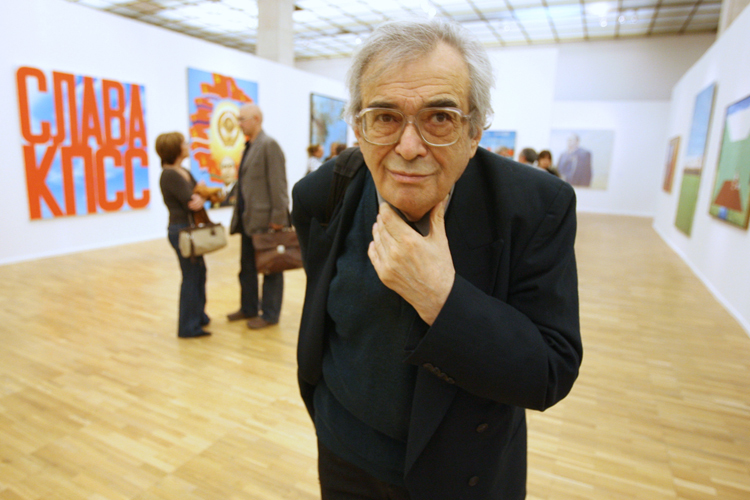
At the end of September , Yuri Zlotnikov died . The editor of the magazine "Disagreements" Gleb Zapenko explains why this artist is so important.
Yuri Zlotnikov was one of the last modernists. What does it mean? The combination of cybernetics and painting in his early works (“signaling system”, “Geiger counter) was aimed at searching for a universal - universal language, a universal model of being. His late works, more biomorphic, organic in their forms, proposed another model of the universal - not technocratic, but referring to the unity of nature. One way or another, Zlotnikov’s desire for a universal language, to master the perfect representation of reality, is one of the components of what is called modernism.
The modernism of Zlotnikov is the fruit of Soviet socialism of the period of the thaw period when the intelligentsia had hopes for a change in the Soviet system from the inside. Unlike the radical left art of the 1920s, thawing modernism did not claim the possibility of fully overcoming the opposition of the soul and body, art and production-as, for example, it was conceived in the production movement or in biomechanics of Vsevolod Meyerhold. The universalist ambitions of the Soviet project after Stalinism became much more moderate. The frame of the social system arose and was wicked, which was not subject to systemic transformation and criticism and resisted it - although such attempts were made “from above”, for example, by the same Khrushchev. The modernist impulses of authenticity, transparency or universality were now inevitably limited by this frame. The place of production art, overcoming the boundaries of art and life and reorganizing society, was taken by the art of applied. The place of radical restructuring of life by constructivist architecture - refinement and rationalization of life in thawing and design, including in the mass development of Khrushchevs. The place of the world revolution, the authorities of the Soviets and proletarian internationalism - the “peaceful coexistence of the two systems”, capitalism and socialism, and “return to Leninist norms”.
 © MMSI Yuri Zlotnikov. From the series "Signal System". 1957-1962
In this series, the art of Zlotnikov is one of the most radical manifestations of the thaw with all its restrictions. Zlotnikov’s turn to the abstraction was caused by two impulses. The first is a meeting with Western abstract painting at the World Youth and Students Festival in 1957 - one of the manifestations of “peaceful coexistence”. The second is a fascination with mathematics and cybernetics. In particular, under the influence of his friend, artist Vladimir Slepyan, Zlotnikov attended lectures by the mathematician of Israel Gelfand . The question of the possibility of combining art and science, “physicists and lyrics” was part of the thawing modernism with his boom of science fiction and hopes on the high -tech basis of the upcoming communist society. Zlotnikov in his works resolved the issue of combining physics and lyrics positively. In its “signaling systems” you can see the planning of the development of the modernist microdistrict, and the abstract thinking scheme of a person, and, finally, they have a place for love, error, and the subjective construction of the composition.
The art of Zlotnikov is one of the most radical manifestations of the thaw.
Of course, this synthesis remained limited by the framework of the easel canvas. It reads the inheritance of a thaw of truthfulness: you can reach art to the plane of the canvas, to the failure of illusory, to business whiteness and simplicity of the technical drawing - but you cannot call into question the frame that limits the work - the frame set by the public system [1] . In this, the inheritance of thawing modernism is not much different from the inhibitory of autonomous bourgeois art - for example, American or Western European abstraction.
One of Zlotnikov’s last bright appearance in the public field was scandalous and symbolic: he was given a replica from the hall in the public discussion of Ilya Kabakov and John Baldessari in the Garage - but when Zlotnikov began to argue with the Kabakov version of the history of Soviet art, the director of Garage Anton Belov tried to take away the microphone from him. Irina Saminskaya remarkably wrote about this scene in the article "What will we tell my grandchildren?" .
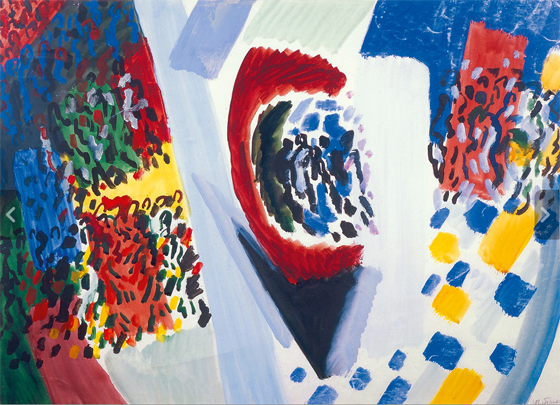 © MMSI Yuri Zlotnikov. People, space, rhythm. The end of the 1970s
 Today, at a temporary distance of several years that contributes to schematization, this scene seems even more symbolic. What do we see? On the stage there are masters of postmodern art, ironic critics of modernist universalism, at the same time - the flesh from the flesh that they criticize: the USSR in the case of Kabakov, the total of the language in the case of Baldessari. These masters are caressed by large capital and attention of the media, they are honored in the Garage, an exemplary corporation of the Neoliberal cultural industry for Russia. The thawing modernist Zlotnikov, who was striving to put in the word for his late teachers of the 1940-1950s, cramped by Kabakov, do not allow to speak out. But this is not at all sophisticated postmodernism drops naive modernism from the ship of our time. No, this is the work of the manager Anton Belov, an employee of the oligarchic capital. It is not artists who argue with artists - they are harshly moderated by those who ultimately determine the cultural agenda today. The victory of managers as capital agents is the victory of the absolute present, the victory of oblivion. This is the victory of the story approved by those in power, over the history of erased traces and lost names. I recall the final words of the film by Chris Marker “A Smile without a Cat”, dedicated to the revolutionary events and disappointments of the 1960s, the time of Yuri Zlotnikov’s youth, and collected from the many scraps of activist filming of historical events: “The real authors of this film are activists and operators, who have prevailed the right to see the right to see in the power that we always have no memory.”
[1] About this writes in detail Alexander Novozhenov in his not yet published text “almost abstract”.