
Translated material
Babylonian vertical
Vladimir Putin is extremely successfully creating the means by which he intends to rule Russia. However, where he is going to send her, it is unclear either to himself or the host of his advisers
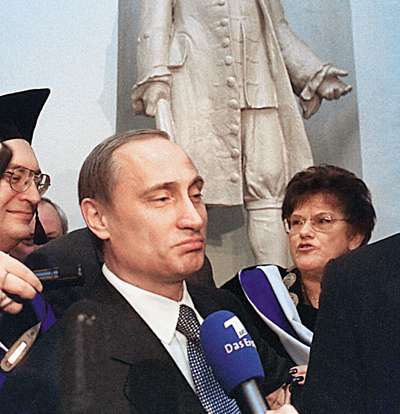
(Photo: AP )
It is only to count chickens in the fall. But the preliminary results of the activities of the new Russian president are appropriate to summarize just in August, the last summer month. The year from that day on the day, on August 7, 1999, when several hundred Chechen militants under the command of Shamil Basayev and Huttab invaded the territory of Dagestan, and a war began, the consequences of which were destined to decisively affect the future of not only the North Caucasus, but all of Russia. Already two days later, on August 9, Sergey Stepashin was set aside from the post of prime minister, and Vladimir Putin was declared the “successor” of President Yeltsin and began ascent to the heights of power under the thunder of the artillery cannonade. Finally, on August 16, it turns a year as Vladimir Putin runs Russia: first, as approved by the parliament of the Prime Minister, and then the head of state. As a popularly elected president Vladimir Vladimirovich officially (if you count from the date of the inauguration) has already lived for 100 days.
The victorious pathos of anniversary comments resembles the pages of old history textbooks on the "triumphal procession of Soviet power" or "ten Stalinist blows." In fact, almost everything that the president and his team were taken for was to fulfill. The war in Chechnya, thanks to which the inconspicuous retired KGB lieutenant colonel turned into a non -alternative national leader, ended with the establishment of (albeit in many respects and formal) power of the federal center over the territory of the rebellious republic. The fact that Russia is involved in a chronic war with a rebel movement, which can last more than one decade, is still aware of an insignificant minority of citizens.
Society enthusiastically met a large -scale attack on the "rich", deployed by the Kremlin at the end of May. The spectacle of the “oligarchs” inclined in front of the president, who humbly listen to him to the maxims about the need to be “more modest” and not annoy the simple, for the most part, the poor people, completely unequivocally demonstrated to everyone and everyone on whose side power. Power no longer depends on the captains of large business.
Within some three months, the current owner of the Kremlin managed to solve the problem over which the Yeltsin team fought for several years. The once omnipotent regional barons approved the law on the formation of the Federation Council, according to which they cease to be members of the upper house of parliament. They reconciled both with the division of Russia into seven federal districts, and with the appointment of Putin's governors in them. The governors did not even resist the implementation of tax reform, which deprived them of a significant part of the traditional sources of replenishment of regional budgets. 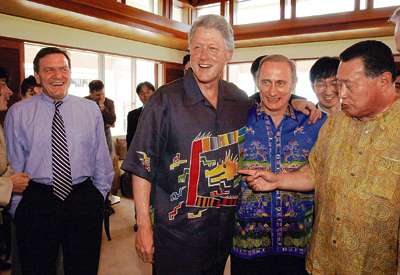
The success that Vladimir Putin achieved at a meeting with the leaders of industrialized countries is to a large extent explained by their immense fatigue from the escapad of his predecessor. The current president did not violate the image of a responsible and energetic head of state, at least in their right mind and sober memory (photo: AP )
Finally, the Russian president has achieved serious success in foreign policy. During a meeting on Okinawa, Vladimir Vladimirovich appeared to the leaders of industrialized countries immensely tired of the escapad of his predecessor, in the image of a responsible and energetic head of state, at least in their right mind and sober memory. At the same time, the Russian president, again, will pay tribute to him, successfully presented the new role of Russia in the international arena. He did not limit himself to disputes with the American president regarding US plans to deploy the national missile defense system. Before Okinawa, he visited the DPRK, heading the list of "rogues", and brought from there the consent of Kim Jong Ira to stop the missile program, in the implementation of which Washington and Tokyo see one of the most serious threats of their safety. At the same time, Putin managed to somehow arrange everything that, having taken on the role of the negotiator, he does not bear any responsibility if the North Korean leader suddenly abandons his words.
No matter what Kim Jong Ir has made, Putin managed to demonstrate that he interspersed in relations with the marginals of the world community to act as a representative of the civilized world, and not at all blackmail his partners in Russian ties with states like Cuba, Serbia, Iraq and Libya.
"The Russian president made it clear that he is in the same boat with us, that he is not going to play along with the other side," Michael Steiner, adviser to the German Chancellor for International Affairs, told reporters. World leaders vying told reporters about the very favorable impression that the Russian colleague made on them. The recognition was not limited by polite words: Germany made a proposal not to hold in the future meetings without the participation of the Russian president, and literally the day after the summit reported to delay the payment of part of our debt until 2016.
If we add to these victories also a good economic situation that allowed the government not only to pay on time, but also to raise pensions and salaries, is it worth it to be surprised that, according to VTsIOM polls, more than 70 percent of the country's population has been sympathy for Vladimir Putin.
Based on the support of the population and a significant part of the political elite, the president and his team are determined to develop an offensive. On the agenda, new grandiose reforms vertical of power.
The plans are nearby
According to available information, the Kremlin primarily intends to continue the attack on regional leaders. Having tossed the Governor's Corporation as a whole, the presidential team will now get scores with all the objectionable and disloyal one. They will try to change most of the heads of local administrations in the next four to five months in almost half of the subjects of the federation during the autumn elections. In the same place where the elections are far from the election, the governors will push the voluntary complexity of their power.
In recent months, the capital's political bomond has excited rumors about the close voluntary resignation of the Moscow Mayor Yuri Luzhkov "for health reasons." According to sources of varying degrees of awareness, in exchange for refusing the confrontation of the Kremlin, the capital's head seems to be guaranteed inviolability, which ensures its further calm existence.
You can expect from the Kremlin and the next attacks on a free press, the very fact of which does not cease to get out of itself a new government. At the same time, this struggle will be carried out under the slogan of the protection of honest journalists from anti -state -minded owners of information empires, which, as Vladimir Putin recently stated in one of his interviews, "fight more to maintain his influence on the state than for freedom of speech and press." The only question is how the president intends to dispose of the place selected from the "bad" owners? The state will transmit rebellious publications "right", from the point of view of power, oligarchs or will he sit in the master's chair?
At the same time, as they believe in high offices, urgent healing of the media market is necessary, which the Minister of Press Mikhail Lesin loves to discuss recently: “According to our forecast, in October-November there will be a strong crisis of the media. Why? There is a lack of advertising ... Of course, very successful business projects, they are well developed, but today's forecast shows that the majority will have real problems. A fairly serious payable of accounts in both the main broadcasting channels and the regional due to the fact that the volume of work performed categorically does not correspond to the capacity of the advertising market. "
Finally, the next fall, the radical solution of two most important personnel issues is expected: the resignation of the Chairman of the Central Bank Viktor Gerashchenko and the Prime Minister Mikhail Kasyanov.
In the case of Gerashchenko, we are talking about removing an uncomfortable player from the big policy. The Kremlin annoy the intransigence of the country's main banker, its excessive independence and unwillingness to blindly follow the instructions of the presidential guard. On Gerashchenko, the Yeltsinsky environment sharpened his teeth, even picked up the candidacy for a replacement - the head of Vnesheconombank Andrei Kostin. Yes, only until December 1999 it was practically impossible to make a shift, since the State Duma of the past convocation would hardly have agreed to the request of the head of state, and no one wanted to repeat the story with the Prosecutor General. After the parliamentary elections, even with the advent of pocket parliament, the Kremlin inhabitants were not up to the Central Bank. But it seems that now the hands have reached.
The figure of Prime Minister Mikhail Kasyanov does not cause any special allergies. In principle, no one is embarrassed by the emphasized calm of the head of the cabinet in solving acute problems such as the implementation of tax reform. Premier composure was especially striking against the backdrop of frantic activity, which the First Deputy Prime Minister Alexei Kudrin developed in the Parliament of the Tax Code in the last two months during the discussion in the parliament of the Tax Code.
The desire to change the prime minister is dictated not so much by the desire to get rid of an ineffective official, but by the intention to get the head of the human office with completely defined characteristics. He may not be an outstanding economist, nor an original thinking financier, nor a brilliant top manager. He may not understand economic problems. The main thing is to be devoted to the president, so that in turn the head of state could rely on the head of the office as himself. After all, the prime minister is the second person in the Russian power hierarchy-almost the vice president (it is enough to recall the 92nd article of the Constitution, in accordance with which, in the event of the president’s temporary inability to fulfill his duties, his powers pass to the Prime Minister). Kasyanov, on the role of the closest confident and - what could be most important for Putin - the "Vedoom", reliably covering the tail, does not pull in any way. First of all, because of their excessive proximity to that part of the presidential environment, which, by tradition, continue to be called the "family."
Recently, the three have been called as candidates for this post: Alexei Kudrin, Sergei Kirienko, now the presidential envoy in the Volga Federal District, and Sergey Ivanov, Secretary of the Security Council, who in recent months has become an increasing impact on the adoption of the most important political decisions. Of all three, the criterion of unconditional devotion is fully consistent with only the latter. And judging by the information coming from the Kremlin wall, it was Sergey Borisovich who was prepared for the role of the head of the Cabinet of Ministers. And already with him there will be a powerful financial economist with the widest powers, but in a strictly defined area.
I must say that the appointment of Ivanov in the premiere will be the logical end of the Putin personnel revolution, marked by the mass transition to the state administrative apparatus of the pupils of the KGB of the USSR. At first, they flooded the presidential administration, then settled in newly formed federal districts (somewhere directly in the position of envoy, as in Moscow and St. Petersburg, and in other places they received their appointments to the representative of the representative). Now the Chekists in the mass order are appointed to the positions of federal inspectors in the regions, as overseers over the governors.
Such a configuration - a political prime minister, and only under him an economist as the first deputy prime minister will remain until (and if) it is decided to create another command and managerial structure located in the federal government hierarchy between the president and the government, the leader of which will be endowed with the functions of the second person in the state. Then, a non -political figure can be safely assigned to the position of prime minister - at least the same Kudrin or Kiriyenko.
Far plans
According to one version, extremely popular in the Kremlin, the State Council can be such a new body, the structure and powers of which are quite actively discussed recently. Last week, this issue was actively involved in both the Kremlin and the Federation Council. "Life will show how the power system in the country will develop - it will be the merger of the Federation Council with the State Council as it were to the Unified Chamber of the Legislative Authority, or it will be separately existing two bodies," Yegor Straev, Yegor Straev, told reporters on Tuesday. "We discussed whether the heads of all regions or only the largest are included in the State Council and we believe that in Nobody has the right to offend a large or small people to the federal state. "
The leaders of the regions continue to hope that all of them will enter the new body, which was planning as an advisory institute under the head of state. Meanwhile, the Kremlin has long been a cross on all such wishes. According to our interlocutors in the presidential administration, the State Council must be a compact body formed from representatives of the president, Duma and the governor's corps. It is likely that the president himself will not be a member of the council at all. Some in the presidential administration is seen exclusively as a place of coordination of certain fundamental personnel, economic and political decisions.
However, another point of view is also common: the State Council should become the highest chamber of parliament, which should be transferred to the functions of the Federation Council, and maybe State Duma, which are not related to the legislation. Among these "illegitimate functions" of the upper house, as follows from the 102nd article of the Constitution: the approval of the borders between the subjects of the Federation, the approval of the presidential decrees on the introduction of emergency and military provisions, the decision to use the army outside the country, the appointment of the General Prosecutor and judges of the Higher courts, the appointment of the date of the presidential election and, finally, the departure of the president from the post. If we add the right to appoint the Chairman of the Central Bank and the head of the Cabinet of Ministers, who have so far belonged to the State Duma, the list of powers of the State Council looks extremely impressive to this list. In the case of implementing this plan, it will be possible to talk about the emergence of a legislative and administrative “convention” in the country, fully controlled by the head of state, who will take away all those powers that the president cannot assign without causing a flurry of accusations of authoritarianism.
Since President Putin himself already spoke of giving the State Council of constitutional status, it can be assumed that in the near future an appropriate bill on amendments to the Constitution will appear. And, as they believe in the Kremlin, in the current situation of forces in the Duma and the completely broken council of the federation of special problems with their approval should not arise.
True, there is a real danger that, raising their hands on the basic law, the presidential advisers will decide to correct something in his other sections. For example, as thinkers from the Center for Strategic Development of Herman Gref recommended, to adjust something in the “Judicial Power” section: to abandon the principle of lifelong irremovability of judges or to merge the supreme and constitutional courts into one.
It is appropriate to recall the events of almost seven years ago. In the fall of 1993, when preparations for a referendum under the new Constitution, which was in a hurry, was pre -painted, a discussion in the company was in a hurry on the topic: is the head of state transferred to the head of state under the new basic law? After all, Yeltsin, they say, might have come by no means liberal, and the conservative, God forbid, is still left -handed, with frankly dictatorial manners, and then, hiding behind the constitution, which establishes strong presidential power, he will immediately turn all democratic transformations and establish an authoritarian regime. However, the discussion was quickly stalled. It was constantly interfering with its normal course was constantly interfering with a completely irrational thought, sitting somewhere in the depths of the subconscious of many, which prevented them from seriously discussing this problem: Yeltsin would rule forever (when he was still happening, 2000, and until the last moment he believed that Boris Nikolaevich would agree to leave his post in the Kremlin). And besides, in a decent society, for some time, they completely stopped discussing the topic of possible changes in the Constitution, not wanting to find themselves in the same company with the Communists, who invariably demanded the transfer of part of the powers of the head of state to the parliament. И даже выносили на рассмотрение Думы законопроект с соответствующими поправками.
Однако на фоне планов Владимира Путина меркнут даже самые пессимистические прогнозы 1993 года: выяснилось, что новому российскому лидеру еще и не хватает полномочий, выданных первому президенту и казавшихся тогда чрезмерными.
Среди других долгосрочных прожектов Кремля, требующих длительной работы в парламенте, стоит упомянуть новый закон о партиях. Как утверждают источники "Итогов", документ находится в стадии разработки. Однако, по некоторым данным, главная идея законопроекта уже выкристаллизовалась, и состоит она в ужесточении требований к новым и уже существующим политическим объединениям. Например, предполагается, что на статус общефедеральных могут претендовать только партии с индивидуальным фиксированным членством, и при этом численность таких объединений должна измеряться сотнями тысяч (видимо, разработчики отталкивались от цифры 500 тысяч - такое число подписей должен собрать в свою поддержку избирательный блок для включения в избирательный бюллетень).
Если закон когда-нибудь вступит в силу, то на политической арене могут остаться только две партии - "Единство", которому необходимая массовость будет обеспечена за счет пресловутого "административного ресурса", и КПРФ. Тогда можно будет и не отказываться от существующего принципа формирования Госдумы (половина по одномандатным округам, половина по партийным спискам). Тогда же можно будет воплотить в жизнь и другой кремлевский замысел, который так пришелся по душе Владимиру Путину, что он даже упомянул о нем в своем послании Федеральному Собранию: "России необходимы партии, которые пользуются массовой поддержкой и устойчивым авторитетом... Возможно, и кандидатов на пост главы государства должны выдвигать только общественно-политические объединения. Я понимаю, что это серьезный вопрос, он требует отдельной, широкой дискуссии".
Надо сказать, что одной дискуссии мало. Потребуется еще и внесение поправок в те разделы Конституции, которые полномочно изменить только Конституционное собрание, поскольку проектируемый порядок выдвижения кандидатов ограничивает пассивное избирательное право граждан. (И в этом случае нельзя исключать того, что, "взломав" вторую главу Основного закона, власть не захочет заодно избавиться, например, от раздражающего генералитет положения о праве граждан на альтернативную военную службу или что-нибудь поправить в статье о гарантиях свободы совести и вероисповедания.) Впрочем, процесс этот представляется еще более длительным, нежели конституционное закрепление статуса Госсовета.
Один кремлевский чиновник недавно в разговоре с корреспондентом "Итогов" заметил: "Путин - он как горец. Для него время не имеет значения. Он считает, что пришел навсегда. Поэтому его интересует только одно: задуманное должно быть воплощено в жизнь, пусть не сегодня и даже не завтра". А завтра это может оказаться совсем не таким уж и далеким: уже на осенней сессии предполагается рассмотреть законопроект о формировании Конституционного собрания.
Свобода копать
До недавнего времени господствующей была точка зрения, что Путин и его команда сосредоточивают власть, ликвидируя "сдержки и противовесы", для нового стратегического наступления, целью которого в конечном счете является обеспечение устойчивого экономического роста и развития России. Некоторые либеральные экономисты и финансисты любят поговорить о том, что эффективные реформы возможны лишь при некотором ограничении гражданских свобод и концентрации власти в одних руках.
"Свобода, конечно, не делится на кусочки. И тем не менее определенное ограничение демократических процедур может быть допустимо, - заявил не так давно в интервью "Итогам" президент Альфа-банка Петр Авен. - Некоторые изъятия из демократии могут иметь место и будут иметь благотворные последствия для экономики".
С этим можно было бы, наверное, согласиться, если бы знать наверняка, как Кремль поведет себя, когда, добившись ограничения гражданских свобод, столкнется с объективными экономическими трудностями и порождаемыми ими политическими кризисами.
Не секрет, что нынешним относительным благополучием в экономике Россия обязана прежде всего высоким ценам на нефть. Однако благоприятная конъюнктура вряд ли продержится долго. Более того, существует реальная опасность, что спад поступлений от нефтяного экспорта совпадает с неизбежным спадом налоговых поступлений после введения в действие "плоской" тринадцатипроцентной шкалы. Некоторые эксперты, признавая несомненный прогрессивный характер налоговых новаций и отдавая дань новым хозяевам Кремля в последовательности проведения реформы, тем не менее прогнозируют серьезный бюджетный кризис в подавляющей части субъектов Федерации, спровоцированный как раз новой схемой распределения налоговых сборов. Кризис этот может обернуться новыми задержками с выплатами социальных пособий, зарплат бюджетникам и выплатами энергетикам и газовикам, которые в последнее время взялись хладнокровно отключать должникам свет и тепло.
Впрочем, это не единственная трудность, с которой предстоит столкнуться президенту Путину. В ближайшие год-два перед ним во весь рост встанет проблема, о которой экономисты твердят уже не первый год: мощнейший структурный кризис, вызванный дальнейшим моральным и физическим старением основных фондов практически во всех отраслях промышленности и их последующий выход из строя (подробнее см. статью Михаила Делягина ).
Либеральные экономисты из Центра Грефа, начиная с февраля, неустанно твердят о необходимости скорейшего создания благоприятного делового климата для привлечения масштабных иностранных инвестиций в размере 40-50 млрд. долларов в год. В этом они видели единственный способ избежать надвигающегося коллапса. Однако в значительной степени благодаря многочисленным решительным действиям главы государства в политической сфере вожделенный час явления в Россию крупного западного капитала со своими смелыми, долгосрочными и широкомасштабными инвестициями все никак не настает и не настает... Создается впечатление, что в Кремле считают лучшим лекарством от всех российских хворей административный кнут и армейскую дисциплину.
До сих пор единственным существенным аргументом сторонников и соратников Путина было утверждение, что благодаря консолидации власти удалось принять чрезвычайно прогрессивный Налоговый кодекс. И это, мол, должно свидетельствовать о безусловности либеральных устремлений власти. Да вот только, зная опыт и, главное, склонность выходцев из КГБ к провокациям, не удается избавиться от мысли о том, что в конечном счете плоская шкала подоходного налога в один прекрасный день обернется из блага для промышленности и бизнеса в банальный инструмент инвентаризации потенциальных налогоплательщиков, поверивших власти и выведших свои бухгалтерии из "тени". Ровно об этом совсем недавно вдруг заговорил вслух вице-премьер Илья Клебанов. И выступление это прозвучало куда более убедительно, нежели эмоциональные опровержения министра экономики Германа Грефа и замминистра финансов Сергея Шаталова.
"Да что вы все про возможность кризиса твердите, - не удержался в разговоре с корреспондентом "Итогов" один из аналитиков, давно трудящихся в силовых структурах, - можно отстроить такую систему, когда никто в стране никакого кризиса не заметит. Все как один траншеи копать будут". Если так, то может оказаться, что в КНДР Владимир Владимирович ездил неспроста - набирался опыта.
Бесполезная вертикаль
Все инициативы Владимира Путина в области государственного строительства - будь то образование семи федеральных округов, решительное ограничение власти губернаторов и установление контроля над ними из федерального центра, придание властных полномочий Совету безопасности - исходят из того, что идеальной для управления такой страной, как Россия, является строго иерархическая система командования, основанная на строгом единоначалии, безусловном подчинении младшего старшему, какая должна существовать в Вооруженных Силах.
И надо же было так случиться, что в самый разгар формирования этой самой вертикали эти идеальные принципы были откровенно и грубо попраны. Начальник Генерального штаба, первый заместитель министра обороны Анатолий Квашнин откровенно игнорирует своего прямого начальника Игоря Сергеева. Не поставив в известность главу военного ведомства, он направляет президенту собственный план реформирования Вооруженных Сил (о его содержании "Итоги" уже неоднократно писали). Более того, он выносит этот план на суд общественности до обсуждения на коллегии Министерства обороны. Страна ведет войну, а высший российский генералитет разделился на два непримиримых враждующих лагеря, и деятельность как Минобороны, так и Генштаба оказалась по сути дела парализованной.
Самое удивительное, что Владимир Путин и его ближайшие сотрудники, пытающиеся насадить армейский порядок в сфере гражданского управления, в течение нескольких недель мирятся с его вопиющим нарушением в армии. Вместо того чтобы немедленно отправить в отставку нарушителя субординации, они длительное время пытались представить происходившее как своего рода интеллектуальную дискуссию в среде военных специалистов. Между тем любому, кто представляет, как функционируют Вооруженные Силы (а Верховный главнокомандующий и секретарь Совета безопасности как кадровые офицеры специальных служб должны бы это знать наверняка), ясно, что вне зависимости от того, заслуживает план начальника Генерального штаба одобрения или нет, он грубо нарушил принципы управления армией. И это куда серьезнее, чем любые проекты.
Считая армейскую вертикаль совершенным управленческим механизмом, президент и его команда оказались совершенно не готовы к тому, что жесткий конфликт может вспыхнуть собственно в армейской среде. Они просто не могли поверить, что генералы принесут дисциплину и субординацию в жертву собственным амбициям. Преклонение перед армией вылилось в неспособность одернуть и примерно наказать зарвавшихся военачальников. Здесь уместно вспомнить, что Путин точно так же растерялся и в прошлом году, когда генерал Шаманов шантажировал власть, угрожая отставкой, если поступит приказ о приостановке наступления в Чечне.
В ходе состоявшегося в прошлую пятницу заседания Совета безопасности, которое, как утверждали кремлевские начальники, сыграет роль третейского суда, Путин признал, что он, Верховный главнокомандующий, до сих пор "терпимо относился к той полемике, которая шла в военном ведомстве". На самом деле это есть не что иное, как признание собственной растерянности. Что же до намерения "подвести черту" в ходе заседания Совбеза, то четырехчасовые бдения вроде бы так и не завершились принятием итогового документа. А поскольку и министр обороны, и начальник Генштаба остались на своих постах, а обсуждавшейся концепции развития Вооруженных Сил предстоит "редакционная доработка", можно предположить, что губительное для армии двоевластие сохранится. 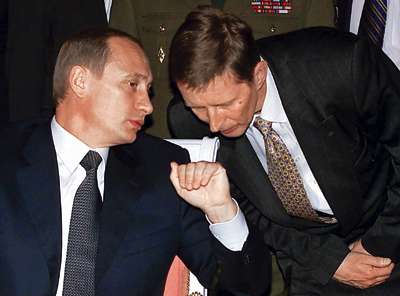
Если секретарь Совета Безопасности Сергей Иванов станет премьер-министром, кадровая революция Путина получит логическое завершение. Выходцы из КГБ разместятся на каждой ступени иерархической лестницы - от федеральных инспекторов в областях до председателя правительства (Фото: AP )
Похоже, что высшее руководство страны считает создание "вертикали власти" не средством, а целью. Своеобразным философским камнем. Ему кажется, что достаточно сформировать идеальную управленческую структуру и все в один день преобразится само собой: чиновники перестанут брать взятки, экономика вдруг оздоровится, исчезнет губернаторский произвол, а бизнесмены прекратят прятать доходы в оффшорах на Кипре и Каймановых островах. Путин и его сотрудники, очевидно, уверены, что такая система сама по себе является панацеей. Однако растерянность, которую продемонстрировали руководители государства при возникновении конфликта в Министерстве обороны, дает основания полагать, что президент и его команда на самом деле не знают, как управлять этой вертикалью, как избежать внутренних конфликтов, а главное, что делать, если от самого по себе построения заветной структуры не наступит долгожданное светлое завтра.