
Translated material
By donkey
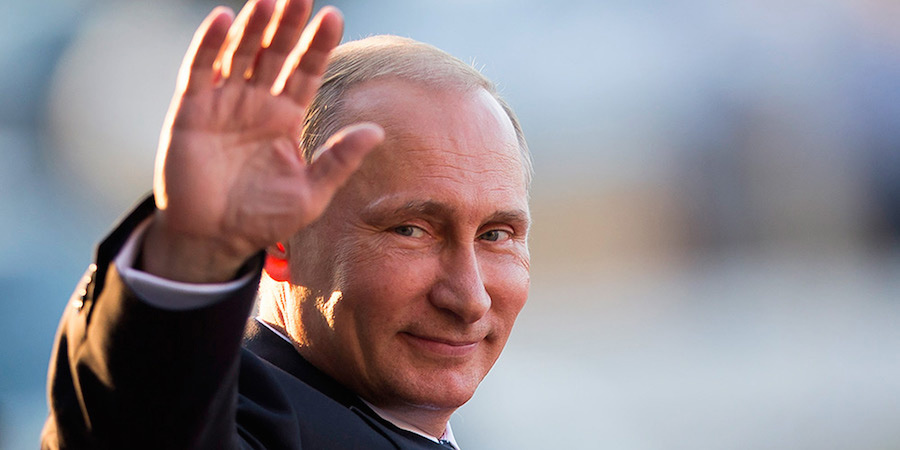
Previously, there was such a hierarchy of the ways of the appearance of Vladimir Putin to subjects. The simplest thing is in television news, “Working meetings”, that is, a scene in the office and two or three replicas in a dialogue with a guest resoner, usually the Minister or Governor of the March story with Putin’s disappearance that such meetings are sometimes recorded in advance, that is, the president can be anywhere and will still show the next working meeting.
The level above is the Council of People's Commissars and other meetings, often away, where Putin sits at the head of the table, and on the left and on the right are many different people who listen and nod. The next level is extravagant television. Sterhs, amphoras and so on, which in recent years it was customary to laugh, and what dates back to the television adventures of Putin's early period, when he flew on a fighter and appeared on the tatami; Then everyone, as a rule, liked it.
Finally, the highest level still had three annual television clips: the message to the Federal Assembly - a monologue with a set of memes for next year - from “doubling of GDP” to “spiritual bastards”; A large press conference-jokes and reprisals with the participation of idiots from the regional media and a “direct line”-a multi-format show with two leading, a dozen direct inclusions from different places and, for some time, with permanent curls, the role of which, after a resignation from the Ministry of Finance, boils down to the fact that now he has the right to publicly hint to the president that the government is ready to lead.
The system, as we see, is bulky, but by old age, Vladimir Putin wanted to make it even more bulky, adding a new and vertex - a large documentary movie about how great he is. The first big film about Putin was also shot by Vitaly Mansky in 2001, but then it was a private episode of the creative biography of Mansky (and the next year - several other authors up to Nikita Mikhalkov with the film “55”), now we are dealing with such a movie, the creation of which works all the power of the Russian state, so we have a new, unprecedented genre. In the first film "Crimea. The path to his homeland ”, a month ago, for the sake of the VGTRK cameras, the Bastion missile was uncovered and flashed light bulbs in the new office of the Ministry of Defense. There were fewer special effects in the new film “President”, but the cinema turned out to be larger - either because the more senior characters were involved in second -plan roles, or because the coverage of events is incomparably wider - fifteen years in the “President” against a month in the “Way to your homeland”.
In the middle of the zero on Russian television, two very strange films were shown in the most prime time-“The Great Secret of Water” and “Mold” about the secrets of water and mold, respectively. Then the commentators were perplexed that it was for a monumental scientific scientist, who invented it and why he was needed. Now, when the creator of both films Said Medvedev shot the “President”, it can be assumed that “Water” and “Mold” were testing the format - probably successful. In general, since the film - the second one in a month with a little, this is the main impression of the “president” - they liked it, they will not calm down and will make many more, many films about the great Putin. Over the years, this will become an industry - unless, of course, they have these years.
Why do they humiliate him again, how much can they? This is very striking and causes a spectator shame separate from everything else.
Prior to the premiere of the film, TV presenter Vladimir Soloviev managed to give a few large interviews on what it was like to take a great interview from Vladimir Putin (if very short - this, according to Solovyov, is difficult, but interesting). Soloviev simply did not see the final result of the installation - there is no hard work that he spoke to the premiere in the frame, and his role boils down to not even asking questions, but with enthusiastic remarks (“You present the concept of its fair structure, and the world does not want to hear you, Black, Black - Black”) to bring Putin to the appropriate mood, so that it He said monologues - they say, yes, that's the great, what is it there. Everything else is done by the archival chronicle and auxiliary interview.
These interviews are given by a fifteen person - from the aged Primakov to the mysterious businessman Petrov from the Sverdlovsk region, who, in comparison with the other heroes of the film, is so unimportant that the question arises, who was responsible for PR and how much (and to whom) to stand on a par with the patriarch, Mikhalkov and Rastorguev. Another riding of casting - mockingly tiny - one synchron of seconds for thirty and two appearance in the chronicle; This is generally the least, even businessman Petrov has more words and archival personnel - the role of Dmitry Medvedev, who was entrusted with only one phrase about the Georgian war in the film, and this looks like a uniform mockery of a person, four years as a former Russian president. Why do they humiliate him again, how much can they? This is very striking and causes a spectator shame separate from everything else. You can’t.
Paradoxically, at the same time, of course, for our PRocracy, that the second most importantly after Putin was the hero of the film, his spokeswoman Dmitry Peskov turned out to be-this Harmsa character with disheveled hair and bulging eyes appears on the screen every few minutes and always says something completely unimaginable, such as “I learned how and how he learned to play piano.”
Behind Peskov there are two independent, that is, not consisting of a civil service, an expert - journalist Andrei Kolesnikov and writer Zakhar Prilepin. They are entrusted with talking about Putin as a person: Prilepin recalls how in 1999 in Dagestan Putin made a toast and put an unbearable glass on the table - “we will drink after the victory” - and how at the Olympics he drew attention to the stillet, playing “on a white Putin's cheekbone”; Prilepin saw this Zhelvka and realized that something was waiting for us in Ukraine. Kolesnikov, on the other hand, solved the riddle of Putin's eternal delays - the fact is that Putin is always talking to everyone and cannot leave until he finishes to the end. Kolesnikov once had such a case when he stood near Putin to talk to him, and Putin at that time spoke on the phone with Kudrin - “his call distracted Putin from a conversation with me, if I may say so” (here Kolesnikov giggles in embarrassment). The same two heroes are in the episode about Bolotnaya. Prilepin says that from the very beginning he laughed at the opposition, because he knew that they would not succeed. This is true - in the dispute of “Swamp or the Square of the Revolution”, Zakhar Prilepin was, like all the National Bolsheviks, for the area of the revolution, that is, for a strict confrontation and against the coordinated rally; But this context in the film, of course, is not, and it looks as if Prilepin was against swamp, like every conservative supporter of Putin. Kolesnikov explains where the “swamp business” came from - to punish the participants of the rally on May 6 "corresponded not only to the laws of the Russian Federation, but also by the internal law of Vladimir Putin."
Imagine an American who begins to decipher in detail what “September 11th” is - it does not make sense, it is clear, but we need to pronounce such things in detail, because they are almost forgotten.
There is a lot of Sergei Shoigu in the film - he accompanies Putin from December 31, 1999, when the TV was dragged into Yeltsin’s reception room (“Then there were such thick chubby TVs”) and officials invited by Yeltsin, including Putin and Shoigu, saw Boris Nikolayevich’s famous farewell hosting. Then, summing up the results of the fifteen Putin years, Shoigu will say that “not a single president has gone through such a number of tests” - it is clear that the disasters of the nationwide scale of the Kursk level and Beslan, and the President has been announced primarily, not the President, and not the people, pronounces this completely calmly, as for the granted.
There is a similar awkward moment in the synchron of Nikolai Patrushev-speaking of difficult moments, he suddenly asks: "Remember" Nord-Ost "?" - And he starts to tell that there was such a case in 2002 on Dubrovka, the terrorists captured the theater center, many hostages died. This is also absurd: imagine an American who begins to decipher in detail what “September 11” is - it makes no sense, it is clear, but we have to say such things in detail, because they are almost forgotten.
Ramzan Kadyrov almost for the first time publicly (although everyone knows) says in Russian-“In the first campaign, I fought against the federal center, not a secret”, and then they show some former militant Zaur Dimaev, now an employee in the Chechen Ministry of Internal Affairs (is it Dadaev with urgently crossed credits?). Vladimir Potanin retells his conversation with Putin about the money spent on the Olympics, ”Putin said that this was folk money,“ and his voice trembled. ” “He really believes that the money is folk” - Potanin says this with surprise, almost laughs. Alexei Miller tells how he went to Suzdal, the abbess recognized him in the monastery and said that recently "the number of notes for the health of the President of the Russian Federation Vladimir Vladimirovich Putin has sharply increased." Nazarbayev notes in Putin the “ability to get into the topic”, no matter what it means. Mikhalkov on behalf of the people tells Putin: "We are with you, we will tolerate." The monologue of Mintimer Shaimieva is beautiful: “Tatarstan was not entirely entirely and completely in the legal field of the Russian Federation. Vladimir Vladimirovich told me that Tatarstan should be entirely in the legal field of the Russian Federation. Now Tatarstan is entirely in the legal field of the Russian Federation. ”
Suddenly there are a lot in the film of nostalgic words about the beginning of the zero, when Putin had fantastically good relations with Western leaders in the current standards. Bush show the remark about the eyes and soul of Putin, the former Foreign Minister Igor Ivanov recalls the meeting of the two presidents: "They joked a lot, laughed." Putin himself tells how Bush complained to the American special services, flirting with Chechen leaders, and Bush said: "I will hire their ass." No less warm memories of Schroeder and Shirake - Ivanov says that after their departure, the idea of united Europe from Vladivostok to Lisbon was buried.
Recreating the panorama of this fifteenth anniversary, the authors of the film took only those episodes that passed the test of time, that is, the Sterhi-yes, and amphoras-there are no or the Munich speech (empty and meaningless, but for some reason they value it and sincerely consider it historical)-yes, and tears in Manezhnaya in March 2012-no. “Return the pen” and “slave on galleys”-yes, and the reading of Lermontov in Luzhniki and the dialogue with the “Yura-musician”-no. Unexpectedly in detail and in the best sense, the forgotten and politically incorrect is touching - Kadyrov is offended by such things - the feat of the sixth company in the second Chechen war, when 90 paratroopers stopped a thousand Huttab militants. The film is the mother of the battalion commander, which included this company, Mark Evtyukhin - when there were four out of 90 fighters, he caused artillery fire and died. Lidia Evtyukhina says that Putin remembers the families of paratroopers and helps them.
Perhaps the tasks of such a movie are not so much propaganda as psychotherapeutic ones - as if Putin himself needs a television light to his mirror proved to him that in these fifteen years he did everything correctly and there is nothing to blame him for. But, damn it, this is in any case fifteen years, and the more they tell more and more colorful about them, the more unbearable and obvious the main conclusion, which the creators of the film clearly did not think: fifteen years - this is a very, very long time.
If you do not pay attention to it, if you forget-how society has forgotten about everything that happened during these years, and archival videos really look like a discovery, like news, then you can still live. But in a concentrated form, in the heavy, gloomy monumental cinema, the events of these years, in each of which Putin, Putin, Putin, look even more terrible than in the news at one time. All life with him, we are old with him, many will die with him, and there is no getting away from this.
Most of the synchrons begins against the background of the personnel of the chronicle, that is, the voice sounds first, and then they show the speaker. And for some reason it seems that this is the same voice, it is impossible to distinguish from each other in the voice: Shoigu, Kozak, both Ivanov, Lavrov, Kudrin, Potanin, even Patriarch-they are indistinguishable from each other, fifteen Putin years and they, once, living people, each of which are already fifteen years old (and some years ahead) is wearing only to rejoice and agree. Shchedrinsky and Gogol characters, who gave each for fifteen years and only to maintain confidence in one small man that he is the greatest, most intelligent, most fair, most honest.
The layman is easier than them - he turned off the TV and went to bed, and after all, they have been living in the TV turned on for fifteen years, and for which - only for Putin for the sake of Putin. Potanin tells how Putin was skiing in a red clearing for hours-he got up, rose, rose and got into, and so many times. You can imagine what it feels like Potanin himself - to stand for hours and look at Putin, who rises to the mountain and descends from the mountain. Potanin is a billionaire, rich and, as you can assume, a happy person, but is it possible at all, if you are forced to stand at the mountain for hours and look at Putin skating? This is not life, it is just an abomination.
The final of the film is a gift to a sentimental and pious viewer, an Athos parable about a donkey, which, when Putin came to the monastery, walked along the road in front of the Putin car, as if leading it. The monk suggests that the appearance of a donkey was a miracle of the Mother of God, but speaks of this uncertainly, advises asking Putin himself, he knows better. What Putin believes in, we do not know, but such a story that sounds in the final of the film makes a strange impression - fifteen years Putin led Russia, and he himself walked behind a donkey.