
Translated material
Life after the tower
The etheric centralized television is gradually obsolete. If you do not think about the introduction of new technologies, do not avoid other television facilities
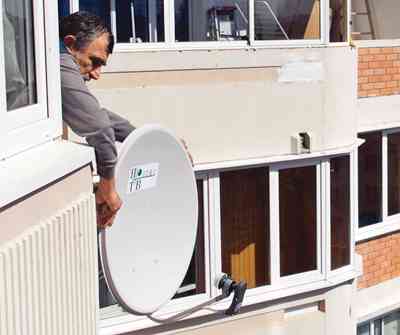
Thanks to the modern satellite transmission of the TV signal, millions of Muscovites in the first days after the fire were not left without a TV.
NTV -Plus antennas, in particular, are installed on both private television receptions and head stations of whole cable networks - through these "plates" the main national channels came to Muscovites for free these days. (Photo: ar )
We were all lucky that in the Ostankino tower, only a mine barrel with cables was actually burned out, and the main equipment was not actually injured. And if the transmitters themselves were destroyed? In the warehouses they do not lie; The transmitter is a piece work, for each channel it is ordered and set up separately. Moreover, relay lines would stop working along which the signal goes into many Russian cities. Recovery would take many months, and all this time millions of people (not only in Moscow) would be left without a TV. However, in such a situation, one could also find a positive side - maybe then it would be clearer that all hopes cannot be laid on a centralized etheric analogue broadcast. Alternative ways of delivering TV, the viewer exist, and all of them look preferable.
Ether center
To explain how in Russia the TV signal of the main channels is fed to the screen of a regular TV, it is easiest to use the restaurant metaphor. Relatively speaking, the "waiters" who deliver this dish to the consumer from the television studio - the "kitchen", three are etheric broadcasting, satellite and cable; In fact, they often work not alone, but help each other. The delivery process itself can be divided into two parts - the transmission system and the reception system.
The transmission system of large national channels and parts of small ones is organized as follows: each television company has a studio complex, hardware, where programs are being prepared. “At the exit” is “forming hardware”, in which a signal from different studios (“live air”) or from tape recorders is assembled, and this signal along the optical -fiber lines enters the center of communication (GTSMS), and from it - to the Ostankino Tower.
True, exceptions happen - sometimes the signal goes directly to the tower. A number of television companies are not in Ostankin, but in other places: VGTRK is located on the 5th Street of the Yamsky Field, the 31st channel is nearby, the TVC channel on Pyatnitskaya, and you can’t list everything. All of them are nevertheless connected with Ostankin with optical-fiber lines. The signal from them falls on the central distribution system of Ostankin and from there - still to the tower. It installed transmitters of all television channels (except for the transmitter of TNT, which is installed on the tower in the October field). They are not at all above, closer to the spire, as many often believe, but below, at an altitude of 17 meters (where round windows are visible on the basis of the tower), in the machine room. The transmitters, fortunately, were not injured in a fire. We must pay tribute to the firefighters and employees of the Ministry of Emergencies: imagining the astronomical value of this equipment, they reacted to it, according to local experts, in the bustle of the fire, did not flood with water and did not damage it in another way.
From the transmitters to the antennas located in the upper part of the tower (above 400 meters), the so -called feeders are stretched. They can also be called cables, although in fact the feeder is more like a kind of pipe on which the waves pass, repeatedly reflected from the walls. Through the Ostankino antenna, the signal spreads throughout the territory of Moscow and the region. It was the etheric transmission system that failed in a fire, but not all, but only feeders connecting transmitters and upper antennas. With the same transmitters, by the way, in some channels, the signal goes along the relay lines (a chain of towers located in direct visibility from each other) to other cities of Russia. Where again he is broadcast from the local analogue of the Ostankino Tower. The system reproduces itself.
The broadcasting scheme described above is classic. Recently, satellite and cable broadcasting have been developing more and more. They differ from the ethereal in that in the first case the formed signal is not supplied to the Ostankino antennas, but through the center of communication to the satellite, which sends it down to everyone who wants to accept it and has the appropriate reception equipment (in collision with a “plate”). With cable broadcasting directly from Ostankin, the picture falls to the largest Moscow cable operators through the company "Komcor", which takes the signal of the main channels from the television center of the country from the television center, and they "distribute" its private consumers. But only to those who can accept it - after all, not all Moscow cable networks communicate with each other and even within themselves. Often, the cable operator is only the owner of a number of fragmented reception systems, which can only accept the etheric signal.
In general, the reception system is arranged as follows:
1) Individual technique: those who have a summer house or a house in the village are well acquainted with it. In this case, an individual antenna serves only one house, the antenna is manually oriented by the owner’s capabilities (I can testify from my own experience that this is not simple);
2) the antenna-entrance: when the antenna serves only the residents of this entrance;
3) Antenna-house: about the same thing, but all the entrances of the house are served. The second and third schemes are absolutely prevailing in the Central District of Moscow (about 900 thousand apartments);
4) Antenna Riion: when the antenna on the head station of the local cable network serves a signal of several houses, or even a whole microdistrict (tens of thousands of apartments).
No matter how antennas (collective or individual) the TV signal is accepted, in Moscow in most cases it does not come through a satellite or cable, but comes from the Ostankino Tower. There are exceptions - about a hundred thousand Moscow NTV -Plus subscribers, to which the “picture” enters the personal “plate” immediately. Together with a large set of exotic channels, they receive ordinary national (NTV, RTR, Culture, TNT). In the first days after the fire, the ORT with the TVC was added to this set, and the NTV-Plus signal was converted so that everyone who did not even pay for the services of NTV-Plus could accept it. Good, but little. There are also a small number of subscribers whose cable operators are directly connected (through the “comor”) with Ostankin, and along the way to which the signal does not “rise” on the air. Great, but there are even fewer of them. It is worth mentioning another satellite system of transmissions, "space" - but its transmitter also stood in Ostankin, with all the ensuing consequences.
Give me a signal!
So, at that moment when it seemed that the spire of the Ostankino television tower strewn with antennas was about to crack and fall off like a burned head from a match, it turned out that most of the Muscovites could not be delivered. By the evening of the first day of the fire, it became clear that it would be necessary to look for an alternative solution to deliver the signal. When experts worked on a freshly reinforced tower, evaluating the scale of destruction, a natural impulse was to restore broadcasting using some other tower.
For example, it was possible to use a tower on the October Field for broadcasting two more decimeter channels (TNT channel was already working). By a successful coincidence, there were a spare antenna and feeders to it. It remained only to put the transmitters themselves - the first, for the 33rd channel, left from St. Petersburg to Moscow the next day after the fire (VGTRK asked NTV for use their reserve St. Petersburg transmitter; it is curious that the day after he went to Moscow, the main St. Petersburg transmitter NTV burned down). In addition, the company that owed this tower had a transmitter of the 35th channel, which instantly was redone for broadcasting to the 31-channel (the device was quickly taken to St. Petersburg to the factory and reorganized there). In addition, the same NTV has an antenna, a feeder and a transmitter at a frequency of 8 meters (this is the usual NTV frequency when broadcasting from Ostankin). It would seem that it is simpler - we begin broadcasting from the tower of the October field, during the crisis period we share channels with all those in need, and the whole short -lived. But in order for the city antennas to receive a signal from there, they need to be reoriented by slightly “entrusted” to the west. It is not so simple. It is even more difficult to configure the antennas for receiving decimeter channels.
So, the author of these lines, as probably for many readers, is not caught by the TNT channel. The TV is quite modern, with a built -in block of decimeter signal. Actually, you can catch a signal, but only using a special decimeter antenna. But in the general cable it is not. Why? It turns out that on the collective antenna, from where the signal comes to the TV, there should be a special converter of the decimeter signal. And not general, immediately for everything, but for each channel - its own. And each specific cable operator decides to put a converter of a certain channel or not to set. In most cases, this voluntarism does not stem because of the maliciousness of the operators, but because historically our local cable networks were built with the expectation of televisions that could accept the signal only in the meter range. The transmission of the signal of decimeter channels, to which we managed to get used to in the past few years, was not provided at all. So in many cases, it was also necessary to install special decimeter resonators on the antennas.
As another example, one can recall the epic with the introduction of the TV-6 channel-in Soviet times, the reception of the sixth channel was not provided, TV-6 then spent a whole year and huge funds that the converters of their signal appeared on almost all collective antennas. Usually, the installation of "recognizers" is carried out at the expense of the channel that wants to be "accepted"; Only occasionally, a large cable network of some considerations includes a channel in its package free of charge. In order to get to most Moscow spectators on local cable networks, total investments of several million dollars are needed. In other words, today to start the work of the new channel is not the biggest problem. Get a license, hire an editor, buy a transmitter, install an antenna and start broadcasting, but no one will hear you until you get your signal on each individual antenna. It is not necessary to count on the fact that the audience will independently catch your channel with individual antennas.
The meticulous reader will undoubtedly ask how, in fact, the cable differs from the individual antenna of the “ox” from the collective antenna cable. Why doesn’t you need to put converters-converters on the first to receive new channels, but is it necessary for the second? Ask - we answer. Firstly, the collective antenna stands on the roof, on the "road" to your TV there is an inevitable attenuation of the signal - therefore, the signal of each channel must be intensified individually. Secondly, each operator has a so-called frequency plan. Not always some 51st air channel is in the cable at the same frequency, it is often moved somewhere to another place. And in general, most of the old cable systems were designed at best for 12-14 channels - for the rest there is simply no room. It does not matter that you have a new TV at home, capable of accepting a good hundred channels - the transmitting capacity of the transmitting system is significantly less. That is, maybe in fact it is not so small: in order to increase it, you often do not need to change the cable itself, but it is enough to buy new filters, converters, other accompanying equipment - then the channels are all “placed”, and even you can connect to the Internet on the same cable.
Where to go?
The conclusion suggests itself: to build a new tower or use the (say, "shoulders" of the new building of Moscow University) is expensive and inconvenient - you will have to reorient all the antennas. It is generally almost impossible to transmit a signal to the cable - in Moscow there is a dozen large cable operators, covering most of the capital with their nets, but this does not mean that they can freely direct the signal to their network. As explained above, these networks are often not “physical”, but virtual, their individual sections are not interconnected by this. A large operator may be the owner of fifty fragmented head stations that accept the etheric signal and distribute it to subscribers. There is no signal on the air - no broadcasting. In total, in Moscow there are about 2000 head stations. You can bind them all with a cable, but this is not fast, and there is no money, as always,. Just with this situation, the proposal of the NTV leadership was to give the NTV-Plus signal (which, recall, is currently included all the largest national channels) through the "plates" to the largest 100-150 head stations. And they would continue to spread it to Muscovites in the cable of about one and a half million apartments (about four million people). The rest will not reach immediately, especially in the Central District. It seems completely unthinkable to all Muscovites to all Muscovites their own “plates” - who will finance?
Therefore, it is necessary to restore broadcasting from the Ostankino Tower - the Ministry of Press is pushing this conclusion. For the Minister of Lesin, the option with central broadcasting is preferable: firstly, so it is easier to control and provide a pressure, it will be needed; And secondly, you can once again postpone the issue with the concept of television broadcasting as such - after all, momentary political games are more interesting and the capital is faster.
Meanwhile, it is obvious that the situation when the information supply of tens of millions of people depends on only one somewhere a burned cable is clearly abnormal. It is abnormal when most viewers can take only five to six channels of dozens of available free ones. It is not normal that when changing the scene of broadcasting, it is necessary to reorient the antennas. It is not normal that hundreds of thousands of people are forced to live in the zone of strong electromagnetic fields arising in the area of the action of powerful transmitters and antennas. It is abnormal, finally, that the TV signal, passing almost dozens of knots along the way to the user, has to reinforce repeatedly - the funds spent on this could be enough for new technologies.
In the USA, for example, all national channels are required to finally switch from analogue to digital broadcasting by 2005. Firstly, with digital broadcasting in the same frequency range, you can squeeze four times more channels. Secondly, the image quality rises sharply (to the quality of the film). Thirdly, the old frequencies will be submitted to the state, where they will certainly come in handy for the development of other sectors of telecommunications (for example, mobile radio services). And fourthly, collective antennas that are strictly oriented in one direction will no longer be needed: it will be possible to get by small individual, for which orientation is not important, the thickness of the walls (to a certain limit, of course) is not important, even the angular displacement of the signal source (so, the TV can be watched in the car).
It is wonderful, but where to get the money for such large -scale projects? Unfortunately, the state has no money, as usual, the advertising market is weak and does not allow even the largest television channels to exist. Nevertheless, only more than one million dollars will take the initial restoration of the broadcast functions of the tower in Ostankin. And a month or a year later - God forbid, of course - the spire of the tower will hurt the plane; There will be a fire from an unusually powerful thunderstorm; It himself will fall, because there was an error in the calculations during recovery. Again all over again?
It would be more logical to indicate the potential investors of the path through which Russian broadcasting will develop. If there is no money for digital broadcasting, is it not wiser to tie at least Moscow with cables? And in the outback, where it is impossible to reach the cable, reorient to the receiving of the air signal through satellites to collective antennas - to let the signal through another satellite, if necessary, takes much less time than restore the collapsed tower. In the end, do we not build at least a reserve tower at worst, why not? Instead of giving answers to all these questions and determining the strategic directions for the development of broadcasting infrastructure (the concepts, however, are there, but are under the rear of the press and are not widely discussed), the ministers of the press and communications prefer to command the monsters under the Abraly. The generals are full - there are not enough commanders. 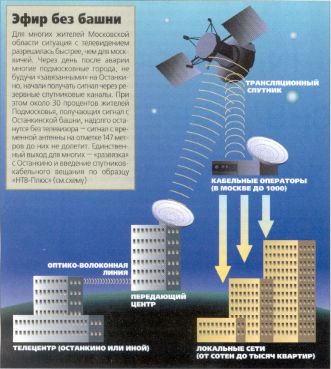
For many residents of the Moscow region, the situation with television was resolved faster than for Muscovites. A day after the accident, many cities near Moscow, not being "tied" on Ostankino, began to receive a signal through reserve satellite channels. При этом около 30 процентов жителей Подмосковья, получающих сигнал с Останкинской башни, надолго останутся без телевизора - сигнал с временной антенны на отметке 147 метров до них не долетит. Единственный выход для многих - "развязка" с Останкино и введение спутников-кабельного вещания по образцу "НТВ-Плюс".